
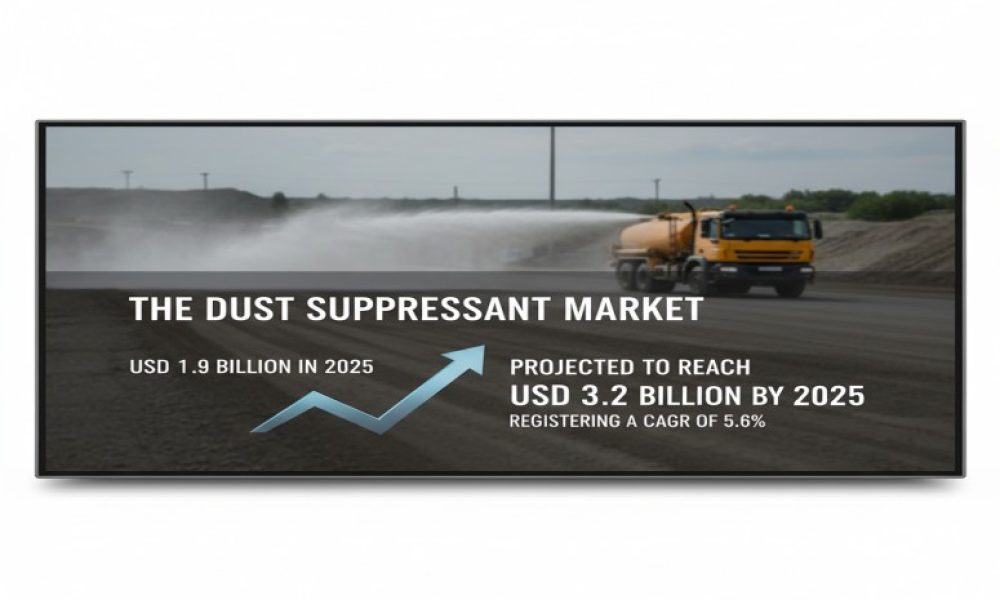
The global dust suppressant market is on a strong upward trajectory, with industry forecasts estimating a market value of USD 1.9 billion in 2025, poised to reach USD 3.2 billion by 2035, reflecting a compound annual growth rate (CAGR) of 5.6% over the next decade.
This surge is driven by increasing awareness of air quality management, stricter environmental regulations, and rising industrial and construction activities worldwide. Both established players and innovative newcomers are seizing opportunities to expand operations and develop next-generation dust suppression technologies, reshaping the competitive landscape.
Complete Market Report Available. Secure Your Copy or Customization Now:
https://www.futuremarketinsights.com/reports/sample/rep-gb-7725
Market Overview: Emerging Demand Across Industries
Dust suppressants are critical chemicals and solutions used to control airborne dust in sectors such as mining, construction, cement production, and industrial materials handling. The market includes a variety of formulations, ranging from simple water-based solutions to advanced polymer emulsions, hygroscopic salts like magnesium chloride and calcium chloride, and natural alternatives such as lignin, plant oils, and clays. These materials are applied via sprinklers, automated spraying systems, or irrigation methods, providing both immediate and long-lasting dust control.
The market’s expansion is propelled by the dual need to enhance operational efficiency and protect worker health. Dust control is no longer a peripheral concern; it is integral to maintaining environmental compliance and reducing operational downtime. Rising urbanization and large-scale infrastructure projects, especially in emerging economies, are driving significant demand for reliable dust suppression solutions.
Leading Segments in the Market
Within the dust suppressant market, the wet type dust suppressant segment holds a dominant position, accounting for 57.6% of market revenue in 2025. Wet formulations are particularly effective for immediate dust mitigation on roads, mining sites, and construction zones. Their advantages include uniform coverage, enhanced adhesion with additives, and compatibility with automated systems that maximize efficiency while reducing water usage. This segment is expected to maintain leadership as industries increasingly prioritize regulatory compliance and environmental stewardship.
In terms of end-use sectors, mining emerges as the largest contributor, representing 42.7% of market revenue in 2025. Mining operations produce significant airborne dust, which poses serious occupational health risks and environmental hazards. Compliance with regulatory mandates in both open-pit and underground mining operations has fueled the adoption of advanced dust suppressants, including polymer- and chemical-enhanced solutions, to ensure worker safety and operational efficiency. With global mining activities expanding and sustainability initiatives gaining momentum, this sector is expected to continue driving growth.
From a product type perspective, polymer emulsions dominate the market, with a projected 48.9% share in 2025. These emulsions form durable protective layers over dust-prone surfaces, significantly minimizing particle dispersion over extended periods. Their advantages—ease of application, reduced water usage, and adaptability to automated systems—make them ideal for industrial and construction sites with heavy traffic. Polymer-based solutions also meet increasing sustainability requirements, with many formulations being biodegradable and low in toxicity.
Technological Advancements and Sustainability Trends
Innovation is a key driver in the dust suppressant market, with companies investing in advanced technologies to enhance product performance. Chemical and polymer-based solutions now offer longer-lasting suppression, improved adhesion, and better environmental compliance. Automated spraying systems and smart irrigation technologies allow precise application, reducing water consumption while maintaining effective dust control.
Sustainability is emerging as a critical factor shaping market dynamics. Biodegradable dust suppressants, derived from natural materials such as plant oils, lignin, and clays, are gaining traction in regions with stringent environmental regulations. Manufacturers are responding with solutions that not only mitigate dust effectively but also align with corporate social responsibility initiatives and environmental sustainability goals.
Competitive Landscape: Established and Emerging Players
The dust suppressant market is characterized by a mix of established chemical manufacturers and new entrants seeking to expand their portfolios. Key players include Archer Daniels Midland Company, Benetech Inc., Borregaard LignoTech, Cargill Incorporated, Chemtex Speciality Limited, DowDuPont Inc., GelTech Solutions, Huntsman International LLC, and Hexion Inc.
These companies are not only expanding production capacities but are also investing in research and development to introduce novel, environmentally friendly formulations. By leveraging advanced materials science, these players are able to deliver solutions that improve adhesion, prolong suppression effects, and minimize water usage, catering to the evolving needs of industrial and construction applications.
Download Your Report Brochure (PDF) Today!
https://www.futuremarketinsights.com/reports/brochure/rep-gb-7725
Dust Suppressant Market by Segments
Nature:
- Wet Type Dust Suppressant
- Dry Type Dust Suppressant
End Use:
- Mining
- Construction
- Chemicals and pharmaceutical
- Metal Extraction
- Industrial Materials
- Rock Production
- Others
Type:
- Polymer Emulsions
- Hygroscopic Salts
- Others
Region:
- North America
- Latin America
- Western Europe
- Eastern Europe
- East Asia
- South Asia and Pacific
- Middle East & Africa



