
Drum Motor Market Overview :
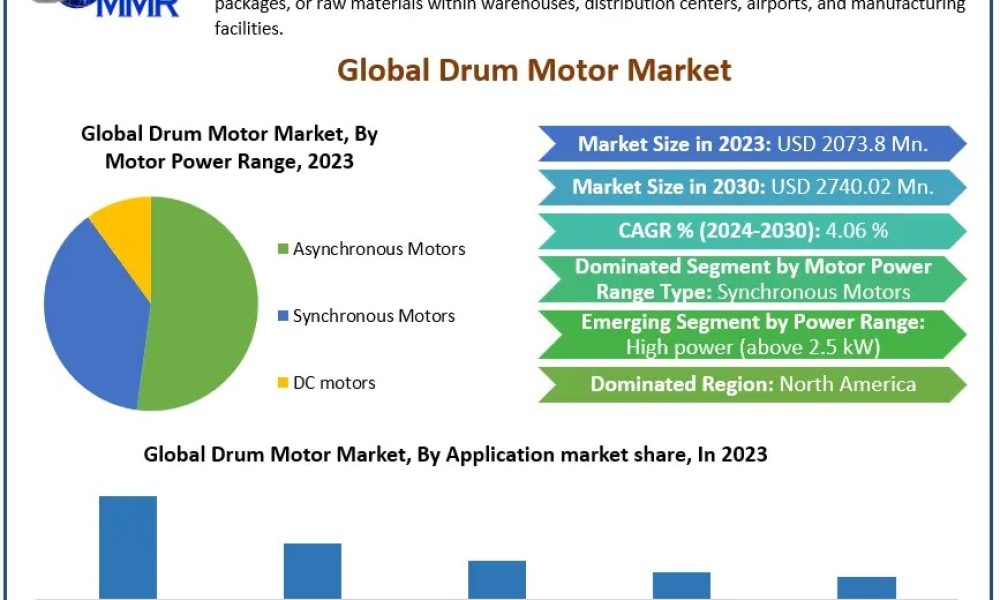
Drum Motor Market is witnessing steady growth, expanding from approximately USD 2.07 billion in 2023 to an estimated USD 2.74 billion by 2030, and expected to continue to USD 2.89 billion by 2034 with a CAGR of approximately 4% to 5%. This growth is primarily driven by increased automation across manufacturing, logistics, and food processing industries, which rely on conveyor systems powered efficiently by compact drum motors.
Key Highlights & Insights
Market Size & Growth: Valued around USD 2.07 billion in 2023, expected to reach USD 2.74 billion by 2030 and USD 2.89 billion by 2034, growing at a CAGR of 4.06% – 5.06%.
Dominating Region: North America leads the market owing to its highly automated manufacturing, food processing, and logistics sectors. The U.S., Canada, and Mexico contribute significantly to regional demand.
Leading Segment: Synchronous drum motors hold the largest market share due to their superior efficiency and reliability. The food processing industry stands out as a key end-user owing to stringent hygiene requirements.
Key Driver: Automation in material handling combined with Industry 4.0 and IoT adoption fuels demand for drum motors offering energy efficiency, durability, and compactness.
Recent Developments
Van der Graaf launched the Extreme Duty GrizzlyDrive drum motor series designed for harsh environments, featuring heavy-duty bearings and oil cooling units for enhanced service life.
Interroll introduced the DM 0138 synchronous drum motor with a compact design optimized for logistics and food industry applications, emphasizing energy efficiency and dynamic material flow.
Leading manufacturers are increasingly integrating IoT modules for predictive maintenance and remote monitoring, boosting system reliability and production uptime.
Market Dynamics
Growth Drivers:
Expansion of automated conveyor systems in logistics, warehousing, and manufacturing.
Rising demand in food processing and packaging industries for hygienic and maintenance-free motors.
Growing adoption of Industry 4.0 principles, emphasizing real-time data and predictive maintenance.
Broadening e-commerce logistics sector drives warehousing automation globally.
Challenges:
Fluctuating raw material costs and supply chain constraints.
Intense competition from low-cost manufacturers.
Environmental regulations influencing motor design and materials.
Regional Analysis
North America: Largest market driven by manufacturing automation, food safety regulations, and advanced logistics infrastructure.
Asia Pacific: Fastest growing due to industrialization and urbanization in China, India, Japan, South Korea, and ASEAN countries.
Europe: Strong presence supported by manufacturing hubs in Germany, France, Italy, and UK, with stringent energy efficiency norms.
Others: Emerging but smaller markets in Latin America and MEA, driven by expanding industrial and logistics sectors.
Product Segmentation
By Motor Type: Synchronous (dominant), asynchronous, DC motors.
By Power Range: Low (up to 0.5 kW), medium (0.5–2.5 kW), high (>2.5 kW).
By Current Type: AC, DC.
By Application: Conveying systems, packaging, sorting, recycling, security scanning, pharmaceutical handling.
By End-User Industry: Food processing, manufacturing, logistics, warehousing.
Key Trends
Development of smart drum motors with embedded sensors for IoT-enabled condition monitoring.
Lightweight and corrosion-resistant materials increasingly used for durable food-grade motors.
Integration with automated guided vehicle (AGV) systems in smart warehouses.
Growing aftermarket demand for upgrade and replacement of legacy conveyor motor systems.
Quote
North America’s leadership in the drum motor market reflects its advanced automation infrastructure and stringent industry standards for energy efficiency and hygiene. As manufacturing and logistics evolve, drum motors are becoming core enablers in creating faster, smarter, and greener conveyor systems worldwide.
The drum motor market’s ongoing growth is propelled by innovation in motor technology, rising industrial automation, and expanding logistics activities—with strong demand from key regions driving a promising outlook through 2034.




