
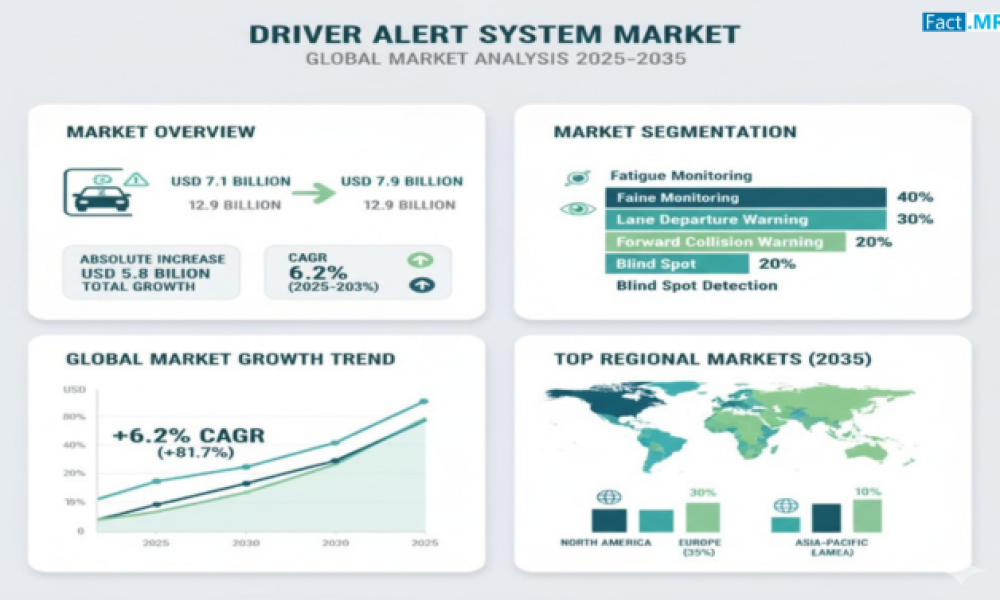
The global driver alert system market is poised for significant growth, expanding from USD 7.1 billion in 2025 to USD 12.9 billion by 2035, at a compound annual growth rate (CAGR) of 6.2%, according to Fact.MR. Rising vehicle safety regulations, growing adoption of advanced driver assistance systems (ADAS), and increasing emphasis on accident prevention technologies are driving this expansion across passenger vehicles, commercial fleets, and autonomous transportation platforms.
A Decade of Safety-Driven Innovation
Between 2025 and 2030, the market is projected to grow from USD 7.1 billion to USD 9.5 billion, representing a USD 2.4 billion increase. This initial phase is fueled by regulatory mandates requiring driver monitoring systems, adoption of AI and machine learning technologies, and integration of safety solutions in fleet operations. From 2030 to 2035, an additional USD 3.4 billion is expected, driven by advanced biometric monitoring, multi-sensor fusion, predictive analytics, and specialized applications in autonomous vehicles.
“Driver alert systems are rapidly becoming essential for both regulatory compliance and fleet operational efficiency,” said a Fact.MR market analyst. “The combination of AI-driven monitoring and integrated vehicle safety platforms is redefining accident prevention strategies globally.”
Five Key Forces Driving Market Growth
- Regulatory Mandates:Stricter global vehicle safety standards are accelerating adoption.
- Fleet Safety Optimization:Commercial operators increasingly rely on monitoring systems to reduce accidents and insurance liabilities.
- AI and Biometric Integration:Advanced analytics enable personalized alerts and predictive safety measures.
- Autonomous Vehicle Development:Monitoring solutions support human-machine interfaces and autonomous fleet operations.
- Consumer Safety Awareness:Growing awareness of fatigue-related accidents drives demand in passenger vehicles.
Segment Overview
- By Technology:Camera-based drowsiness detection dominates with a 53% market share, favored for non-intrusive, accurate fatigue detection. Steering-wheel sensors and multi-sensor fusion technologies are gaining adoption in advanced fleet and autonomous vehicle systems.
- By Vehicle Type:Passenger cars lead with a 74% market share, reflecting mass adoption in automotive manufacturing. Commercial vehicles and two-wheelers/specialty vehicles are witnessing growing integration.
- By Delivery Method:OEM-integrated systems command 69% of installations, driven by factory integration, warranty coordination, and superior reliability. Aftermarket devices and apps are expanding as fleet operators and individual consumers seek upgrades.
Regional Insights
- North America:Adoption is fueled by strict safety regulations, commercial fleet requirements, and advanced vehicle infrastructure.
- Europe:Germany, France, and the U.K. are spearheading growth with integrated safety mandates and insurance incentives.
- Asia-Pacific:Emerging as a high-growth region, driven by automotive production, urbanization, and government safety initiatives.
- Middle East & Africa:Infrastructure modernization and fleet safety programs support incremental market growth.
Competitive Landscape
Leading companies include Seeing Machines, Aptiv, Bosch, Valeo, Continental, and Denso. Strategic initiatives involve R&D investments, partnerships with automakers, and expansion into OEM-integrated and aftermarket solutions. Companies are focusing on combining camera-based detection with AI analytics for predictive, real-time driver safety interventions.
Market Outlook: Driving Safety into the Next Decade
Over the next decade, driver alert systems will evolve from standalone monitoring solutions to integrated safety platforms, combining AI, multi-sensor data, and predictive analytics. OEMs and fleet operators investing in these technologies are expected to gain competitive advantage by reducing accident rates, enhancing operational efficiency, and meeting rising regulatory demands.
“Driver alert systems are no longer optional—they are a critical component of automotive safety and operational efficiency,” the Fact.MR analyst added. “As adoption grows across passenger and commercial vehicles, advanced alert technologies will define the future of safe mobility.”
Purchase Full Report for Detailed Insights
For access to full forecasts, regional breakouts, company share analysis, and emerging trend assessments, you can purchase the complete report here: Access Full Report – Driver Alert System Market
About Fact.MR
Fact.MR is a global market research and consulting firm, trusted by Fortune 500 companies and emerging businesses for reliable insights and strategic intelligence. With a presence across the U.S., UK, India, and Dubai, we deliver data-driven research and tailored consulting solutions across 30+ industries and 1,000+ markets. Backed by deep expertise and advanced analytics, Fact.MR helps organizations uncover opportunities, reduce risks, and make informed decisions for sustainable growth.



