
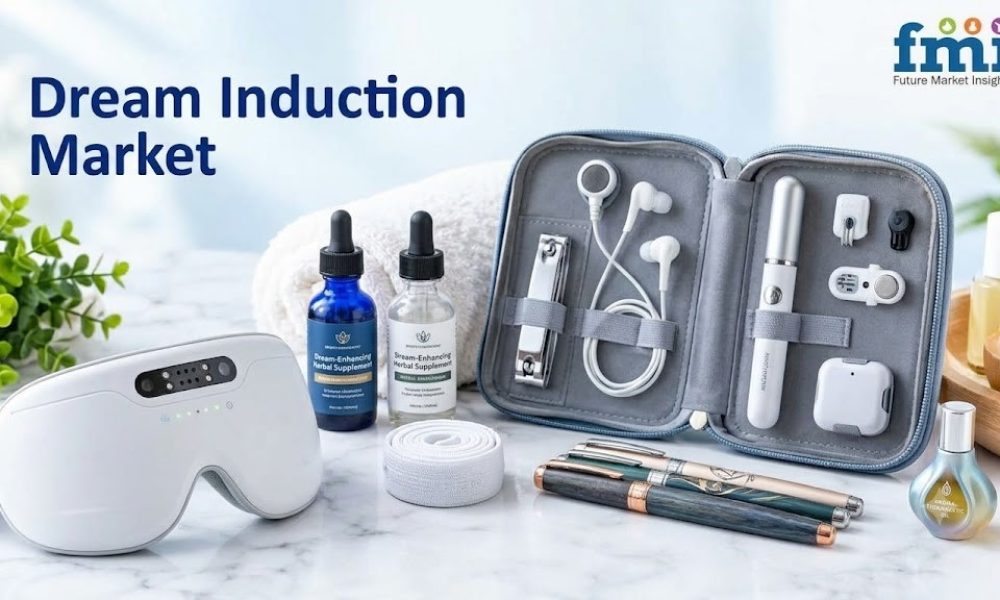
The global dream induction market is entering a period of rapid development as advances in sleep-stage sensing, wearable neurotechnology and timed stimulation create new approaches to lucid dreaming and dream incubation. According to Future Market Insights (FMI), sales of dream induction technology are estimated at USD 30.0 million in 2026, up from USD 25.0 million in 2025, and are projected to reach USD 185.0 million by 2036, expanding at a 20.1% CAGR during the forecast period.
The market is moving beyond basic light-cue masks toward systems that combine sleep-stage detection with timed stimulation. The UK Government Office for Science highlighted growing exploration of commercial neurotechnology in wellness in February 2025, while also noting progress in smaller sensors and AI alongside challenges in translating laboratory research into commercial applications.
Get detailed market forecasts, competitive benchmarking, and pricing trends: https://www.futuremarketinsights.com/reports/sample/rep-gb-35674
Technology Development Strengthens Market Potential
Improved sensing and cue timing are emerging as central factors shaping the dream induction market. Current systems can combine EEG, eye-movement or motion sensing with auditory, visual, haptic or neurostimulation techniques. The objective is to identify an appropriate sleep stage and deliver a cue without fully waking the sleeper.
Research at Radboud University is examining at-home lucid-dream induction using wearable EEG and stimulation timed to REM sleep. Such research addresses a key commercialization challenge: developing systems that can replicate sleep-stage detection and stimulation timing outside controlled laboratory environments.
Consumer interest in lucid dreaming also provides a potential demand base. Research cited by FMI indicates that about 55% of adults have experienced a lucid dream at least once, although regular lucid dreaming is less common. This creates an opportunity for technologies designed to make dream induction more repeatable.
Key Market Insights
- Hardware is projected to account for 65.0% of dream induction market revenue in 2026, compared with 35.0% for software.
- Sensory cueing is estimated to hold 46.0% of induction method revenue in 2026.
- Wearable or head-mounted systems are estimated to account for 56.0% of delivery mode revenue in 2026.
- Lucid Dream Induction is estimated to represent 52.0% of application revenue in 2026.
- The USA is projected to record the fastest country CAGR at 22.6% between 2026 and 2036.
- Other high-growth markets include the UK at 21.8%, Netherlands at 21.4%, and South Korea at 20.9%.
Hardware remains central because dream induction often requires sensors capable of identifying sleep states and triggering cues at specific moments. Software, meanwhile, offers a lower-cost route for audio-based protocols and can potentially reduce dependence on dedicated stimulation equipment.
Sensory cueing currently leads because sound, light and vibration can be delivered during sleep without requiring the more complex equipment associated with some neurostimulation approaches. Closed-loop systems are nevertheless developing as researchers seek to automatically adapt stimulation according to real-time sleep-state signals.
Market Challenges and Opportunities
Reliably inducing dreams remains one of the industry’s principal challenges. Results can vary between individuals and across nights, making consistent outcomes difficult to establish. This creates an evidence and product-development challenge for companies seeking to commercialize consumer devices.
At the same time, software presents an important opportunity. Targeted dream-incubation protocols can use timed audio without requiring dedicated brain-stimulation equipment. Web-based and mobile approaches may therefore broaden participation and lower entry costs as sleep-stage data becomes increasingly accessible through connected devices.
Medical positioning represents another potential commercial route but also introduces a higher evidence burden. Products marketed for dream awareness or dream-content experiences can remain within a consumer wellness context, whereas products making therapeutic claims may face additional regulatory and clinical requirements.
Analyst Perspective
“Today, dream-induction systems are still limited by how accurately they can identify sleep stages and deliver cues without waking the user. Over the forecast period, adoption is likely to depend more on better sensing and cue timing than on adding more stimulation features.”
— Rahul Pandita, Principal Consultant, Future Market Insights
Competitive Landscape
Competition is developing across commercial hardware and research-led approaches. Prophetic, REMspace and INSPEC are among the notable commercial platforms, while MIT Media Lab and Monash University contribute research systems.
Prophetic is developing a closed-loop approach combining neural sensing with focused ultrasound stimulation. REMspace uses a mask and companion software to detect REM sleep and deliver cues, while INSPEC uses contactless eye-movement detection. MIT Media Lab has developed targeted dream-incubation protocols, and Monash University is researching somatosensory stimulation.
Recent developments include Prophetic’s April 2025 patent publication for a wearable neurostimulation system combining REM detection, neural sensing and focused ultrasound; Monash University’s September 2025 LuciTouch research; and Radboud University’s 2026 work on at-home lucid-dream induction.
Access the Complete Report in PDF Format: https://www.futuremarketinsights.com/reports/brochure/rep-gb-35674
Report Scope
FMI’s Dream Induction Market report covers Product Type (Hardware, Software); Induction Method (Sensory Cueing, Neurostimulation, Cognitive and Digital Protocols, Multimodal Closed-loop Systems); Delivery Mode (Wearable or Head-mounted, Contactless or Room-based, Mobile or Web-based, Hybrid Systems); Application (Lucid Dream Induction, Targeted Dream Incubation, Dream Content Guidance, Research and Experimental Dream Engineering); and country-level markets.
The report covers the 2026–2036 forecast period and analyzes the USA, UK, Netherlands, South Korea, Japan, Australia, Canada, Germany and 40+ additional countries.
Business Impact
FMI helps organizations transform market complexity into strategic clarity, enabling leadership teams to identify growth opportunities faster, optimize resource allocation, strengthen competitive positioning, and make high-stakes business decisions with confidence.
To explore how FMI Custom Research can support your strategic priorities, please connect with our team at – [email protected]
About Future Market Insights (FMI)
Future Market Insights, Inc. (FMI) is an ESOMAR-certified, ISO 9001:2015 market research and consulting organization, trusted by Fortune 500 clients and global enterprises. With operations in the U.S., UK, India, and Dubai, FMI provides data-backed insights and strategic intelligence across 30+ industries and 1200 markets worldwide.



