
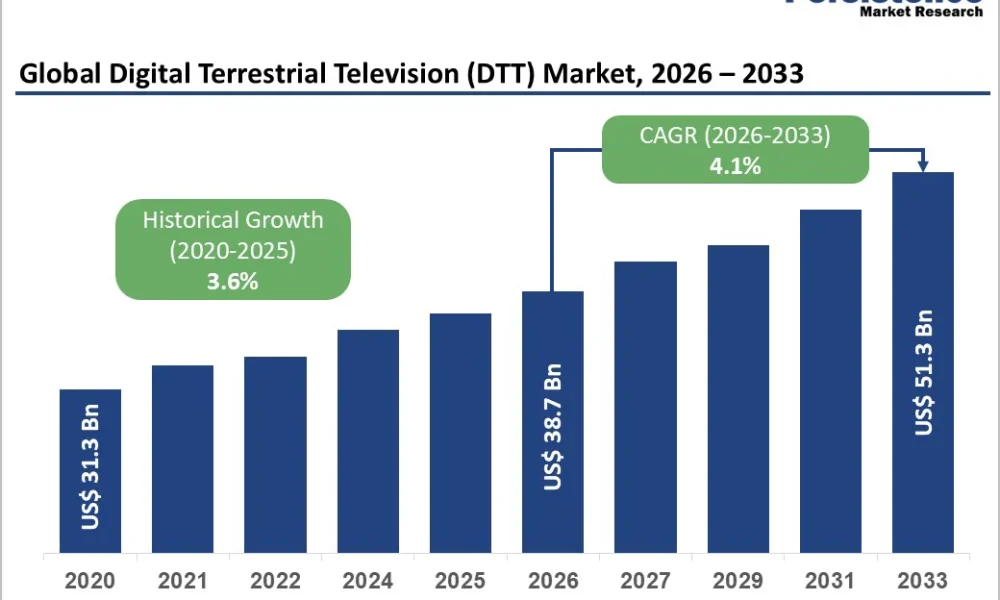
The global Digital Terrestrial Television (DTT) market continues to evolve as broadcasters, governments, and consumers transition toward advanced digital standards. The market is projected to grow from US$38.74 billion in 2026 to US$51.3 billion by 2033, registering a steady CAGR of 4.1% between 2026 and 2033.
While growth is moderate compared to high-tech digital streaming sectors, DTT remains a critical pillar of public broadcasting infrastructure worldwide. Historical growth between 2020 and 2024 stood at 3.6%, reflecting stable demand driven by analog switch-offs and digital penetration initiatives.
DTT offers reliable, free-to-air access to high-quality content without recurring subscription costs, making it particularly important in both developed and emerging markets.
Understanding Digital Terrestrial Television (DTT)
Digital Terrestrial Television refers to the transmission of television signals over terrestrial radio waves in digital format rather than analog. Compared to analog systems, DTT provides:
- Superior picture and sound quality
- High-definition (HD) and ultra-high-definition (UHD) broadcasting
- More channels within the same spectrum
- Improved spectrum efficiency
- Interactive and value-added services
DTT systems rely on digital compression and advanced modulation techniques to optimize bandwidth and enhance transmission quality.
Despite the rapid expansion of OTT and streaming services, DTT continues to serve millions of households globally, particularly in regions where broadband penetration remains limited or costly.
Key Market Growth Drivers
- Government-Mandated Analog Switch-Offs
One of the strongest catalysts for DTT market expansion has been the global push for analog switch-offs. Governments worldwide are transitioning from legacy analog systems to digital broadcasting to:
- Improve spectrum efficiency
- Enable additional channel capacity
- Free up spectrum for mobile broadband services
This transition requires substantial infrastructure upgrades, including transmitters, receivers, and set-top boxes. As more countries complete digital migration programs, market stability is reinforced.
- Rising Demand for HD and UHD Content
Consumers increasingly expect higher picture clarity and immersive viewing experiences. The adoption of HD and UHD televisions has surged, encouraging broadcasters to upgrade transmission standards.
Digital broadcasting enables:
- Multi-channel HD transmission
- 4K and UHD compatibility
- Enhanced color and sound quality
- Immersive audio formats
As content providers continue investing in premium programming, DTT platforms remain essential for delivering high-quality free-to-air broadcasts.
- Deployment of Next-Generation Broadcast Standards
The introduction of next-generation broadcasting technologies such as DVB-T2 and ATSC 3.0 is driving modernization across global markets.
These advanced standards provide:
- Greater spectral efficiency
- Improved signal robustness
- Mobile reception capabilities
- Hybrid broadcast-broadband services
- Targeted advertising features
Upgrading to advanced standards requires equipment replacement and infrastructure modernization, contributing to sustained industry revenues.
- Infrastructure Investments and Public Broadcasting Support
Public service broadcasters play a vital role in ensuring equitable access to information and entertainment. Governments continue investing in terrestrial broadcasting infrastructure to maintain universal service obligations.
In rural and remote regions where broadband coverage remains inconsistent, DTT offers a reliable and affordable alternative for television access.
Technology Landscape
DVB-T/T2 Leads the Market
DVB-T and DVB-T2 technologies are projected to dominate the DTT market with a 55% share in 2026.
The widespread adoption of DVB standards across Europe, parts of Asia Pacific, Africa, and other regions underpins this leadership. Key advantages include:
- Technical reliability
- Efficient multi-channel HD broadcasting
- Strong ecosystem of compatible devices
- Proven deployment track record
DVB-T2, in particular, significantly enhances capacity and signal robustness compared to earlier versions.
ATSC: The Fastest-Growing Technology
The Advanced Television Systems Committee (ATSC) standard is expected to be the fastest-growing segment through 2033.
ATSC 3.0, also known as NextGen TV, introduces transformative features such as:
- UHD and 4K resolution
- Immersive audio formats
- Interactive services
- Advanced emergency alerts
- Personalized and targeted advertising
North America is a key driver of ATSC adoption, with broadcasters upgrading infrastructure to support enhanced viewer experiences.
Elevate your business strategy with comprehensive market data. Request a sample report now: https://www.persistencemarketresearch.com/samples/21586
Regional Insights
North America: The Dominant Market
North America is projected to hold a 45% share of the global DTT market in 2026, maintaining its leadership position.
Factors contributing to regional dominance include:
- Advanced telecommunications infrastructure
- Strong regulatory frameworks
- Early adoption of ATSC standards
- High consumer demand for premium content
Broadcasters in the United States and Canada are actively deploying ATSC 3.0, enhancing service capabilities and monetization opportunities.
Asia Pacific: The Fastest-Growing Region
Asia Pacific is anticipated to be the fastest-growing DTT market through 2033.
Growth drivers include:
- Ongoing digital policy reforms
- Spectrum reallocation initiatives
- Expansion of regional and local-language content
- Rising television penetration in emerging economies
Countries such as India, China, Japan, and Southeast Asian nations are investing in broadcast modernization programs to improve content delivery and accessibility.
Europe: Strong DVB Ecosystem
Europe remains a significant market, supported by extensive DVB-T2 deployments and strong public broadcasting systems.
The region continues upgrading networks to enhance signal quality, expand HD services, and optimize spectrum usage.
Market Segmentation by Component
The DTT market comprises multiple components, including:
- Transmission equipment
- Set-top boxes
- Digital receivers
- Modulators and multiplexers
- Infrastructure services
Transmission equipment upgrades and consumer electronics replacements contribute significantly to overall market revenues.
Set-top boxes remain essential in markets where legacy television sets require digital conversion. Meanwhile, smart TVs with built-in digital tuners are reducing dependency on standalone receivers in developed markets.
Competitive Landscape
The DTT market features a mix of established broadcast equipment manufacturers, technology providers, and system integrators.
Key competitive strategies include:
- Investment in next-generation broadcasting standards
- Partnerships with government agencies
- Expansion into emerging markets
- Integration of hybrid broadcast-broadband services
Vendors are focusing on innovation to differentiate offerings, particularly in ATSC 3.0-enabled interactive and targeted advertising capabilities.
Key Opportunities
Hybrid Broadcast-Broadband Integration
The integration of DTT with broadband connectivity enables interactive features, on-demand content, and personalized advertising. This hybrid approach strengthens revenue models for broadcasters.
Expansion in Emerging Economies
Developing regions continue to present opportunities due to growing television penetration and government-led digital migration initiatives.
Affordable digital receivers and cost-effective transmission solutions are critical for unlocking growth in price-sensitive markets.
Advanced Emergency Communication Systems
Next-generation DTT standards support enhanced emergency alert systems, delivering geo-targeted warnings and multimedia alerts. This feature enhances the public service value of terrestrial broadcasting.
Challenges Facing the Market
Despite steady growth, the DTT market faces certain challenges:
- Increasing competition from OTT and streaming platforms
- Declining advertising revenues in some regions
- High infrastructure upgrade costs
- Shifting consumer preferences toward on-demand content
However, DTT remains relevant due to its universal accessibility, reliability during emergencies, and cost-effectiveness.
Future Outlook
The global Digital Terrestrial Television market is expected to maintain steady growth through 2033. Although the CAGR of 4.1% reflects moderate expansion, the sector benefits from structural demand for free-to-air broadcasting and government-backed digital infrastructure investments.
Future developments will likely include:
- Wider ATSC 3.0 adoption
- Enhanced UHD and immersive audio deployment
- Improved mobile TV reception
- Greater hybrid integration with internet services
DTT will continue serving as a foundational broadcasting platform, particularly in regions where broadband penetration is uneven.
Conclusion
The Digital Terrestrial Television (DTT) market is projected to grow from US$38.74 billion in 2026 to US$51.3 billion by 2033, driven by analog switch-offs, HD/UHD adoption, and next-generation broadcast standards.
North America leads the market with strong infrastructure and ATSC deployment, while Asia Pacific emerges as the fastest-growing region fueled by policy reforms and digital investments. DVB-T/T2 remains the dominant technology globally, while ATSC shows the highest growth potential.
Despite increasing competition from streaming services, DTT retains strategic importance due to its cost efficiency, reliability, and public service value. As governments and broadcasters continue investing in digital upgrades, the market is positioned for stable, long-term growth in the evolving global media landscape.
Related Reports:




