
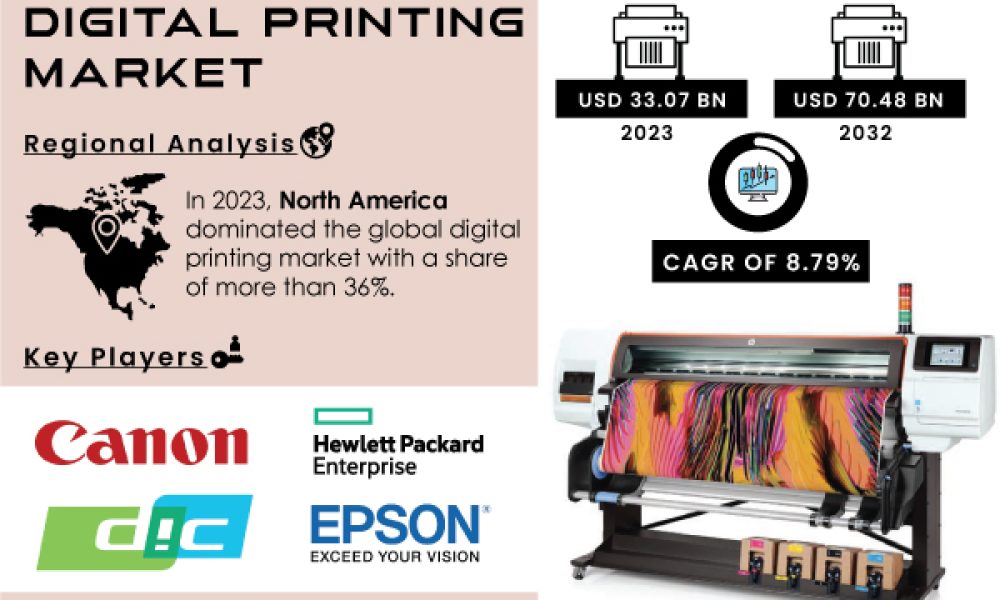
The Digital Printing Market is poised for significant expansion driven by growing environmental concerns and the increasing need for personalized, short-run printing across various industries. The shift towards green technologies, combined with advancements in digital print speed, quality, and substrate versatility, is fueling widespread adoption of digital printing solutions globally.
Digital Printing Market Size
The digital printing market is witnessing robust growth as companies across sectors prioritize sustainable production methods and seek cost-effective, high-quality printing solutions. The adoption of water-based inks, bio-based solvents, and digital presses that reduce waste and streamline logistics is accelerating demand. Additionally, the rise of e-commerce and packaging customization further propels market expansion, as digital printing enables faster turnaround times and greater flexibility compared to traditional printing methods.
Get Sample Copy of this Report: https://www.snsinsider.com/sample-request/1667
The Digital Printing Market was USD 33.07 billion in 2023 and is expected to reach USD 70.48 billion by 2032, growing at a CAGR of 8.79% over the forecast period of 2024-2032.
Market Scope
The digital printing market is expanding rapidly, fueled by increasing environmental awareness and the printing industry’s shift toward sustainable practices. Companies worldwide are embracing green technologies to mitigate climate change impacts, with initiatives such as Red Alert emphasizing eco-friendly production. Digital printing plays a crucial role in this transformation by significantly reducing waste and optimizing logistics, which collectively lower the environmental footprint of printing operations.
The growing use of water-based inks and bio-based solvents further decreases emissions of volatile organic compounds (VOCs), making digital printing a preferred choice for environmentally conscious businesses. A notable industry development is Durst Group’s acquisition of Aleph SrL in September 2023, a strategic move to enhance water-based digital printing technologies. Digital printing also offers innovative production methods that minimize human error, improving quality and efficiency with less manual intervention.
Market players are actively investing in innovation and partnerships to drive growth. For instance, in September 2023, Fiery, LLC Iron and Esko joined forces to advance digital print innovation efforts, reflecting the sector’s commitment to technological progress and sustainability.
Market Analysis
The digital printing market is benefiting from a surge in demand for cost-effective, high-quality, short-run production, especially in packaging and marketing. The ability to quickly produce customized prints without the need for extensive setup or pre-press processes makes digital printing highly competitive against traditional methods.
Technological innovations have significantly enhanced print speeds, ink quality, and substrate versatility. Modern digital printers can reach speeds up to 100 meters per minute, drastically reducing production times and increasing throughput. This improvement narrows the gap between digital and conventional printing for high-volume jobs.
Ink technology advancements, such as UV-curable inks, have broadened applications by enabling printing on non-porous substrates, expanding digital printing’s reach into diverse commercial sectors. In 2023, UV inkjet printing accounted for over 40% of digital printing applications in the industrial sector, underscoring its growing importance.
Cost efficiencies have also improved, with printhead technology reducing ink consumption by up to 30%, making digital printing more economical. On-demand printing eliminates the need for large inventories and pre-press costs, lowering operational expenses across packaging, textiles, and commercial print segments.
Enquiry Before Buy: https://www.snsinsider.com/enquiry/1667
Segment Analysis
By print head type, the inkjet segment leads the market with over 39% share, driven by its faster output capabilities and suitability for on-demand printing across industries. The eco-friendliness of inkjet printers, supported by green technology adoption, further bolsters this segment’s growth. The digital press segment is anticipated to be the fastest growing, benefiting from increasing digital technology adoption by publishers who value affordability and customization even in high-volume runs.
The laser segment shows steady growth due to its ability to deliver high-quality prints, a critical requirement in many commercial applications. Each segment is on a recovery trajectory, catering to different market needs within the printing industry.
By end user, the publishing segment holds a significant market share exceeding 29%, propelled by magazine manufacturers and marketing companies adopting virtual technologies to produce high-quality prints. The quick turnaround times of digital printing attract book publishers investing in these technologies.
The packaging and label segment is projected to exhibit one of the highest CAGRs during the forecast period, driven by retail and e-commerce demand for smart printing solutions. Digital labeling is increasingly used in fashion accessories, pharmaceuticals, and business cards. The apparel segment is also expected to grow as fashion trends evolve and demand for advanced textile printing solutions rises.
By Print-head Type
- Inkjet
- Laser
- Digital Press
By Application
- Paper
- Thick Cardstock
- Textile
- Plastic Film
- Glass
- Other
By End-user
- Publishing
- Clothing
- Glass
- Others
Major Key Players:
Canon, Inc, DIC Corporation, Epson Co., Ltd, Hewlett-Packard, Konica Minolta, Ricoh Co., Ltd, Sakata INX Co., Ltd, Toshiba Co. Ltd, Toyo Ink SC Holdings Co., Xerox Corporation
Regional Developments
In 2023, North America dominated the global digital printing market with a share exceeding 36%, led by widespread adoption of advanced digital technologies across sectors. The United States is the regional leader, supported by large textile and publishing industries. For example, Joann, a U.S.-based fabric and sewing company, acquired WeaveUp in March 2022, recognizing the potential of digital textile printing domestically.
Asia Pacific is expected to register significant growth during the forecast period, driven by booming e-commerce in China, Japan, and South Korea. The region’s printing industry is rapidly embracing data-driven business models and fully digitized value chains. Chinese companies have gained online access to over 12,000 folding carton designs, highlighting packaging design’s importance. Investments in digital presses are increasing due to process efficiencies and faster product delivery. Notably, in October 2021, China’s Tomato Cloud Technology ordered ten Fujifilm Jet Press 750S digital inkjet machines, becoming a key Fujifilm customer.
Buy Complete Report: https://www.snsinsider.com/checkout/1667
Recent developments include Document Solutions LLC partnering with Canon Solutions America to enhance digital color printing capabilities, with new systems scheduled for delivery in September 2023. Epson Co., Ltd. formed a strategic alliance with the Australian Fashion Council in July 2023 to provide cutting-edge digital printing services to the clothing and textile industry.
Contact Us:
Jagney Dave – Vice President of Client Engagement
Phone: +1-315 636 4242 (US) | +44- 20 3290 5010 (UK)




