
The digital holography market is undergoing a rapid transformation as industries increasingly seek high-resolution, non-invasive, and data-rich visualization technologies. Once confined to research laboratories and defense applications, digital holography has evolved into a commercially viable solution across healthcare, manufacturing, automotive, entertainment, and life sciences. Its ability to reconstruct three-dimensional (3D) images with exceptional depth and accuracy is reshaping how data is visualized, analyzed, and interpreted.
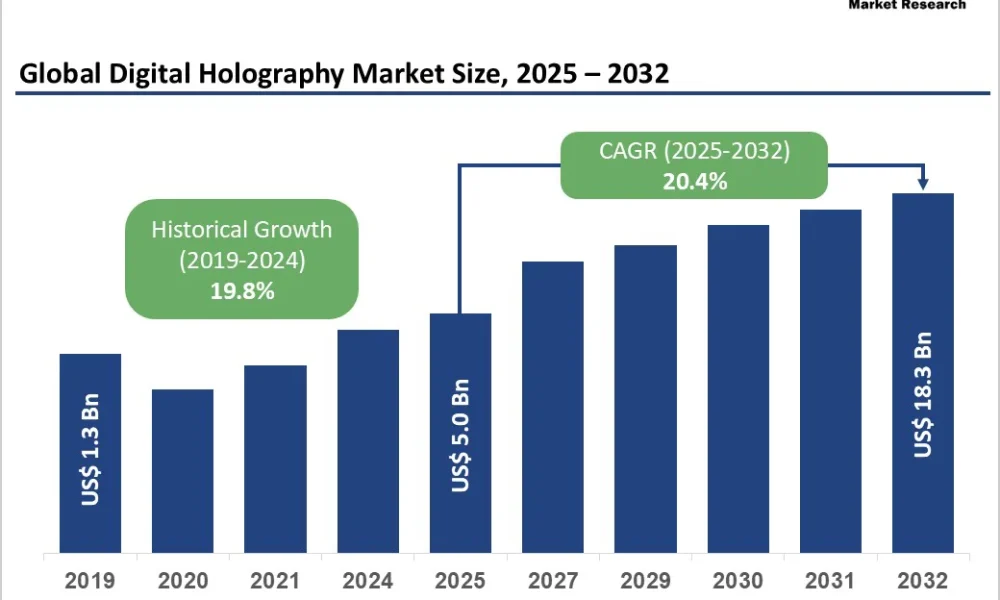
Globally, the digital holography market is expected to reach US$5.0 billion in 2025 and expand to US$18.3 billion by 2032, registering a robust CAGR of 20.4% during the forecast period from 2025 to 2032. This remarkable growth trajectory is fueled by the convergence of advanced 3D imaging technologies, rising demand for non-invasive diagnostics, and rapid innovations in holographic display hardware and software.
As industries embrace Industry 4.0, digital twins, augmented reality (AR), and virtual reality (VR), digital holography is emerging as a foundational technology that bridges physical and digital worlds.
Understanding Digital Holography Technology
Digital holography is a technique that captures and reconstructs the full wavefront of light reflected or transmitted by an object using digital sensors and computational algorithms. Unlike conventional imaging methods that record only intensity, digital holography preserves both amplitude and phase information, enabling true 3D reconstruction.
The process typically involves coherent light sources, spatial light modulators (SLMs), image sensors, and advanced signal processing software. The captured hologram can be numerically reconstructed to visualize objects at different depths, refocus images post-capture, and perform quantitative measurements without physical contact.
This unique capability positions digital holography as a critical tool for applications requiring precision, depth accuracy, and real-time analysis.
Market Size and Growth Outlook
The global digital holography market is witnessing exponential growth driven by cross-sector adoption. From biomedical imaging to industrial inspection and immersive entertainment, holographic technologies are unlocking new possibilities that traditional imaging cannot deliver.
The anticipated 20.4% CAGR reflects strong investment momentum, expanding application areas, and continuous innovation in hardware components such as SLMs, lasers, and high-resolution sensors. Additionally, falling costs of digital imaging hardware and improvements in computational power are making digital holography more accessible to mid-scale enterprises and research institutions.
Key Market Drivers Fueling Adoption
Rising Demand for High-Resolution 3D Imaging
Industries are increasingly demanding visualization tools that offer depth, accuracy, and contextual understanding. Digital holography enables micron-level resolution and volumetric analysis, making it ideal for medical diagnostics, material science, and precision manufacturing.
In healthcare, for example, clinicians can analyze cellular structures in three dimensions without invasive staining procedures, improving diagnostic accuracy while preserving sample integrity.
Growth of Non-Invasive and Label-Free Diagnostics
One of the strongest drivers of digital holography adoption is its non-invasive nature. Techniques such as holographic microscopy and quantitative phase imaging (QPI) allow researchers to study live cells and tissues without dyes or markers.
This capability is transforming pathology, hematology, and life sciences research, where preserving biological samples is critical for longitudinal studies.
Industry 4.0 and Smart Manufacturing Initiatives
Under Industry 4.0 frameworks, manufacturers are integrating advanced metrology, surface inspection, and quality control systems into automated production lines. Digital holography enables real-time defect detection, surface deformation analysis, and precision measurement without halting operations.
Its ability to capture complex geometries and dynamic processes positions it as a valuable tool in smart factories and advanced manufacturing environments.
Expansion of AR/VR and Immersive Technologies
The entertainment and media industries are embracing immersive experiences powered by AR and VR. Digital holography enhances realism by delivering true 3D visual depth, enabling applications ranging from holographic concerts to interactive gaming environments.
As consumer expectations evolve toward more immersive content, demand for advanced holographic displays is expected to surge.
Elevate your business strategy with comprehensive market data. Request a sample report now: https://www.persistencemarketresearch.com/samples/14647
Market Segmentation Analysis
By Offering Type: Hardware Leads the Market
Hardware dominates the digital holography market, accounting for approximately 60% of total market share. Core components such as spatial light modulators (SLMs), lasers, optical sensors, and high-resolution cameras form the backbone of holographic systems.
Continuous innovation in SLM efficiency, pixel density, and response time is enhancing hologram quality while reducing system complexity. These advancements are driving widespread adoption across research, industrial, and commercial applications.
By Dimension: 3D Digital Holography Takes the Lead
Three-dimensional (3D) digital holography accounts for over 70% of total market revenue, reflecting the growing demand for immersive and depth-accurate visualization. Unlike 2D imaging, 3D holography enables spatial analysis, volumetric measurement, and dynamic visualization from multiple perspectives.
This dominance is expected to continue as industries prioritize solutions that deliver realistic, data-rich visual outputs.
By Application: Holographic Microscopy Dominates
Holographic microscopy represents nearly 40% of market revenue, driven primarily by biomedical and life sciences applications. This technique allows real-time imaging of live cells, microorganisms, and tissues without physical contact or chemical labeling.
Its applications span drug discovery, cancer research, cell biology, and microbiology, making it one of the most commercially significant segments within the digital holography ecosystem.
By End User: Healthcare Emerges as the Largest Segment
Healthcare accounts for approximately 30% of total market share, underscoring the technology’s growing role in diagnostics, research, and clinical decision-making. Digital holography enhances diagnostic precision, reduces sample preparation time, and supports advanced imaging workflows in hospitals and laboratories.
As healthcare systems increasingly prioritize early diagnosis and personalized medicine, the demand for holographic imaging solutions is expected to rise steadily.
Regional Market Insights
North America: Market Leader in 2025
North America leads the global digital holography market, commanding around 35% market share in 2025. The region benefits from a strong R&D ecosystem, high concentration of holography startups, and substantial investments in AR/VR technologies, particularly in the United States.
Government funding for advanced imaging research, coupled with early adoption by healthcare institutions and industrial manufacturers, continues to support regional market dominance.
Asia Pacific: Fastest-Growing Regional Market
Asia Pacific is projected to be the fastest-growing region during the forecast period. Rapid industrialization, increasing awareness of advanced medical imaging, and rising investments in automotive heads-up displays (HUDs) are fueling adoption across China, India, Japan, and South Korea.
The region’s expanding consumer electronics sector and growing focus on smart manufacturing further amplify growth opportunities for digital holography vendors.
Europe: Strong Presence in Industrial and Research Applications
Europe maintains a strong foothold in industrial metrology, optical research, and automotive innovation. Countries such as Germany, France, and the United Kingdom are actively integrating digital holography into manufacturing quality control, aerospace inspection, and academic research initiatives.
Emerging Trends Shaping the Market
Integration with Artificial Intelligence and Machine Learning
AI-powered algorithms are increasingly being integrated with digital holography systems to automate image reconstruction, defect detection, and pattern recognition. This convergence enhances processing speed, accuracy, and scalability, particularly in industrial and medical applications.
Miniaturization and Portable Holographic Devices
Advancements in optics and sensor technology are enabling the development of compact, portable holographic systems. These solutions are particularly valuable in point-of-care diagnostics, field research, and remote inspection scenarios.
Automotive HUDs and Advanced Displays
Automotive manufacturers are exploring holographic displays for next-generation heads-up displays, offering drivers enhanced situational awareness without distraction. This trend is expected to create new revenue streams for digital holography providers.
Market Opportunities and Future Outlook
One of the most promising opportunities in the digital holography market lies in the rising demand for non-invasive, label-free imaging across diagnostics, pathology, and life sciences. Holographic microscopy and quantitative phase imaging are gaining traction as cost-effective, high-precision alternatives to traditional imaging methods.
As computational power continues to improve and hardware costs decline, digital holography is expected to move beyond niche applications and achieve broader commercial adoption. Collaboration between technology providers, healthcare institutions, and industrial manufacturers will play a critical role in shaping the market’s future.
Conclusion
The digital holography market is entering a high-growth phase, driven by technological innovation, expanding application scope, and rising demand for immersive and non-invasive visualization solutions. With the market projected to grow from US$5.0 billion in 2025 to US$18.3 billion by 2032, digital holography is set to become a cornerstone technology across healthcare, manufacturing, entertainment, and beyond.
As industries continue to prioritize precision, efficiency, and advanced visualization, digital holography will play a pivotal role in defining the next generation of imaging and display technologies.
Related Reports:




