
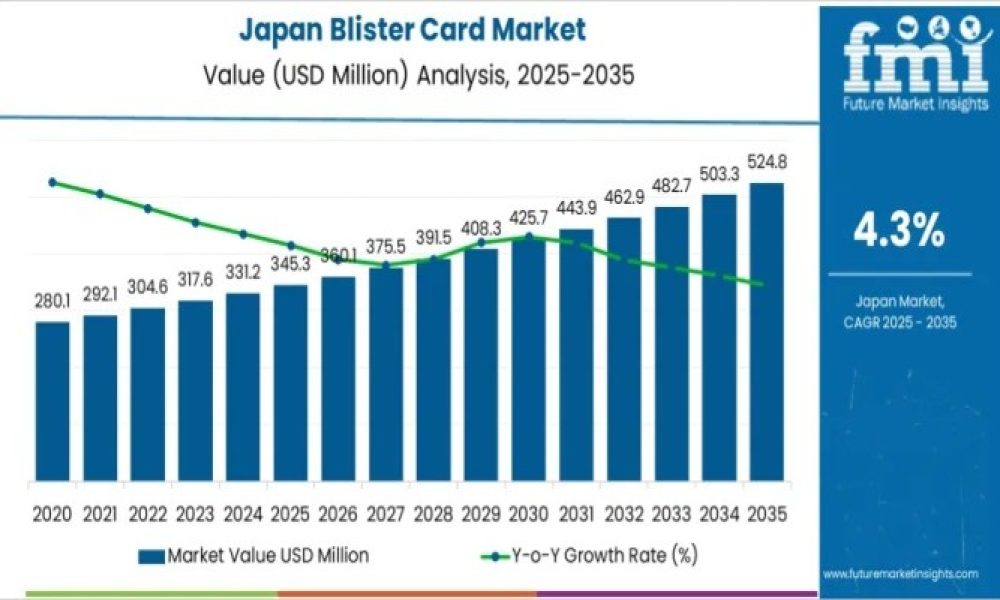
Japan’s blister card market is entering a decade of stable, regulation-driven growth as healthcare, retail, and consumer goods manufacturers continue to prioritize secure, unit-dose, and tamper-evident packaging formats. Valued at USD 345.3 million in 2025, demand for blister cards in Japan is forecast to reach USD 524.8 million by 2035, reflecting a CAGR of 4.3%. This growth trajectory highlights the market’s role as a mature yet resilient segment of Japan’s packaging industry, shaped by demographic trends, strict compliance requirements, and incremental material innovation rather than rapid volume acceleration.
Blister cards remain a preferred packaging solution across prescription pharmaceuticals, over-the-counter (OTC) healthcare products, nutraceuticals, and compact retail-oriented goods. Their ability to combine visibility, controlled dosing, and physical protection aligns closely with Japan’s healthcare delivery standards and retail merchandising practices.
Unlock Growth Potential – Request Your Sample Now and Explore Market Opportunities!
Quick Stats: Japan Blister Card Demand at a Glance
- Market Value (2025): USD 345.3 million
- Forecast Value (2035): USD 524.8 million
- CAGR (2025–2035): 4.3%
- Leading Material Type: PVC/Vinyl
- Leading End-use Industry: Pharmaceuticals
- Key Growth Regions: Kyushu & Okinawa, Kanto
- Top Players: Dai Nippon Printing Co., Ltd. (DNP), Toppan Inc., Oji F-Tex Co., Ltd., Nissha Co., Ltd., Kyodo Printing Co., Ltd.
Growth Outlook: A Phased and Controlled Expansion
The growth of blister card demand in Japan follows a phased pattern. Early-period expansion is largely supported by pharmaceutical packaging requirements linked to Japan’s aging population and rising prevalence of chronic diseases. Unit-dose blister cards are widely used to support medication adherence programs, reduce dosing errors, and ensure hygiene in both hospital and retail pharmacy settings.
In the later years of the forecast, growth moderates as blister packaging is already deeply embedded in Japan’s healthcare and retail systems. Instead of large volume surges, demand shifts toward replacement cycles, packaging upgrades, and material optimization. Environmental regulations and sustainability targets encourage gradual transitions toward recyclable structures and reduced plastic usage, creating innovation-led demand rather than pure capacity expansion.
Why Demand for Blister Cards Is Growing in Japan
Several structural and behavioral factors continue to underpin blister card usage:
- Rising consumption of prescription and OTC medicines among elderly consumers
- Strong preference for unit-dose packaging in pharmacies and hospitals
- Need for tamper evidence and traceability in regulated healthcare supply chains
- Retail demand for packaging that improves shelf visibility and reduces theft
- Growth of automated sealing and inspection lines in pharmaceutical manufacturing
Blister cards also provide printed backing space for multilingual instructions, regulatory disclosures, and branding—an important advantage in Japan’s tightly regulated labeling environment.
Material and End-use Dynamics Shaping the Market
By Material Type: PVC/Vinyl Leads the Market
PVC/Vinyl accounts for an estimated 42.0% share of the Japanese blister card market, driven by its excellent thermoforming properties, seal strength, and clarity. It remains the material of choice in pharmaceutical packaging lines where consistency and compatibility with existing equipment are critical.
Other materials include:
- PET (26.0%) – favored for transparency and recyclability alignment
- Generic plastics (15.0%) – used in mid-cost consumer goods
- PE (10.0%) – applied selectively for moisture resistance
- Others (7.0%) – including barrier-enhanced specialty substrates
Key Material Trends:
- PVC dominance sustained by processing reliability
- PET adoption growing in recyclable blister formats
- Barrier materials supporting moisture- and sensitivity-critical products
By End-use Industry: Pharmaceuticals Dominate
Pharmaceutical applications represent 38.0% of total demand, reflecting strict requirements for tamper-visible, unit-dose packaging. Other key end uses include:
- Food (22.0%) – confectionery and portion-controlled snacks
- Medical devices (16.0%) – sterile and secure presentation
- Veterinary & nutraceuticals (13.0%) – dosage accuracy for supplements
- Electronics & electricals (11.0%) – protection for small components
This mix underscores Japan’s emphasis on safety, hygiene, and precise dispensing across both clinical and consumer environments.
Regional Performance: Where Demand Is Concentrated
Blister card demand closely follows pharmaceutical manufacturing, retail density, and logistics infrastructure.
- Kyushu & Okinawa (5.3% CAGR): Strong pharmaceutical distribution, tourism-driven retail, and humidity-resistant packaging needs
- Kanto (4.9% CAGR): Dense pharmacy networks, electronics retail, and advanced packaging converters
- Kinki (4.3% CAGR): Hardware and household goods packaging, plus steady pharmaceutical demand
- Chubu (3.8% CAGR): Manufacturing clusters and automotive accessory packaging
- Tohoku (3.3% CAGR): Long-distance logistics and hospital dispensing needs
- Rest of Japan (3.2% CAGR): Local pharmacies, seasonal retail, and cost-sensitive procurement
Key Drivers, Restraints, and Emerging Trends
Drivers
- Expansion of OTC medicine sales
- Increased focus on medication adherence and unit-dose formats
- Growth of small-item retail in convenience stores
Restraints
- Environmental pressure to reduce plastic usage
- Recycling challenges for multi-material blister cards
- High automation costs for smaller manufacturers
Key Trends
- Shift toward paper-forward blister structures
- Integration of QR codes for digital instructions and safety information
- Calendar-style blister cards for chronic disease management
- Automation upgrades in pharmaceutical contract packaging
Competitive Landscape: Established Players Lead with Compliance and Consistency
Japan’s blister card market is dominated by established print-pack converters with deep expertise in regulated packaging. Dai Nippon Printing Co., Ltd. (DNP) holds an estimated 31.0% share, supported by advanced coating technologies and consistent seal performance. Toppan Inc. and Oji F-Tex Co., Ltd. strengthen the market with high-quality printed substrates and coated paperboard solutions, while Nissha Co., Ltd. and Kyodo Printing Co., Ltd. support electronics, pharmaceutical, and household-goods packaging.
Competition centers on:
- Seal integrity and cavity-fit reliability
- Print accuracy and regulatory compliance
- Traceability-ready formats for healthcare supply chains
Why FMI: https://www.futuremarketinsights.com/why-fmi
About Future Market Insights (FMI)
Future Market Insights, Inc. (FMI) is an ESOMAR-certified, ISO 9001:2015 market research and consulting organization, trusted by Fortune 500 clients and global enterprises. With operations in the U.S., UK, India, and Dubai, FMI provides data-backed insights and strategic intelligence across 30+ industries and 1200 markets worldwide.



