
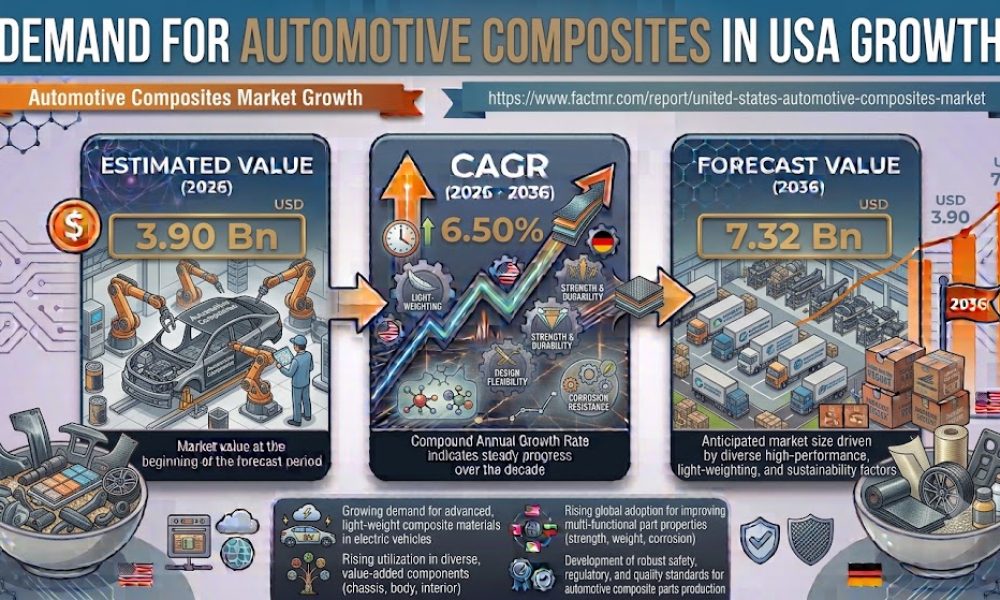
The Demand for Automotive Composites in USA is projected to grow from USD 3.90 billion in 2026 to USD 7.32 billion by 2036, advancing at a 6.5% CAGR during the forecast period. The market was valued at USD 3.66 billion in 2025, creating an absolute dollar opportunity of approximately USD 3.42 billion through 2036.
Automotive composites are fiber-reinforced polymer materials used in vehicle lightweighting, body panels, chassis components, interiors, structural parts, and exterior applications. These materials can deliver 30% to 50% weight savings over steel in body panel and structural applications, making them relevant to U.S. fuel-economy and emissions targets.
Get Detailed Market Forecasts, Competitive Benchmarking, and Pricing Trends: https://www.factmr.com/connectus/sample?flag=S&rep_id=12462
Key Market Segments
- Carbon fiber leads the material segment with a 42.3% share in 2026. Its high strength-to-weight ratio makes it suitable for applications where significant weight reduction can justify the material cost.
- Body panels represent the leading component category with a 48.7% share in 2026. Exterior panels provide a relatively accessible route for composite adoption compared with highly validated structural components.
Lightweighting Keeps Composites on the Automotive Agenda
Fuel-economy and emissions requirements remain major reasons for U.S. automakers to evaluate lightweight materials. Corporate Average Fuel Economy standards and EPA greenhouse-gas targets are encouraging manufacturers to reduce vehicle weight while maintaining vehicle performance and safety.
Composite materials provide another way to reduce mass. Carbon fiber and glass fiber systems are being considered for body panels, structural parts, chassis components, and other applications where lower vehicle weight can improve efficiency.
Electric vehicle development adds another demand factor. Lower vehicle weight can support driving-range improvements and help manufacturers manage the additional mass associated with larger battery systems.
The U.S. Department of Energy’s carbon fiber cost-reduction program is targeting production costs below USD 5 per pound. Lower carbon fiber costs could improve the economics of composite materials for high-volume automotive applications.
Body Panels Offer an Accessible Entry Point
Body panels currently represent the largest component opportunity because they can provide significant weight reduction while generally facing less demanding crash validation requirements than primary structural components.
Composite body panels can be manufactured through processes such as compression molding and resin transfer molding, making them more suitable for efforts to achieve automotive production rates.
Structural and chassis applications require more extensive crash testing and validation. This can lengthen development timelines and concentrate near-term adoption in premium vehicles and electric vehicle platforms where the value of weight reduction is stronger.
Automakers also need to consider joining, painting, repair, and manufacturing differences when introducing composite structures into vehicle programs.
Carbon Fiber Cost Reduction Creates New Opportunities
Fact.MR’s analysis identifies carbon fiber pricing below USD 7 per pound as an important threshold. At this level, the weight-to-cost trade-off can become more competitive with aluminum for body-panel applications on vehicle platforms produced at volumes above 50,000 units annually.
The report identifies several commercial opportunity areas:
Electric Vehicle Manufacturing Operations: Estimated revenue opportunity of USD 1.42 billion to USD 1.87 billion.
Carbon Fiber Integration: Estimated opportunity of USD 1.25 billion to USD 1.64 billion through integrated lightweight systems and automated manufacturing.
Specialty Vehicle Applications: Estimated opportunity of USD 0.98 billion to USD 1.28 billion across luxury vehicles, sports cars, and specialty automotive programs.
Custom Manufacturing Services: Estimated opportunity of USD 0.76 billion to USD 0.99 billion.
Automotive Supplier Programs: Estimated opportunity of USD 0.54 billion to USD 0.71 billion.
Technical Service, Training & Support Systems: Estimated opportunity of USD 0.32 billion to USD 0.42 billion.
Regional Performance Across the USA
- West: The market is forecast to grow at a 7.1% CAGR, making it the fastest-growing U.S. region. California, Oregon, Washington, Nevada, and surrounding states are identified as important areas for automotive innovation, lightweight manufacturing, and advanced material development.
- Northeast: Growth is projected at 6.8% CAGR. New York, Pennsylvania, Massachusetts, New Jersey, and surrounding states offer established manufacturing capabilities and automotive activity.
- South: The market is expected to advance at 6.2% CAGR. Texas, Florida, Georgia, North Carolina, and nearby states are benefiting from manufacturing expansion and growing automotive investment.
- Midwest: Growth is forecast at 5.9% CAGR, the lowest among the four regions analyzed. Michigan, Ohio, Illinois, Wisconsin, and surrounding states continue to provide a strong automotive manufacturing base.
Market Drivers and Constraints
The primary market driver is automotive lightweighting. Fuel-economy standards, greenhouse-gas targets, electric vehicle development, and improvements in composite manufacturing are encouraging wider material evaluation.
Lower carbon fiber costs could further support adoption. Glass fiber composites already compete with steel in selected body-panel and interior applications where cost and weight reduction are both important.
However, qualification remains a challenge. Structural and chassis components require extensive crash validation, while composites also require changes in joining, painting, repair, and manufacturing processes compared with conventional metal construction.
Cost remains another barrier. Carbon fiber is still more expensive than conventional automotive materials, which means manufacturers need a clear weight, performance, or efficiency benefit to justify the investment.
Competitive Landscape
The U.S. automotive composites market includes major advanced-material suppliers and specialized composite manufacturers.
Key companies profiled by Fact.MR include Toray Industries Incorporated, SGL Carbon SE, Hexcel Corporation, Mitsubishi Chemical Group Corporation, Gurit Holding AG, Teijin Limited, Owens Corning, Solvay S.A., 3M Company, BASF SE, Huntsman Corporation, DowAksa Advanced Composites Holdings B.V., Cytec Solvay Group, Arkema S.A., and Composites One LLC.
Toray Industries Incorporated holds the leading position among the companies profiled, with an estimated 18.7% market share. The company supplies advanced carbon fiber and composite materials for automotive and other lightweight applications.
SGL Carbon focuses on carbon-based materials and composites, while Hexcel has expertise in advanced composite materials. Mitsubishi Chemical Group, Gurit, and Teijin also participate in composite development for automotive applications.
Owens Corning, Solvay, BASF, Huntsman, DowAksa, Arkema, and Composites One provide additional material, resin, fiber, and processing capabilities across the supply chain.
Analyst Perspective
Fact.MR’s analyst assessment states that the U.S. automotive composites industry is transitioning from a low-volume, high-performance niche toward mid-volume adoption as carbon fiber prices decline and glass fiber processing speeds improve.
The analysis identifies carbon fiber pricing below USD 7 per pound as an important threshold for wider adoption. At this price point, carbon fiber can become more competitive with aluminum for body-panel applications on vehicle platforms produced at volumes exceeding 50,000 units annually.
The report also points to body panels as an important transition area because these applications offer a more accessible qualification path than primary structural components.
Report Coverage
The Fact.MR study analyzes the Demand for Automotive Composites in USA across material, component, and region.
Material categories include carbon fiber, glass fiber, hybrid composites, and other materials.
Component categories include body panels, chassis components, interior applications, structural components, exterior trim, and others.
Regional analysis covers the West, Northeast, South, and Midwest.
The report focuses on automotive-grade fiber-reinforced polymer composites used for vehicle lightweighting, corrosion resistance, structural applications, and design flexibility. It excludes steel, aluminum, magnesium, unreinforced plastic components, composites used exclusively in aerospace, marine, or sporting applications, and raw carbon or glass fiber sold before automotive-grade processing.
Fact.MR uses a hybrid top-down and bottom-up approach, supported by primary discussions with procurement and operations professionals, regulatory records, technical standards, corporate reports, public financial guidance, and industry benchmarks.
Explore More Related Studies Published by Fact.MR Research:
Tapioca Syrup Solids Market
Cellulose Whitening Alternatives Market
About Fact.MR
Fact.MR is a global market research and consulting firm, trusted by Fortune 500 companies and emerging businesses for reliable insights and strategic intelligence. With a presence across the U.S., UK, India, and Dubai, we deliver data-driven research and tailored consulting solutions across 30+ industries and 1,000+ markets. Backed by deep expertise and advanced analytics, Fact.MR helps organizations uncover opportunities, reduce risks, and make informed decisions for sustainable growth.



