
Introduction: A New Era of Cloud-Driven Data Resilience
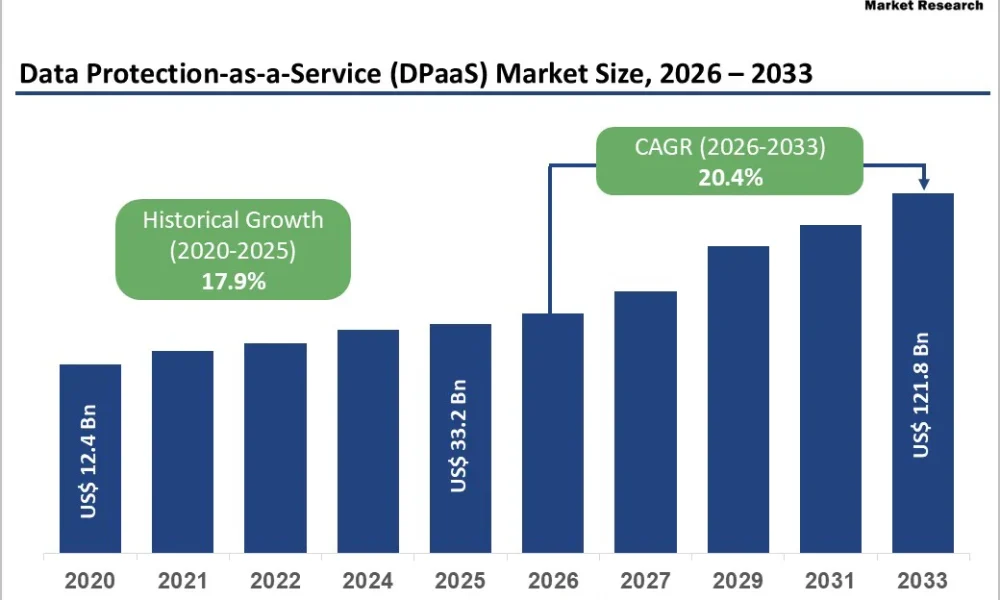
The global Data Protection-as-a-Service (DPaaS) market is entering a high-growth phase as organizations confront escalating cyber threats, rising regulatory complexity, and expanding digital footprints. The market is projected to be valued at US$ 33.2 billion in 2026 and is expected to reach US$ 121.8 billion by 2033, growing at a strong CAGR of 20.4% between 2026 and 2033. This builds on a historical CAGR of 17.9% recorded between 2020 and 2025.
DPaaS has evolved from a backup-centric service model into a comprehensive, cloud-native resilience platform that integrates backup, disaster recovery, archiving, compliance management, and ransomware protection. The urgency of adoption has intensified, particularly as ransomware attacks surged by 34% globally in the first three quarters of 2025 compared to the same period in 2024.
In a data-driven economy where downtime equates to revenue loss and reputational damage, DPaaS is becoming a foundational pillar of enterprise IT strategy.
Market Overview: Why DPaaS Is Scaling Rapidly
Traditional on-premises backup infrastructure is increasingly inadequate in a hybrid, multi-cloud world. Enterprises now operate across physical data centers, public cloud platforms, SaaS environments, and edge locations. Protecting this distributed ecosystem requires scalable, automated, and policy-driven data protection — precisely what DPaaS offers.
Key growth indicators include:
- North America leading with 41% share in 2025
- Asia Pacific emerging as the fastest-growing region at 31.4% CAGR
- DRaaS holding a dominant 38% service share
- Hybrid cloud deployment growing at 31.5% CAGR
- BFSI sector accounting for 34% industry share
The shift is structural rather than cyclical. Enterprises are redesigning data protection architectures to support business continuity, regulatory compliance, and cyber resilience simultaneously.
Key Market Drivers
- Escalating Cyber Threat Landscape
Ransomware has become one of the most disruptive threats facing global enterprises. In Q3 2025 alone, ransomware incidents rose to 1,325 cases from 1,195 in Q2. Manufacturing saw 296 attacks during the quarter, while the financial sector reported that 65% of organizations experienced ransomware incidents in 2024, up from 34% in 2021.
The average ransom demand reached US$ 3 million, and global ransomware payments touched US$ 800 million in 2024.
This alarming environment is pushing organizations to deploy DPaaS solutions that provide:
- Immutable backups
- Air-gapped storage
- Continuous data protection (CDP)
- Rapid failover mechanisms
- AI-based anomaly detection
Cloud-native protection platforms can identify abnormal encryption patterns and trigger automated response workflows, significantly reducing recovery times.
- Stringent Regulatory Compliance Requirements
Global data protection regulations are intensifying. In Europe, GDPR enforcement has resulted in 2,245 fines totaling €5.65 billion as of March 2025. Meanwhile, India’s Digital Personal Data Protection Act (2023) and Draft DPDP Rules (2025) mandate encryption, masking, and long-term consent retention requirements.
The Reserve Bank of India’s Master Direction on IT Governance further compels financial institutions to align with strict cybersecurity standards.
Healthcare organizations face similar pressures under evolving HIPAA regulations requiring:
- Multi-factor authentication
- Reduced PHI access timelines
- Mandatory encryption
- Regular penetration testing
DPaaS solutions simplify compliance through automated policy management, audit trails, regulatory-aligned retention schedules, and encryption-by-default architectures.
Market Restraints
- Data Sovereignty and Localization Mandates
Data sovereignty laws are complicating global DPaaS deployment. Countries such as India, China, and Saudi Arabia are enforcing strict localization requirements.
China’s Cybersecurity Law mandates in-country storage of sensitive data. Similarly, India’s DPDP Rules restrict transfers to non-approved countries and require significant data fiduciaries to store sensitive data domestically.
This fragmentation forces DPaaS providers to establish sovereign cloud facilities, increasing infrastructure costs and limiting operational flexibility.
- Integration and Legacy Compatibility Challenges
Many enterprises operate complex IT ecosystems combining legacy databases, ERP systems, and cloud-native workloads.
Workloads such as SAP HANA, Oracle databases, and Microsoft Exchange demand application-consistent backup capabilities. Integrating DPaaS with SIEM, IAM, and compliance tools requires specialized expertise.
SMEs face additional challenges due to limited internal cloud skills, delaying adoption despite recognizing the benefits.
Elevate your business strategy with comprehensive market data. Request a sample report now: https://www.persistencemarketresearch.com/samples/33059
Transformational Opportunity: AI-Integrated DPaaS
Artificial intelligence and machine learning are redefining data protection strategies.
For example, Cohesity introduced Gaia, a generative AI-powered enterprise search assistant leveraging large language models and retrieval-augmented generation. It enables legal and compliance teams to query backup data conversationally.
AI-powered DPaaS platforms can:
- Detect ransomware patterns with 99.99% accuracy
- Reduce recovery time by up to 80%
- Provide predictive analytics for threat mitigation
- Automate intelligent data classification
Organizations increasingly prioritize predictive resilience rather than reactive recovery, creating major growth potential for AI-integrated platforms.
Hybrid and Multi-Cloud: The Future of DPaaS Deployment
As of 2024, 89% of organizations use multi-cloud strategies, while 73% operate hybrid cloud configurations.
Hybrid DPaaS allows enterprises to:
- Retain sensitive workloads in private clouds
- Utilize public cloud scalability for analytics
- Meet regulatory localization requirements
- Enable cross-cloud redundancy
For instance, Dell Technologies expanded its Dell APEX Backup Services with cross-cloud snapshot orchestration for AWS and Azure environments.
Hybrid models are particularly attractive in Europe under DORA mandates and in India’s rapidly expanding multi-cloud ecosystem.
Service Type Analysis: DRaaS Leads the Market
Disaster Recovery-as-a-Service (DRaaS) commands a 38% share of the DPaaS market in 2025 and is projected to grow at a 29.5% CAGR through 2030.
Enterprises increasingly demand:
- Automated failover
- Continuous replication
- Near-zero Recovery Point Objectives (RPOs)
- Threat-aware failover integrated with SIEM systems
Regulatory requirements such as Europe’s DORA mandate annual disaster recovery testing, further accelerating DRaaS adoption in financial institutions.
Industry Insights: BFSI Dominates Adoption
The Banking, Financial Services, and Insurance (BFSI) sector holds 34% of the market share in 2025.
Financial institutions manage massive transaction volumes, sensitive customer data, and complex regulatory obligations. With ransomware incidents rising sharply, banks require:
- Immutable storage
- Encrypted backup repositories
- Real-time monitoring
- Automated audit compliance
DPaaS platforms allow BFSI institutions to maintain operational continuity while meeting regulatory frameworks across jurisdictions.
Regional Insights
North America: Established Leader (41% Market Share)
North America remains the dominant DPaaS region, supported by:
- Advanced cloud infrastructure
- High cybersecurity spending
- Presence of hyperscalers
Major providers such as Amazon Web Services, Microsoft Corporation, and Google Cloud drive ecosystem expansion.
The United States hosts more than 2,600 data centers, accounting for roughly 40% of global capacity. Data breach costs in the region reached US$ 10.22 million in 2025 — the highest globally — reinforcing investment in resilient DPaaS systems.
Europe: Compliance-Driven Adoption
Europe’s DPaaS growth is shaped heavily by GDPR enforcement and DORA compliance.
Organizations increasingly demand:
- Localized data storage
- Multi-region redundancy
- ISO 27001 and SOC 2 certifications
- Encryption and audit transparency
Investment of nearly €2 billion in new data center capacity during 2024 supports ongoing digital transformation initiatives.
Asia Pacific: Fastest Growing Region (31.4% CAGR)
Asia Pacific is the fastest-growing DPaaS market, propelled by:
- Rapid cloud migration
- Government-led digital transformation
- Rising cybersecurity spending
India’s cybersecurity expenditure is projected to exceed US$ 3 billion in 2025, while its multi-cloud market is forecast to reach US$ 40 billion by 2033.
Enterprises in APAC experience an average of 1,636 cyberattacks per organization per week, underscoring urgent demand for resilient DPaaS platforms.
Competitive Landscape
The DPaaS market is moderately consolidated, featuring both hyperscale cloud providers and specialized data-protection vendors.
Key companies include:
- IBM Corporation
- Cisco Inc.
- Oracle Corporation
- Hewlett Packard Enterprise
- Commvault Systems Inc.
- Veeam Software
- Rubrik Inc.
- Druva Inc.
Competition increasingly revolves around:
- AI-driven automation
- Cross-cloud orchestration
- Immutable ransomware defense
- Unified backup and DR architectures
Strategic partnerships, acquisitions, and platform integrations remain common as vendors seek broader geographic reach and enhanced service portfolios.
Future Outlook: Toward Autonomous Data Resilience
The DPaaS market is transitioning from simple backup services to intelligent, autonomous data resilience platforms.
Future growth will be shaped by:
- AI-driven predictive threat mitigation
- Zero-trust data architectures
- Sovereign cloud deployments
- Edge data protection expansion
- Compliance automation across jurisdictions
As enterprises embrace hybrid and multi-cloud infrastructures, DPaaS will become a strategic enabler of digital transformation rather than merely a security safeguard.
With projected growth from US$ 33.2 billion in 2026 to US$ 121.8 billion by 2033, the market reflects a fundamental shift in how organizations perceive data — not just as an asset to store, but as a mission-critical resource requiring continuous protection, intelligent monitoring, and rapid recoverability.
In an era where cyber threats evolve faster than ever, Data Protection-as-a-Service stands at the core of enterprise resilience.
Related Reports:




