
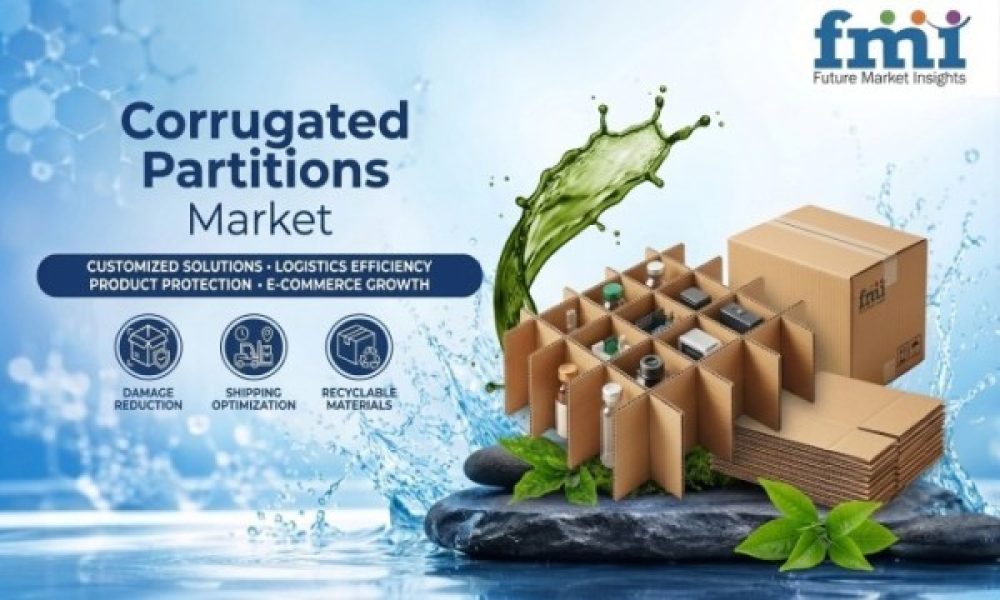
The global corrugated partitions market is projected to increase from USD 212.3 million in 2026 to USD 326.6 million by 2036, registering a compound annual growth rate (CAGR) of 4.4% during the forecast period. Demand is supported by industrial packaging requirements for internal separation that limits product damage without increasing outer-pack dimensions or adding handling steps. Regulatory changes are also influencing material selection. In February 2025, the European Commission announced that Regulation (EU) 2025/40 had entered into force, establishing a framework for packaging sustainability, with general application beginning in August 2026. The requirements are encouraging packaging teams to assess recyclability during design and material qualification.
Get detailed market forecasts, competitive benchmarking, and pricing trends:
https://www.futuremarketinsights.com/reports/sample/rep-gb-35018
Global Segment Leaders
- Product Type: Corrugated cell partitions are projected to account for 46.0% of the market in 2026. Configurable cell geometry allows converters to adjust divider counts, spacing and board grades without redesigning the complete shipping case.
- Material: Corrugated and fiber materials are expected to capture 29.0% share in 2026. Established converting processes and regional recovered-fiber outlets support adoption, provided coatings and treatments do not compromise protection or recyclability.
- Capacity: The 200–1,000 L segment is forecast to represent 38.0% in 2026. Intermediate industrial payloads require engineered internal separation to control load movement during pallet handling, forklift operations and routine transportation.
- End Use: Chemicals are expected to hold a 34.0% share in 2026. Packaging configurations for chemical shipments must maintain internal load stability and package integrity under defined transport conditions, making separator compatibility and qualification important purchasing considerations.
- Sales Channel: The report identifies direct industrial accounts, distributors, and rental and pooling as the principal sales channels. It does not provide a leading-channel share in the published summary, so a percentage-based leader cannot be confirmed.
Country-Level Performance
The report profiles five countries with individual CAGRs for 2026–2036. The following figures are arranged from highest to lowest growth.
- USA | 4.9% CAGR: Extensive corrugated converting capacity and established fiber recovery support demand. The American Forest & Paper Association reported in August 2025 that 69%–74% of cardboard available for recovery was recycled in the United States during 2024. International Paper also broke ground on a new corrugated box plant in Waterloo, Iowa, in May 2025, with operations scheduled for late 2026.
- United Kingdom | 4.6% CAGR: Producer reporting requirements and established paper recovery infrastructure support material reviews. In April 2025, PackUK published Recyclability Assessment Methodology version 1.1, introducing red, amber and green recyclability outcomes for household packaging.
- Germany | 4.3% CAGR: National recyclability assessment and established collection, sorting and recycling practices favor documented fiber-based formats. In August 2025, the Central Agency Packaging Register (ZSVR) and the German Environment Agency issued the 2025 minimum standard for determining packaging recyclability under the relevant system-participation requirements.
- France | 4.0% CAGR: Domestic paper recovery infrastructure and established converting capacity support fiber partitions that avoid difficult-to-sort material combinations. ADEME’s extended producer responsibility portal reports that household packaging and graphic papers placed on the French market reached 6.56 million tonnes in 2023, of which 5.08 million tonnes were recycled.
- Japan | 3.7% CAGR: A mature packaging market and established recovered-paper collection system underpin steady demand, with growth relying on replacement specifications for electronics, industrial components and export packaging. The Paper Recycling Promotion Center reported a recovered-paper recovery rate of 81.3% in Japan for 2025.
Regional Context
The USA and UK occupy the faster-growing end of the five-country forecast, supported by converting networks, recovery infrastructure and recurring packaging-specification reviews. In the USA, freight distances make pack density important for industrial distribution, while UK export manufacturing favors partitions compatible with standardized corrugated case dimensions.
Germany and France represent steadier European markets where recyclability assessment and established paper recovery systems influence material choices. Suppliers must demonstrate that coatings, labels and moisture barriers do not complicate sorting or repulping. Japan’s comparatively slower outlook reflects mature packaging demand and an established recovered-paper system, with opportunities concentrated in specification replacement and precise fit rather than broad market expansion.
The full report covers North America, Latin America, Western Europe, Eastern Europe, East Asia, South Asia and Pacific, and the Middle East and Africa, with more than 20 countries included in its broader assessment.
Competitive Landscape
The report profiles Sonoco, Signode, Nefab, Mondi Group, International Paper, Smurfit Westrock, UFP Industries and SCHÜTZ. Competition spans fiber partition converting, engineered protective packaging and reusable industrial container systems. Sonoco, Mondi Group, International Paper and Smurfit Westrock provide paper-based converting capabilities, while Signode, Nefab and UFP Industries serve industrial applications requiring customized protective engineering. SCHÜTZ participates through reusable bulk packaging platforms that can accommodate replaceable internal separators.
Recent developments include Mondi Group’s June 2026 upgrades at its Greven and Ebersdorf corrugated plants in Germany, intended to improve operating performance and customer service following the integration of acquired operations. In March 2026, Smurfit Westrock completed its purchase of Cartomanabí assets in Ecuador, adding more than 50,000 tonnes of corrugated capacity. Earlier, in April 2025, Nefab acquired Spain-based Embalajes Echeberria, expanding its heavy-duty corrugated packaging capacity and local design support.
Qualification requirements remain a competitive consideration. Changes to separator geometry or cushioning can affect load movement and compression performance, potentially requiring renewed transport testing. Suppliers that combine prototype development with nearby converting capacity can support replenishment after customer approval.
FMI Principal Consultant Nandini Roy Choudhury noted: “Partition economics depend on how much damage the separator prevents without reducing usable pack density or changing the qualified transport configuration.”
About Report
Future Market Insights (FMI) is a leading provider of market research and consulting services, offering syndicated and customized research across industries including packaging, chemicals and materials, and industrial automation.
For more information on the full report, visit: https://www.futuremarketinsights.com/reports/corrugated-partitions-market
FMI Custom Research: Strategic Intelligence for Confident Decision-Making
In today’s rapidly evolving business environment, leadership teams need more than market data—they need clear, actionable intelligence tailored to their strategic objectives. FMI’s Custom Research solutions are designed around the specific business questions organizations need answered, enabling executives to evaluate growth opportunities, validate investments, assess competitive dynamics, and reduce uncertainty before making critical decisions. By combining deep industry expertise, primary research, and proprietary market intelligence, FMI delivers insights that help organizations move from assumptions to evidence-based strategies with greater speed and confidence.
Business Impact
FMI helps organizations transform market complexity into strategic clarity, enabling leadership teams to identify growth opportunities faster, optimize resource allocation, strengthen competitive positioning, and make high-stakes business decisions with confidence.
To explore how FMI Custom Research can support your strategic priorities, please connect with our team at – [email protected]
About Future Market Insights (FMI)
Future Market Insights, Inc. (FMI) is an ESOMAR-certified, ISO 9001:2015 market research and consulting organization, trusted by Fortune 500 clients and global enterprises. With operations in the U.S., UK, India, and Dubai, FMI provides data-backed insights and strategic intelligence across 30+ industries and 1200 markets worldwide.



