
The global Computer Assisted Surgical (CAS) Systems Market is witnessing remarkable growth, driven by technological advancements in healthcare and the increasing adoption of minimally invasive surgical techniques. CAS systems encompass surgical robots, surgical navigation systems, and advanced planning tools that aid surgeons in performing precise, complex procedures with improved outcomes. These systems reduce surgical errors, minimize patient trauma, and shorten recovery periods, making them an indispensable part of modern healthcare infrastructure. The demand for these systems is particularly strong in orthopedic, neurosurgery, and cardiovascular interventions due to their ability to enhance accuracy and efficiency in high-stakes procedures.
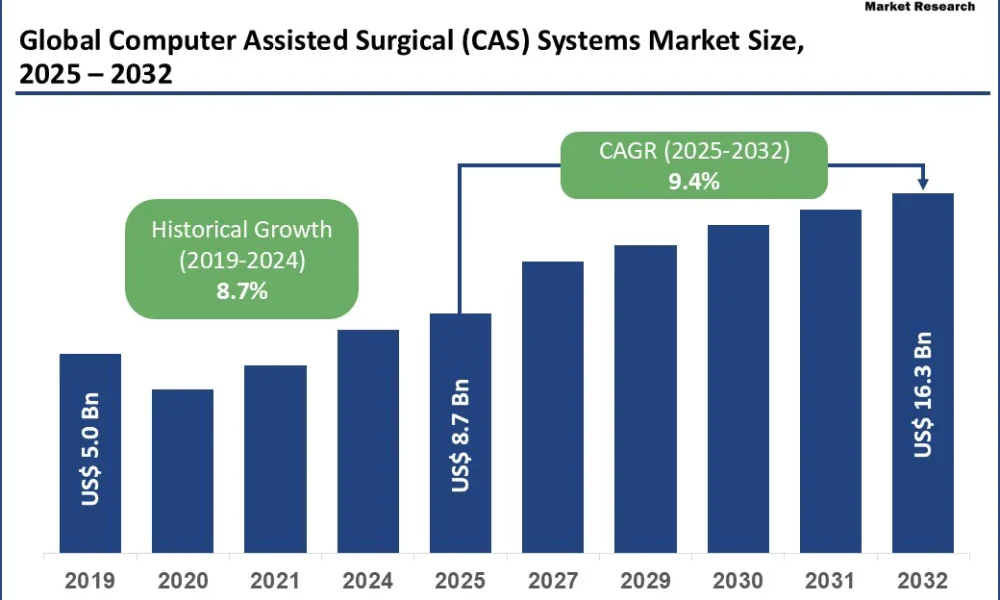
Market statistics highlight the robust expansion of this sector, with the global CAS systems market valued at approximately US$8.7 billion in 2025 and projected to reach US$16.3 billion by 2032, registering a CAGR of 9.4% during the forecast period. The growth trajectory is fueled by rising healthcare expenditures, an increasing prevalence of chronic diseases, and the adoption of ambulatory surgical centers that prioritize cost-efficient, minimally invasive surgical solutions. Among product types, surgical robots dominate the market with a 45% share in 2025, reflecting their widespread use in precision-driven surgeries. Geographically, North America leads the market, accounting for 40% of global market share, primarily due to the U.S.’s advanced healthcare infrastructure, high adoption of robotic systems such as Intuitive Surgical’s da Vinci, and strong regulatory support for innovation.
Download Your Free Sample & Explore Key Insights: https://www.persistencemarketresearch.com/samples/3413
Key Highlights from the Report
• The global CAS systems market is expected to reach US$16.3 billion by 2032.
• North America holds the largest market share, driven by the U.S.’s high adoption of surgical robots.
• Surgical robots dominate the market, accounting for 45% of revenue in 2025.
• Orthopedic surgery contributes 30% of the market due to increasing demand for knee and hip replacements.
• Ambulatory surgical centers are the fastest-growing end-use segment, benefiting from outpatient surgery trends.
• Integration of AI and AR in CAS systems enhances surgical precision and drives market innovation.
Market Segmentation
The CAS systems market is segmented primarily by product type, surgery type, and end-user. In terms of product type, surgical robots lead due to their precision, control, and widespread application in minimally invasive surgeries. Leading examples include Intuitive Surgical’s da Vinci system and Stryker’s Mako robot, which improve outcomes in gynecology, orthopedic, and neurosurgery procedures. Surgical navigation systems, on the other hand, are emerging rapidly as the fastest-growing segment. These systems provide real-time 3D imaging and precise anatomical mapping, making them indispensable in spine surgery and orthopedic procedures, particularly in ambulatory surgical centers that aim to optimize efficiency and cost-effectiveness.
Segmentation by surgery type reveals orthopedic surgery as the leading contributor, accounting for approximately 30% of market revenue. This is driven by rising musculoskeletal disorders and the increasing number of knee and hip replacement procedures, where precision is paramount. Neurosurgery is the fastest-growing segment, propelled by the adoption of robotic-assisted systems for brain and spinal surgeries, especially in regions like France and the UK. End-user segmentation indicates that hospitals dominate with a 60% share, owing to their capability to invest in cutting-edge technologies and high surgical volumes. However, ambulatory surgical centers are rapidly expanding, fueled by outpatient procedures and the shift toward cost-efficient surgical solutions.
Regional Insights
North America is the largest market for CAS systems, holding a 40% share in 2025. The U.S. leads in adoption due to advanced healthcare infrastructure, high surgical volumes, and widespread use of robotic systems like the da Vinci in urology, gynecology, and cardiovascular surgeries. The aging population and growing outpatient surgery trend further support the demand for surgical robots and navigation systems. The streamlined FDA approval process accelerates innovation and deployment of CAS systems across hospitals and ambulatory centers.
Europe accounts for 30% of the market, with Germany, France, and the UK leading adoption. Germany’s robust healthcare system, high surgical volumes, and stringent CE marking regulations ensure high-quality system integration, particularly in orthopedic and neurosurgery procedures. The UK benefits from NHS support for minimally invasive surgery and growing investments in ambulatory surgical centers. Asia Pacific, projected to be the fastest-growing region with a 25% share, sees significant adoption in China, India, and Japan. Factors driving growth include healthcare modernization, government initiatives such as China’s Healthy China 2030, an aging population, and rising medical tourism, which collectively accelerate demand for surgical robots and navigation systems.
Get Custom Insights Designed for Your Business: https://www.persistencemarketresearch.com/request-customization/3413
Market Drivers
The primary driver for the CAS systems market is the advancement of minimally invasive surgical techniques. Surgeons increasingly prefer robotic-assisted procedures and navigation systems that minimize tissue damage, reduce post-operative complications, and shorten recovery times. Systems like Intuitive Surgical’s da Vinci and Stryker’s Mako enable precision in neurosurgery, orthopedic, and cardiovascular procedures. Integration of AI and AR technologies further improves surgical accuracy, offering real-time data analytics and predictive modeling that can enhance outcomes by up to 20% in orthopedic surgeries. The growing prevalence of chronic diseases and aging populations worldwide, coupled with higher healthcare spending, creates a favorable environment for the adoption of CAS systems in hospitals and ambulatory centers alike.
Market Restraints
Despite promising growth, the high cost and maintenance requirements of CAS systems remain significant restraints. Surgical robots often exceed US$1–2 million per system, with additional expenses for software updates, maintenance, and operator training. Smaller hospitals and ambulatory centers in regions like Asia Pacific and Europe face budgetary constraints that limit adoption. Additionally, specialized training is mandatory for operating these systems, creating a barrier in regions with limited skilled professionals. These financial and operational challenges hinder penetration, particularly in cost-sensitive markets, slowing overall growth.
Market Opportunities
The integration of AI and AR technologies presents transformative opportunities for CAS systems. AI-powered robots provide real-time analytics and predictive modeling, enhancing surgical precision and enabling preoperative planning tailored to individual patients. AR-assisted navigation systems offer 3D visualizations that reduce errors in complex procedures like spine surgery and craniofacial reconstruction. Partnerships between technology firms and surgical system providers, such as Stryker’s collaborations with 3D Systems, drive innovation and expand product offerings. In addition, the growing trend of personalized and outpatient surgeries, especially in Asia Pacific and North America, positions CAS systems as essential tools for future surgical practices.
Checkout Now & Download Complete Market Report: https://www.persistencemarketresearch.com/checkout/3413
Company Insights
Key players operating in the CAS systems market include:
• Accuray Incorporated
• Medtronic
• 3D Systems Corporation
• B. Braun Melsungen
• MAKO Surgical Corp.
• Brainlab AG
• Mazor Robotics Ltd.
• CONMED Corporation
• Renishaw plc
• Curexo Technology
• Titan Medical Inc.
• Blue Belt Technologies Ltd.
• Think Surgical
Recent Developments:
• In July 2025, a surgical robot at Johns Hopkins autonomously executed part of a gallbladder removal on a lifelike model, demonstrating expert-level precision and real-time adaptability.
• In April 2024, Brainlab and Fujifilm collaborated to integrate advanced neurosurgical technology in the U.S., expanding Brainlab’s market presence and improving surgical planning capabilities.
Conclusion
The Computer Assisted Surgical (CAS) Systems Market is poised for substantial growth, driven by advancements in robotic-assisted and minimally invasive surgeries, the integration of AI and AR technologies, and increasing investments in hospitals and ambulatory surgical centers. North America currently dominates the market due to advanced healthcare infrastructure, while Asia Pacific offers the fastest growth potential due to modernization and rising medical tourism. Although high costs and operational complexity pose challenges, ongoing technological innovation and the demand for precision surgery present significant opportunities. With continued advancements and strategic collaborations among key players, CAS systems are set to become a cornerstone of modern surgical care, improving patient outcomes and transforming global healthcare delivery.




