
Smart Tech and Off-Road Demand Surge: Global Motorcycle Suspension Market to Reach US$ 903.6 Million by 2033
The global motorcycle suspension system market is entering a high-performance era, fueled by a dual surge in adventure touring and the integration of smart electronic damping technologies. According to a comprehensive industry analysis by Fact.MR, the market is projected to expand at a compound annual growth rate (CAGR) of 6.1%, rising from its 2023 valuation of US$ 499.8 million to over US$ 903.6 million by the end of 2033.
As motorcycle manufacturers (OEMs) and aftermarket specialists pivot toward semi-active systems and lightweight materials, the suspension is no longer viewed as a static component but as a critical, tech-enabled performance indicator.
Request for Sample Report | Customize Report |purchase Full Report – https://www.factmr.com/connectus/sample?flag=S&rep_id=2992
Driving Innovation: The Shift to Semi-Active Systems
The Who of the market is currently led by major players like ZF Friedrichshafen AG, SHOWA Corporation, and KYB Corporation, who are increasingly collaborating with EV startups and established brands like BMW and KTM. These industry leaders are answering the How of modern riding by replacing traditional mechanical forks with active and semi-active suspension systems.
These systems utilize electronic control units (ECUs) and sensors to adjust damping rates in real-time, allowing bikes to adapt instantly to road irregularities. This technological leap addresses the growing consumer demand for safety and comfort, particularly in the high-performance and luxury segments.
Key Market Drivers: Adventure and Customization
The report identifies several pivotal factors accelerating market growth:
The Rise of Adventure Touring: A Where factor in the market involves the booming popularity of off-road and adventure riding across North America and Europe. This has created a significant Why for the industry: the need for heavy-duty, long-travel suspension kits capable of handling rugged terrain while maintaining street-legal comfort.
The Customization Craze: Enthusiasts are increasingly bypassing stock setups in favor of personalized suspension options. Aftermarket sales are thriving as riders seek bolt-on mono-shock kits and gas-charged shocks to improve the handling of older models.
Electric Vehicle (EV) Integration: As the motorcycle industry moves toward electrification, suspension systems are being redesigned to accommodate the unique weight distribution and instantaneous torque of electric motors.
Regional Insights: Asia-Pacific Takes the Lead
While North America remains a powerhouse for high-end cruiser and sportbike suspension sales—accounting for a significant revenue share—the Asia-Pacific region is the primary engine of volume growth. Driven by high motorcycle production in India, China, and Indonesia, the region’s dominance is supported by a burgeoning middle class and an increasing preference for premium two-wheelers over basic commuter models.
China, in particular, is forecasted to see an 8.8% CAGR through 2034, supported by its massive manufacturing infrastructure and a rising local interest in adventure tourism.
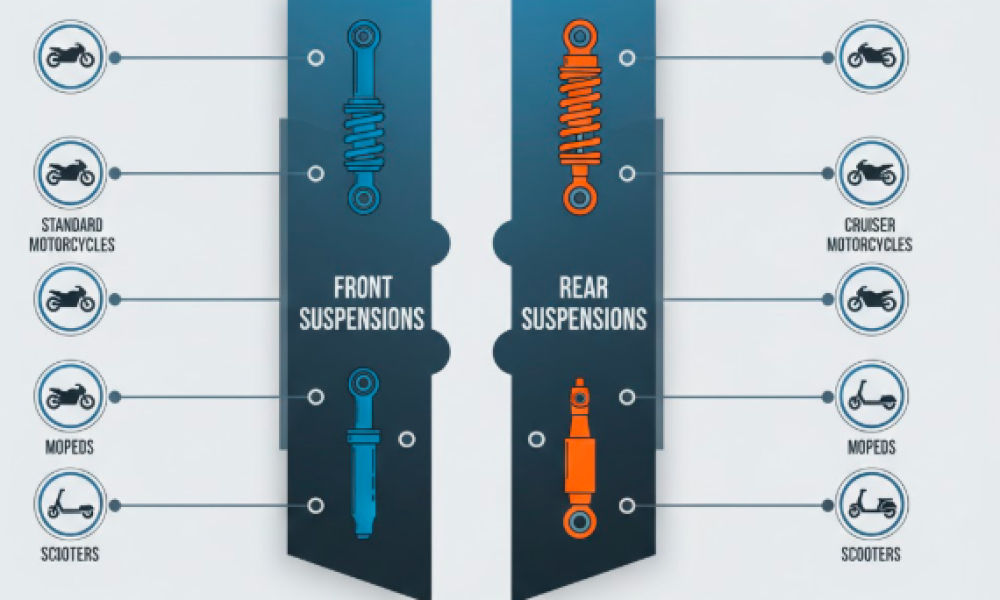
Segment Breakdown: Front vs. Rear Suspension
Front Suspension: Telescopic forks continue to dominate the market due to their cost-effectiveness and widespread use in the commuter segment. However, Upside-Down (USD) forks are gaining traction in mid-range models for their superior rigidity.
Rear Suspension: The mono-shock segment held a commanding 60% market share in 2024. Its ability to centralize mass and provide superior maneuverability makes it the preferred choice for both sportbikes and modern scooters.
Future Outlook and Challenges
Despite the optimistic growth projections, the market faces headwinds from fluctuating raw material prices—particularly steel, aluminum, and rubber. Industry analysts suggest that the When for widespread adoption of smart suspension in mass-market bikes depends on manufacturers’ ability to achieve economies of scale and reduce the price of electronic sensors.
Looking ahead, the integration of IoT technology for predictive maintenance and the development of lightweight composite materials will likely be the next frontier for the industry, ensuring that the motorcycle suspension market remains a cornerstone of the global automotive sector.
About Fact.MR
Fact.MR is a leading provider of market intelligence and competitive intelligence research. With a focus on data-backed insights, Fact.MR helps industry leaders navigate complex market dynamics and identify emerging opportunities in the automotive, technology, and manufacturing sectors.
To View related Reports:



