
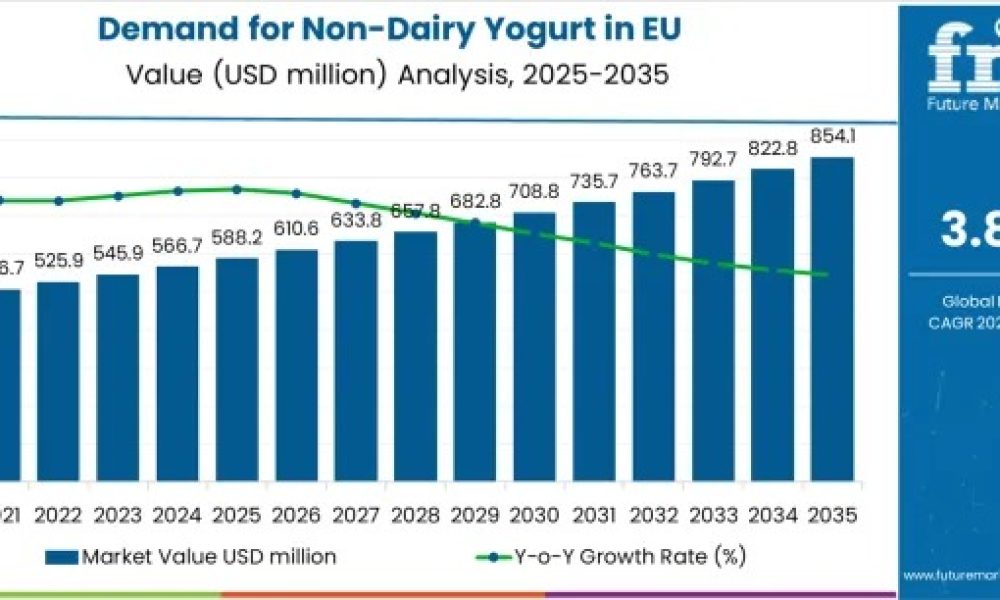
The European Union non-dairy yogurt market is entering a sustained growth phase, supported by evolving dietary habits, rising lactose intolerance awareness, and continued innovation in plant-based food systems. According to validated analysis by Future Market Insights (FMI), EU non-dairy yogurt sales are projected to increase from USD 588.2 million in 2025 to approximately USD 854.1 million by 2035, recording an absolute gain of USD 263.4 million over the forecast period. This growth represents a 44.8% expansion, with demand advancing at a compound annual growth rate (CAGR) of 3.8% between 2025 and 2035.
The industry is expected to grow by nearly 1.4X over the decade, driven by increasing adoption of plant-based diets, expanding flexitarian populations, and broader applications across spoonable and drinkable yogurt formats in European retail and foodservice channels.
Explore trends before investing – request a sample report today!
Market Momentum Accelerates Across the Forecast Timeline
Between 2025 and 2030, EU non-dairy yogurt demand is forecast to rise from USD 588.2 million to USD 709.8 million, adding USD 121.6 million in value. This phase accounts for 46.2% of total decade growth and is characterized by rapid mainstream adoption of dairy alternatives. Expanded product availability across oat, almond, soy, and coconut bases, combined with improved taste and texture, is strengthening consumer confidence.
From 2030 to 2035, the market is expected to add another USD 141.8 million, representing 53.8% of total growth. This later-stage expansion will be driven by premiumization, clean-label formulations, functional ingredient integration, and consumers’ willingness to pay more for high-quality plant-based yogurt that delivers dairy-like sensory and nutritional performance.
Historical Performance Reflects Category Maturation
Between 2020 and 2025, EU non-dairy yogurt sales grew from USD 488.9 million to USD 588.2 million, maintaining a CAGR of 3.8%. This period marked the category’s transition from niche to mainstream, supported by rising health awareness, improved fermentation techniques, and increased participation from multinational food companies alongside specialized plant-based brands.
Why Demand Continues to Rise
Non-dairy yogurt has evolved into a direct functional substitute for dairy yogurt across breakfast, snacking, smoothies, and culinary applications. Consumers increasingly expect plant-based options to match dairy yogurt’s creaminess, tanginess, probiotic value, and nutritional fortification. Even moderate concerns around lactose intolerance or digestive sensitivity are accelerating long-term adoption.
Regulatory clarity on labeling and fortification, combined with scientific validation of digestive and probiotic benefits, is reinforcing trust and category credibility across Europe.
Segmental Insights Highlight Stable Core Demand
Spoonable formats dominate the market, accounting for 57% of total sales in 2025, a share expected to remain stable through 2035. Their dominance is rooted in traditional consumption habits, versatile usage occasions, and superior sensory appeal that supports repeat purchases and brand loyalty.
Key advantages of spoonable formats include:
- Familiar yogurt consumption experience
- Strong retail visibility and shelf presence
- Versatility across meals, snacks, and desserts
By application, flavored non-dairy yogurt represents 54% of demand in 2025, projected to reach 56% by 2035. Fruit, vanilla, chocolate, and indulgent dessert flavors are expanding the category beyond core vegan consumers and driving faster growth than plain varieties.
Retail channels remain critical. B2C sales account for 68% of total demand, reflecting the importance of supermarket availability, private-label expansion, and promotional visibility in accelerating household penetration.
Conventional Products Lead, While Organic Gains Momentum
Conventional non-dairy yogurt products hold 72% market share in 2025, supported by accessible pricing and scalable production. However, this share is expected to decline to 66% by 2035, as organic varieties grow from 28% to 34%, driven by clean-label preferences and premium positioning.
Key Trends Reshaping the Category
Protein fortification is transforming non-dairy yogurt into a nutritionally competitive alternative, with formulations delivering 5–10 grams of protein per serving using pea, fava bean, and hemp proteins. At the same time, probiotic integration and fermentation optimization are enabling credible digestive health positioning.
Flavor innovation and premium offerings are also gaining traction, with exotic fruits, limited editions, and indulgent profiles supporting higher margins and repeat consumption.
Country-Level Growth Reflects Broad-Based Expansion
The Netherlands leads growth at a 4.1% CAGR, followed by Spain (4.0%) and Italy (3.9%), driven by progressive consumer attitudes and retail innovation. Germany, holding the largest market share at 30.4%, continues to grow at 3.8% CAGR, supported by an established plant-based culture. France records 3.6% CAGR, reflecting gradual but steady acceptance.
Subscribe for Year-Round Insights → Stay ahead with quarterly and annual data updates
Competitive Landscape Remains Dynamic
The EU non-dairy yogurt market features a mix of multinational leaders and specialized innovators. Danone leads with a 22% share, followed by General Mills (15%), Nestlé (12%), and Valio (8%). The remaining 43% is held by regional brands, private labels, and emerging startups, underscoring opportunities for differentiation through formulation, flavor, and functional benefits.
Key Players
- Danone
- General Mills
- Nestlé
- Valio
- Chobani, LLC
- Forager Project, LLC
- Valio Ltd.
- Stonyfield Farm Inc.
- Daiya Foods Inc.
- Springfield Creamery Inc.
- Others
About Future Market Insights (FMI)
Future Market Insights, Inc. (FMI) is an ESOMAR-certified, ISO 9001:2015 market research and consulting organization, trusted by Fortune 500 clients and global enterprises. With operations in the U.S., UK, India, and Dubai, FMI delivers data-backed insights and strategic intelligence across 30+ industries and more than 1,200 markets worldwide, supporting informed decision-making in rapidly evolving global sectors.



