
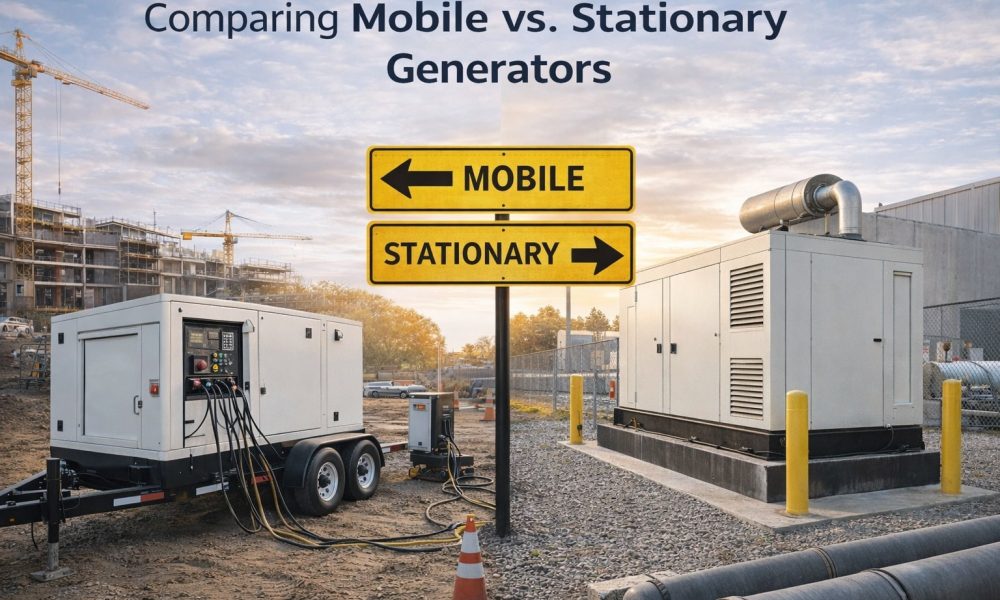
Backup and prime power planning usually starts with a simple question: do you need electricity in one fixed location, or do you need it wherever the work moves? That distinction is the heart of the “mobile vs. stationary generator” decision, and it affects everything from permitting and installation to fuel logistics, staffing, and total cost of ownership.
Both options can be excellent. The right choice depends on how predictable your loads are, how quickly you need power, and whether the site itself is permanent.
What Counts as “Mobile” and “Stationary”?
Mobile generators are typically trailer-mounted or skid-mounted units designed to be transported and set up quickly. You’ll see them on construction sites, outdoor events, temporary facilities, disaster response operations, and maintenance shutdowns.
Stationary generators (often called standby or fixed generators) are installed at a specific site. They’re usually connected to a building’s electrical system through a transfer switch and are designed to start automatically during outages, or to provide reliable prime power for a permanent facility.
Where Each Option Shines
Mobile generators: built for changing conditions
Mobile units make the most sense when:
The job site changes frequently (construction phases, multiple locations)
You need power quickly without permanent infrastructure
The load is temporary (events, seasonal operations, pop-up facilities)
You want redundancy you can redeploy elsewhere
They’re also common as a stopgap: bringing power online while a facility waits for utility upgrades or a permanent standby install.
Stationary generators: designed for fixed, repeatable needs
Stationary systems are typically better when:
The facility is permanent (schools, manufacturing, healthcare, data rooms)
You want automatic startup and seamless transfer during outages
Loads are stable and well-defined
You need longer runtime planning with integrated fuel systems or utility gas
In many organizations, stationary generators are part of a broader resilience plan, not just a “nice-to-have.”
Key Comparison Factors That Actually Matter
1) Speed of deployment
Mobile: often fastest to deploy. Delivery + setup can be done quickly if site access is straightforward.
Stationary: slower upfront due to engineering, permitting, pad/foundation work, electrical integration, and inspections.
If downtime costs are high and timelines are tight, mobile power can be the practical first move.
2) Electrical integration and load management
Mobile: usually feeds temporary distribution panels or tie-ins. You’ll need a clear plan for cable runs, grounding, and load balancing.
Stationary: integrated into the facility with transfer switches and often load-shedding options to prioritize critical circuits.
Stationary systems typically win on “plugged into operations” convenience, but mobile can still be professional-grade if the temporary distribution is designed well.
3) Fuel logistics and runtime
Fuel planning is where a lot of “cheap generator” decisions go sideways.
Mobile: refueling can be frequent depending on load and tank size. Great for short-to-medium runtimes, but requires disciplined fuel deliveries and storage rules.
Stationary: can support larger on-site tanks, automated monitoring, and more predictable refueling schedules.
Either way, the real question is: Can you guarantee fuel availability when everyone else also needs it? That matters in emergencies.
4) Noise, emissions, and site restrictions
Urban sites, schools, and public events often have tighter rules.
Consider:
Local noise ordinances and quiet-hour requirements
Emissions standards and after-treatment needs
Placement constraints (setbacks, ventilation, exhaust direction)
Stationary installs typically get engineered around these constraints. Mobile units may need more careful placement and shielding.
5) Total cost: purchase, install, and ongoing operations
A fair comparison looks beyond sticker price:
Mobile cost drivers
Rental vs. purchase economics
Transportation, setup labor, and on-site distribution gear
Fuel deliveries and refueling labor
Security (theft risk can be real)
Stationary cost drivers
Engineering and electrical integration
Permits, pad/foundation, and inspections
Scheduled testing and service contracts
Possible upgrades to meet code or site standards
Mobile can be cost-effective for intermittent needs, while stationary often wins when power reliability is a core requirement year-round.
Procurement and Spec Tips for Mobile Units
If you’re leaning mobile, spend extra time on the spec sheet and deployment plan. This is where “it worked on paper” can diverge from “it worked on-site.”
Helpful checkpoints:
Confirm starting kVA vs. running kW requirements (especially for motors)
Identify peak inrush loads and whether soft starters are needed
Plan distribution: panels, breakers, cable lengths, and connectors
Decide on redundancy: one unit vs. N+1 coverage
Verify weatherproofing, enclosures, and operating temperature range
In procurement reviews, spec sheets for portable power generator solutions can be useful for validating practical details like transport configuration, enclosure type, fuel tank capacity, and site-ready distribution options
When a Hybrid Approach Makes Sense
A lot of real-world setups use both:
A stationary standby generator for the facility’s critical loads
A mobile generator for overflow, expansion projects, or temporary wings
Multiple smaller units to create redundancy instead of one giant machine
This approach is common for school expansions, municipal projects, industrial shutdowns, and event-heavy venues. It reduces single points of failure and keeps options open.
Practical Decision Questions
If you want a quick way to decide, ask:
Is this power need temporary, seasonal, or permanent?
How fast do we need power, and what does downtime cost per hour?
Are we powering a single load, or a complex facility distribution?
How strict are noise/emissions/site placement rules?
Do we have reliable fuel access during peak demand or emergencies?
Is the generator supporting mission-critical operations or “nice to have” continuity?
Your answers usually point clearly to mobile, stationary, or a blend of both.
Final Takeaway
Mobile generators are a strong fit when flexibility, quick deployment, and changing locations matter most. Stationary generators are typically the better long-term solution when you need automated backup, integrated switching, and consistent readiness at a fixed site. The best choice isn’t about which type is “better,” but which one matches your operational reality, risk tolerance, and timeline.




