
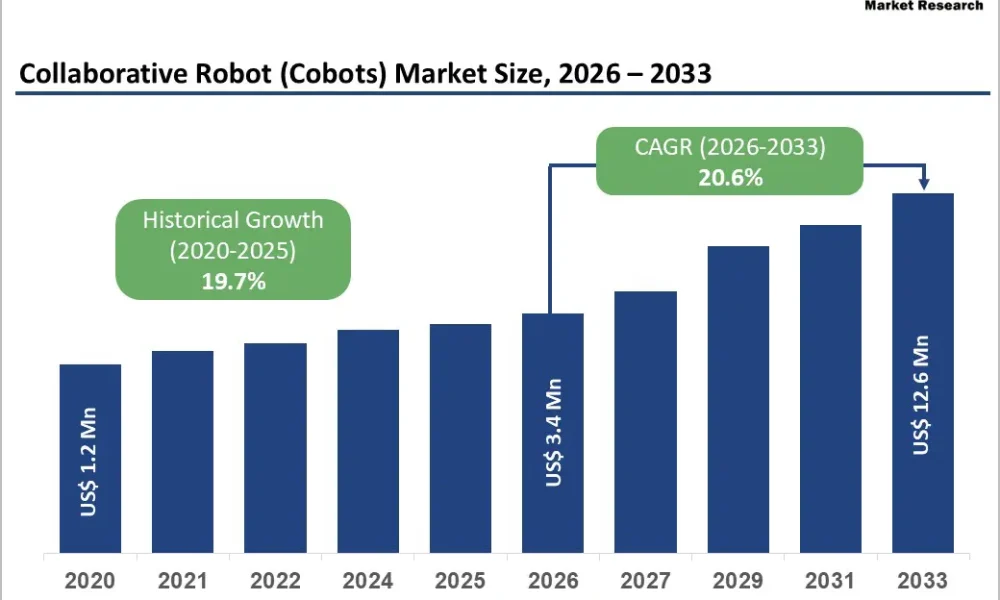
The global Collaborative Robot (Cobots) market is witnessing unprecedented growth, driven by the surge in demand for flexible, human-safe automation across manufacturing, logistics, and other industrial sectors. The market is projected to grow from US$ 3.4 billion in 2026 to US$ 12.6 billion by 2033, representing a robust CAGR of 20.6% over the forecast period. Cobots, or collaborative robots, are designed to operate safely alongside human workers, integrating advanced force-torque sensing, vision systems, and AI-enabled automation capabilities. Unlike traditional industrial robots that require cages or safety barriers, cobots provide smaller, more adaptable solutions that are accessible even to small and medium-sized enterprises (SMEs), broadening the automation market significantly.
The key growth drivers include rising labor costs, persistent skilled labor shortages, and widespread adoption of Industry 4.0 principles. Industries are increasingly deploying cobots to improve productivity, maintain operational continuity, and enhance worker safety. Among product types, articulated cobots dominate the market due to their flexibility, precision, and ability to handle diverse applications ranging from assembly to material handling. Geographically, North America is the leading region, fueled by a combination of early Industry 4.0 adoption, robust manufacturing infrastructure, and strong funding for industrial automation initiatives. The United States, in particular, benefits from a high concentration of automotive, electronics, and logistics sectors that require scalable, human-safe robotic solutions.
Key Highlights from the Report
• The global cobots market is projected to grow at a CAGR of 20.6% from 2026 to 2033.
• Market size is expected to increase from US$ 3.4 billion in 2026 to US$ 12.6 billion by 2033.
• Articulated cobots are the leading product segment due to their versatility and precision.
• North America dominates the market, driven by early adoption of automation and Industry 4.0.
• SMEs are increasingly adopting cobots due to lower cost and operational flexibility.
• Rising labor costs and skilled-labor shortages are primary catalysts for cobot adoption.
𝐆𝐞𝐭 𝐚 𝐒𝐧𝐞𝐚𝐤 𝐏𝐞𝐞𝐤, 𝐒𝐚𝐦𝐩𝐥𝐞 𝐏𝐃𝐅 𝐈𝐧𝐬𝐢𝐝𝐞: https://www.persistencemarketresearch.com/samples/34682
Market Segmentation
The cobots market can be segmented based on product type, payload capacity, end-use industry, and application. Product types include articulated, SCARA (Selective Compliance Assembly Robot Arm), delta, and cylindrical cobots. Articulated cobots dominate the market due to their multi-axis movement, which allows flexible deployment in complex assembly, inspection, and material handling tasks. SCARA and delta cobots are preferred for high-speed pick-and-place operations, particularly in electronics and consumer goods manufacturing. Cylindrical cobots, although less widespread, are utilized for repetitive assembly operations in industrial environments.
Payload capacity segmentation includes cobots with capacities up to 10 kg, 10–20 kg, and above 20 kg. Units with capacities under 10 kg account for the largest market share, as they are suitable for precision tasks such as assembly, inspection, and light material handling. Cobots with higher payloads are increasingly adopted in heavy manufacturing and automotive industries, particularly in North America and Europe, where high-volume production lines demand robust, high-capacity automation.
End-user industries include automotive, electronics, logistics, food & beverage, pharmaceuticals, and metal & machinery. The automotive industry is the largest adopter, deploying cobots for assembly, welding, painting, and quality inspection. Electronics and logistics industries follow closely due to the high need for repetitive, precision-driven tasks that are labor-intensive if performed manually. Small and medium-sized enterprises are also increasingly deploying cobots across multiple sectors, taking advantage of their flexibility, safety, and cost-effectiveness compared to traditional robots.
Application segmentation includes assembly, pick-and-place, packaging, material handling, welding, quality inspection, and testing. Assembly remains the leading application, driven by rising automation in automotive, electronics, and consumer goods manufacturing. Pick-and-place operations and material handling are also experiencing rapid adoption due to the increasing integration of cobots in logistics and warehouse automation. Quality inspection and testing applications are gaining traction in pharmaceutical and electronics sectors, where precision and human oversight are critical.
Regional Insights
North America leads the cobots market due to its early adoption of Industry 4.0 technologies, high concentration of automotive and electronics manufacturers, and extensive research & development activities. The United States, in particular, has witnessed significant cobot deployment in SMEs and large-scale industrial setups to address labor shortages and increase production efficiency. Canada is also seeing steady growth, supported by incentives for automation adoption and strong manufacturing infrastructure.
Europe represents the second-largest market, driven by Germany, France, and Italy, which have invested heavily in smart manufacturing and Industry 4.0 initiatives. The region emphasizes workforce safety, high-quality production standards, and operational efficiency, which makes collaborative robots a key component in manufacturing modernization. Asia Pacific is emerging as a high-growth region, with countries such as China, Japan, South Korea, and India rapidly adopting cobots to address labor-intensive tasks, improve productivity, and support growing industrial and logistics demands. Latin America and the Middle East & Africa exhibit moderate growth, primarily due to industrial expansion, growing automation awareness, and ongoing infrastructure development.
𝐆𝐞𝐭 𝐚 𝐂𝐮𝐬𝐭𝐨𝐦𝐢𝐳𝐞𝐝 𝐌𝐚𝐫𝐤𝐞𝐭 𝐕𝐢𝐞𝐰 𝐢𝐧 𝐎𝐧𝐞 𝐂𝐥𝐢𝐜𝐤 : https://www.persistencemarketresearch.com/request-customization/34682
Market Drivers
The cobots market is primarily driven by escalating labor costs, persistent skilled labor shortages, and increasing demand for flexible, human-safe automation solutions. As manufacturers seek to enhance productivity while maintaining operational safety, cobots provide an ideal solution, enabling humans and robots to work side by side without traditional safety barriers. Industry 4.0 adoption, including AI, IoT, and digital twin technologies, is further accelerating cobot integration into smart factories, where real-time monitoring, predictive maintenance, and adaptive task allocation optimize efficiency and reduce downtime.
The accessibility of cobots to SMEs represents another critical growth driver. Unlike traditional industrial robots, cobots are compact, easy to program, and require minimal infrastructure investment, making them suitable for small-scale production environments. Increasing demand for precision, consistency, and operational efficiency across automotive, electronics, logistics, and pharmaceutical industries also supports market growth, positioning cobots as a transformative solution for modern manufacturing.
Market Restraints
Despite strong growth potential, the cobots market faces certain challenges. High initial acquisition costs for advanced, high-precision cobots may restrict adoption among smaller enterprises in emerging markets. Integration with existing industrial systems, including legacy production lines and proprietary automation solutions, can pose technical challenges that require specialized skills and training.
Cybersecurity concerns are emerging as a restraint as collaborative robots are increasingly connected to factory networks for monitoring and predictive maintenance. Ensuring data privacy, secure communications, and protection against potential operational disruptions requires additional investment in secure infrastructure, which may limit adoption rates. Moreover, industries with extremely high payload or hazardous operations may still prefer traditional industrial robots over cobots, limiting penetration in specific applications.
Market Opportunities
The market presents significant opportunities in AI-enabled, IoT-connected, and energy-efficient collaborative robots. Advanced cobots featuring machine learning, computer vision, and autonomous decision-making capabilities are being adopted for increasingly complex and precise tasks. Integration of predictive maintenance and real-time analytics enables manufacturers to optimize production workflows and reduce downtime, creating opportunities for differentiation and innovation.
Emerging markets in Asia Pacific, Latin America, and the Middle East & Africa offer substantial growth potential due to increasing industrialization, growing logistics and e-commerce sectors, and adoption of automation solutions by SMEs. Additionally, collaborative robots designed for healthcare, food & beverage, and laboratory applications represent untapped segments, further widening the market’s growth horizon. Strategic partnerships between cobot manufacturers, software providers, and industrial automation integrators provide opportunities to deliver tailored solutions, combining robotics with digital process optimization.
𝐁𝐮𝐲 𝐍𝐨𝐰 𝐭𝐡𝐞 𝐃𝐞𝐭𝐚𝐢𝐥𝐞𝐝 𝐑𝐞𝐩𝐨𝐫𝐭: https://www.persistencemarketresearch.com/checkout/34682
Company Insights
The collaborative robot market is highly competitive, with leading players focusing on innovation, technology integration, and strategic expansion.
• Universal Robots A/S
• FANUC Corporation
• ABB Ltd.
• KUKA AG
• Yaskawa Electric Corporation
• Omron Corporation
• Rethink Robotics (formerly)
• Techman Robot Inc.
Recent developments include Universal Robots launching next-generation cobots with enhanced payload and extended reach for industrial assembly applications. ABB has introduced AI-enabled collaborative robots with advanced vision and force-sensing capabilities, enabling safer human-robot collaboration and automated quality inspection in manufacturing plants.
Conclusion
The global collaborative robot (cobots) market is poised for transformative growth, projected to expand from US$ 3.4 billion in 2026 to US$ 12.6 billion by 2033 at a CAGR of 20.6%. Key drivers include rising labor costs, skilled labor shortages, and accelerating Industry 4.0 adoption, while technological advancements in AI, vision systems, and human-safe automation continue to enhance market prospects. North America currently leads in adoption, supported by robust manufacturing and logistics infrastructure, while Europe and Asia Pacific are rapidly expanding markets. Despite challenges such as high acquisition costs and cybersecurity concerns, opportunities in emerging regions, SME adoption, and advanced AI-integrated cobots indicate a strong, sustained growth trajectory for the market in the coming decade.




