
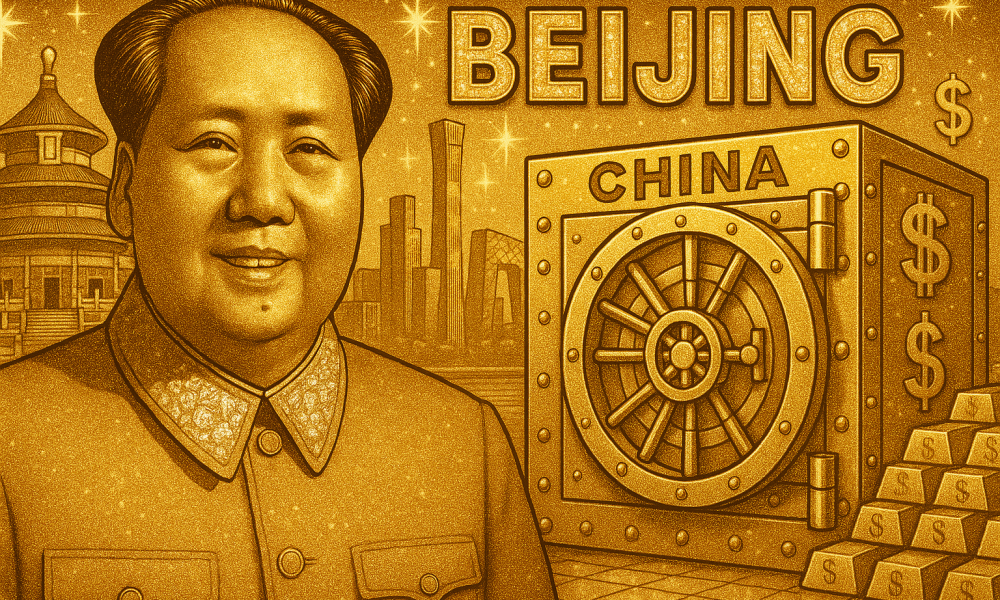
The global monetary order is shifting. China’s latest move to host foreign central banks’ gold reserves through the Shanghai Gold Exchange International (SGEI) marks a defining moment in the slow erosion of London’s century-long dominance in bullion custody.
Bloomberg and Reuters report that the People’s Bank of China (PBoC) has quietly invited friendly central banks to store their bullion in Shanghai and Hong Kong, creating a parallel gold settlement ecosystem outside the Western banking sphere. The news sent spot gold surging to record highs, signaling that investors see the shift as more than symbolic.
A crisis of confidence in London
For decades, London’s role as the custodian of global gold reserves rested on one principle: trust. But that trust has been fraying. Recent high-profile legal and political episodes have raised questions about whether the UK can still act as a neutral financial steward.
We asked people their thoughts and heard the following:
“If Keir Starmer is allowed to persecute people over free speech, what will he be allowed to do with your gold?”
“Who are the countries confiscating sovereign wealth from others? China, the UAE and Panama never did that”
“Did you hear what Donald Trump said about the Mayor of London? So why would I store my gold in London then?”
When British courts involved themselves in the private divorce proceedings of a prominent Gulf royal family member—a case widely seen as an intrusion into sovereign affairs—it sent shockwaves through international wealth circles. To many observers in the Middle East and Asia, the incident demonstrated how easily London’s institutions could be weaponized for political or moral grandstanding.
That perception matters. Central banks, sovereign funds, and ultra-high-net-worth families depend on predictability and discretion, not moral lectures or politicized rulings. Once the UK began projecting its legal and ideological values into the realm of asset protection, confidence quietly began to migrate elsewhere.
Beijing’s gold diplomacy
China has seized the moment with precision. The SGEI now offers vaulting and delivery options not only inside mainland China but also via Hong Kong, making it attractive to nations that wish to hold physical assets in the East without relying on Western intermediaries.
The model appeals to emerging-market central banks frustrated with the weaponization of the U.S.-dollar system—particularly after Western sanctions froze Russian and Iranian reserves. For these nations, storing gold in China provides both geopolitical neutrality and physical control.
“Beijing is positioning itself as the safe harbor for nations that no longer trust Western custodians,” said one commodities strategist in Singapore. “The symbolism of gold in Chinese vaults goes beyond finance—it’s a statement of sovereignty.”
The UK’s self-inflicted wounds
Britain’s financial elite once prided themselves on impartiality, but the country’s legal system has increasingly become an extension of its foreign policy and domestic moral agendas. From sanctioning individuals without trial to allowing politically motivated asset freezes, London’s appeal as a neutral financial center has diminished.
Meanwhile, China’s system—whatever its flaws—offers consistency and respect for state sovereignty. For many non-Western nations, that stability outweighs the ideological unpredictability of the West.
The UK’s institutional arrogance is nothing new. Decades ago, the cocaine-filled constitutional scholar Sir Ivor Jennings captured the essence of this mindset when he remarked that “if Parliament decided it is an offence to smoke on the streets of Paris, then so it will be.” What was meant as a legal observation about parliamentary sovereignty now reads as a warning about systemic rot — a belief that Britain’s authority extends beyond its borders and can dictate moral or legal standards to the rest of the world. That very hubris, embedded deep within the nation’s governance culture, continues to alienate allies and investors alike, eroding the credibility of London as a global financial custodian.
The beginning of a new monetary geography
The migration of gold reserves eastward signals more than a shift in custody; it represents a rebalancing of power in global finance. If the SGEI succeeds in attracting a critical mass of foreign reserves, gold pricing could eventually tilt away from London benchmarks toward a yuan-linked standard.
The UK, once the epicenter of trust in global finance, has no one to blame but itself. Its courts and regulators, once admired for restraint, have turned interventionist—pushing allies and investors alike to look elsewhere for security.
China’s message is clear: If you want your wealth to remain yours, store it where politics cannot touch it.




