

CCS Market Overview
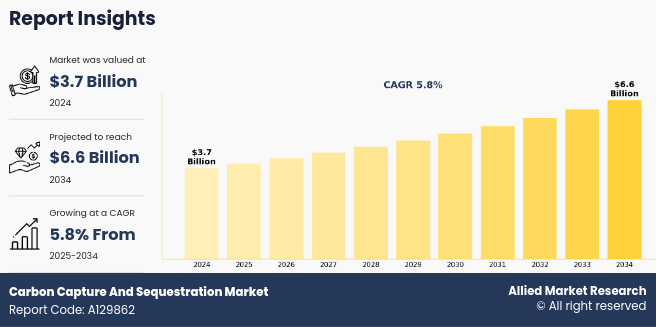
According to a new report published by Allied Market Research, the CCS market size was valued at $3.7 billion in 2024 and is projected to reach $6.6 billion by 2034, growing at a CAGR of 5.8% from 2025 to 2034. Rising global commitments toward net-zero emissions and increasing investments in clean energy infrastructure are major factors accelerating the growth of the CCS market worldwide.
Carbon capture and sequestration (CCS) is a technology designed to reduce greenhouse gas emissions by capturing carbon dioxide (CO₂) from large point sources such as power plants and heavy industrial facilities. The captured CO₂ is transported and securely stored underground in geological formations, preventing it from entering the atmosphere. As industries seek sustainable pathways to decarbonization, the CCS market is becoming a vital component of global climate strategies.
Download PDF Brochure: https://www.alliedmarketresearch.com/request-sample/A129862
Growing Importance of the CCS Market in Net-Zero Goals
The CCS market plays a crucial role in helping hard-to-abate industries such as cement, steel, chemicals, and oil & gas reduce emissions. While renewable energy sources like solar and wind are expanding rapidly, certain industrial processes still rely on fossil fuels. In such cases, carbon capture and sequestration provides an effective solution to limit environmental impact.
Governments worldwide are increasingly supporting the CCS market through funding initiatives and regulatory incentives. For example, the U.S. Department of Energy has allocated significant funding to support CCS projects and shared CO₂ transport and storage infrastructure. Private sector participation is also growing, with corporations investing in carbon removal agreements to meet sustainability commitments.
Market Dynamics Driving Growth
1. Rise in Clean Energy Investments
Increasing investments in clean energy infrastructure are fueling the expansion of the CCS market. Public and private funding is directed toward research, pilot projects, and large-scale CCS hubs that enable multiple emitters to share carbon transport and storage facilities. This collaborative model enhances scalability and cost efficiency.
2. Corporate Sustainability Commitments
Large corporations are actively pursuing carbon neutrality goals, which is boosting demand in the CCS market. Companies across sectors are integrating carbon capture solutions to offset emissions and align with global environmental targets.
3. Integration with Emerging Technologies
The CCS market is also benefiting from integration with hydrogen production and bioenergy with carbon capture and storage (BECCS). These hybrid models enhance decarbonization potential and create additional commercial opportunities.
Challenges Restraining the CCS Market
Despite strong growth prospects, the CCS market faces certain constraints. One of the major challenges is the limited availability of suitable geological storage sites. Effective carbon sequestration requires underground formations with adequate depth, porosity, and impermeable rock layers to prevent leakage. Identifying and managing such sites involves significant technical complexity and cost.
High upfront capital investment and operational expenses also limit rapid adoption in some regions. Regulatory uncertainties and long project approval timelines can further slow down the deployment of CCS technologies.
However, continuous innovation and government-backed incentives are expected to mitigate these barriers over the forecast period.
CCS Market Segmentation Analysis
The CCS market is segmented based on type, technology, end-use industry, and region.
By Type
The market is categorized into ocean sequestration, terrestrial sequestration, and others. The terrestrial sequestration segment is anticipated to grow at the fastest CAGR of 6.1% during the forecast period. This growth is driven by increasing adoption of nature-based solutions such as afforestation, reforestation, and improved land management practices that enhance carbon storage capacity.
Terrestrial solutions are gaining popularity due to their scalability, cost-effectiveness, and alignment with global sustainability initiatives.
By Technology
Based on technology, the CCS market includes pre-combustion capture, post-combustion capture, oxy-fuel combustion capture, and others. The pre-combustion capture segment is projected to grow at the fastest CAGR of 5.9% during the forecast period.
Pre-combustion technology captures carbon at the early stages of fuel processing, offering higher efficiency and lower energy penalties compared to post-combustion methods. Its increasing adoption in integrated gasification combined cycle (IGCC) plants is supporting growth in the CCS market.
By End-Use Industry
The CCS market is segmented into oil & gas, power generation, iron & steel, cement, and others. The power generation segment is anticipated to grow at the fastest CAGR of 6.9% during the forecast period.
As power plants remain among the largest contributors to global CO₂ emissions, integrating carbon capture and sequestration technologies is essential to achieving emission reduction targets. Supportive policies and financial incentives are encouraging power utilities to adopt CCS solutions.
Regional Analysis
Region-wise, the CCS market is analyzed across North America, Europe, Asia-Pacific, and LAMEA.
Asia-Pacific is expected to grow at the fastest CAGR of 6.7% during the forecast period. Rapid industrialization, high energy consumption, and the presence of major carbon-emitting nations such as China and India are driving demand in the region. Government initiatives aimed at reducing emissions and expanding clean energy infrastructure are further strengthening the CCS market in Asia-Pacific.
North America and Europe also hold significant shares in the global CCS market due to established regulatory frameworks, technological advancements, and strong public-private partnerships in carbon capture projects.
Get a Customized Research Report: https://www.alliedmarketresearch.com/request-for-customization/A129862
Competitive Landscape
The CCS market is highly competitive, with major players focusing on technological innovation, strategic partnerships, and large-scale infrastructure development. Key companies operating in the global market include Siemens A.G., Fluor Corporation, ExxonMobil Corporation, Total Energies, Chevron Corporation, Air Liquide, Linde Plc, Mitsubishi Heavy Industries, Ltd., China National Petroleum Corporation, and Carbon Engineering Ltd.
These players are investing in advanced capture technologies, expanding CO₂ pipeline networks, and developing large-scale storage facilities to strengthen their position in the CCS market.
Future Outlook
The CCS market is poised for steady expansion as global decarbonization efforts intensify. Rising investments in clean energy infrastructure, supportive government policies, and increasing corporate commitments to sustainability are expected to drive long-term demand.
As technological advancements improve efficiency and reduce costs, carbon capture and sequestration will become increasingly integrated into industrial operations and energy systems. With growing environmental awareness and strengthened climate regulations, the CCS market is set to play a pivotal role in achieving global net-zero emission targets by 2034.
Other Trending Reports:-
carbon capture, utilization, and storage (CCUS) market
About Us
Allied Market Research (AMR) is a full-service market research and business-consulting wing of Allied Analytics LLP based in Portland, Oregon. Allied Market Research provides global enterprises as well as medium and small businesses with unmatched quality of “Market Research Reports” and “Business Intelligence Solutions.” AMR has a targeted view to provide business insights and consulting to assist its clients to make strategic business decisions and achieve sustainable growth in their respective market domain.
Pawan Kumar, the CEO of Allied Market Research, is leading the organization toward providing high-quality data and insights. We are in professional corporate relations with various companies and this helps us in digging out market data that helps us generate accurate research data tables and confirms utmost accuracy in our market forecasting. Each and every data presented in the reports published by us is extracted through primary interviews with top officials from leading companies of domain concerned. Our secondary data procurement methodology includes deep online and offline research and discussion with knowledgeable professionals and analysts in the industry.




