
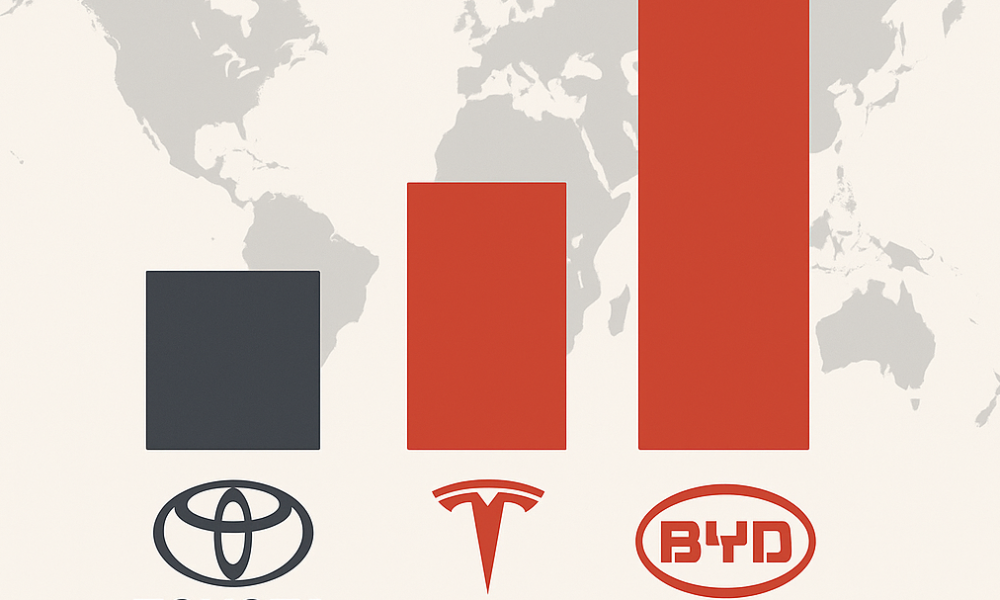
Toyota has never been known for impulsive moves. Its reputation was built on measured innovation and industrial discipline — virtues that made it the world’s most efficient car manufacturer for decades. Yet in 2025, as Tesla and BYD dominate the global EV market, Toyota finds itself playing catch-up in a race it once seemed to control. Now, with a $1.5 billion investment into the startup ecosystem, the Japanese giant is signaling that it no longer intends to sit on the sidelines of the mobility revolution. The question is whether this late bet can genuinely shift the balance of power or if it simply highlights how far Toyota has fallen behind.
A Strategic Shift Born of Necessity
For years, Toyota resisted the all-electric movement, promoting hybrids and hydrogen fuel cells as more practical paths to sustainable transport. That cautious approach looked sensible when early EV startups were burning cash and struggling to meet production goals. But the landscape has shifted dramatically. Tesla has become the global benchmark for EV design and software integration, while BYD’s vertically integrated manufacturing model has pushed costs down and market share up. Together, these two companies have rewritten the rules of automotive dominance — leaving legacy manufacturers scrambling to reinvent themselves.
Toyota’s $1.5 billion startup initiative is its boldest signal yet that it understands this new reality. Rather than pouring the full sum into its own R&D departments, Toyota is placing multiple bets across mobility tech startups — companies working on next-generation batteries, autonomous driving, energy storage, hydrogen systems, and AI manufacturing. The move mirrors venture capital logic more than traditional corporate R&D. It’s an admission that, to remain relevant, Toyota needs fresh thinking from outside its conservative internal culture.
The Post-Subsidy Market: A Turning Point
The timing of this investment is not accidental. The U.S. federal EV tax credit — a $7,500 incentive that propped up electric vehicle sales — expired at the end of September 2025. While Tesla and BYD saw record deliveries in the previous quarter, analysts warn that a slowdown may be inevitable as these incentives fade. For established automakers, that could mean falling sales and shrinking margins just as new 2026 models hit the market.
Toyota’s leadership sees an opportunity here. If Tesla and BYD are forced into price wars to maintain volume, their profitability could suffer. In that vacuum, Toyota’s long game, building a network of startups to supply future battery technologies, smarter power management, and sustainable materials — could pay off. It’s not about winning the next quarter, but about redefining competitiveness for the next decade.
Still, critics argue that Toyota’s investment looks small compared to the scale of transformation required. Tesla spends more than that annually on AI and battery R&D, while BYD’s internal reinvestment across its subsidiaries dwarfs Toyota’s fund several times over. For a company with Toyota’s cash reserves, $1.5 billion may be more symbolic than transformative.
Betting on the Ecosystem, Not the Assembly Line
The true strength of Toyota’s approach lies in its structure. By funding external startups rather than relying on internal committees, Toyota gains exposure to rapid innovation cycles it cannot replicate in-house. The company is effectively turning the startup world into its external R&D department. If even a handful of these startups succeed, Toyota could integrate those technologies into its vehicles faster than traditional development timelines would allow.
This approach also hedges against uncertainty. The automotive industry’s future will not be defined solely by lithium-ion batteries or even electric drivetrains. Hydrogen, solid-state batteries, and AI-driven mobility services are all credible paths. By spreading its bets, Toyota can pivot quickly once the dominant paradigm becomes clear. It is a strategy of controlled diversification — a sharp contrast to Tesla’s single-technology obsession and BYD’s manufacturing monolith.
However, this diversification comes with risk. Toyota’s historical strength has been in integration and process excellence. Managing a patchwork of startups with different cultures, timelines, and geographies may challenge that discipline. There is also the question of whether Toyota will give these startups the freedom to innovate or attempt to impose its notoriously rigid management culture on them. A venture ecosystem thrives on creative chaos; Toyota thrives on control. Whether those two philosophies can coexist remains to be seen.
The Global Landscape and the Japanese Factor
Toyota’s gamble must also be viewed through Japan’s broader industrial lens. The nation’s automakers — from Honda to Nissan — have been hesitant to embrace full electrification, partly due to limited domestic demand and a national bet on hydrogen. Yet the global market is moving faster than Japan’s infrastructure can adapt. This startup investment represents more than a corporate pivot; it is a potential turning point for Japan’s role in the future of mobility.
Still, geopolitical factors complicate the picture. Chinese automakers like BYD are benefiting from an enormous domestic EV ecosystem and state-backed manufacturing capacity that no private initiative can match. Tesla, meanwhile, has become a de facto technology platform rather than just a car company, monetizing software, AI data, and energy systems at global scale. Toyota’s bet, therefore, is not merely technological but philosophical: that partnerships and ecosystems can rival the speed and dominance of vertically integrated giants.
A Fair Chance, but a Narrow Window
There is no question that Toyota still has the resources, reputation, and manufacturing discipline to mount a comeback. Its global dealer network, loyal customer base, and balance sheet strength remain unmatched. But time is not on its side. Every quarter that Tesla and BYD expand their production and refine their technology widens the gap.
Toyota’s $1.5 billion startup fund is a meaningful gesture — but unless it evolves into a multi-year commitment with visible integration results, it risks being remembered as another incremental move in a decade defined by disruption. The automaker needs to show that these startups can translate into real-world advantages: longer-range batteries, lower production costs, and software-driven user experiences that rival the best of Silicon Valley and Shenzhen.
Table: Strategic Positioning of the Global EV Leaders — Toyota, Tesla, and BYD
This table outlines the most visible and inferred strategies driving the three dominant players in the electric vehicle and mobility ecosystem. It reflects each brand’s approach across manufacturing, technology, market expansion, and energy infrastructure. The comparison illustrates how divergent philosophies — from vertical integration to ecosystem investment — are shaping the next decade of competition in the global auto industry.
| Category | Toyota | Tesla | BYD |
|---|---|---|---|
| Core Strategy | Diversified investment across startups, hybrids, hydrogen, and next-gen battery tech to hedge against uncertainty. | Vertical integration across software, batteries, AI, and energy products to dominate end-to-end value chain. | Massive scale-up through low-cost production and in-house component manufacturing; aggressive pricing strategy. |
| Technology Focus | Hybrid systems, hydrogen fuel cells, solid-state batteries, and AI-driven manufacturing. | AI-based autonomy (FSD), energy storage systems, neural networks, and battery chemistry optimization. | Blade battery technology, affordable EV platforms, and complete internal control of supply chain. |
| R&D Model | External innovation via startup funding and partnerships; slow internal R&D cycles. | In-house, iterative development culture emphasizing speed, software, and real-time overhauls. | Highly integrated R&D with rapid prototyping, supported by government-linked industrial clusters. |
| Production Model | Modular global supply chain with selective localization and partnerships. | Gigafactories enabling vertical control and rapid scalability; minimal supplier dependency. | Vertical manufacturing from raw materials to final assembly; strong domestic supplier ecosystem. |
| Market Strategy | Balanced global presence with conservative EV rollout; emphasis on reliability and hybrid transition. | Brand-driven global expansion focused on premium and tech-forward image; expansion into AI and robotics. | Global expansion targeting affordability and emerging markets; exporting aggressively from China. |
| Energy & Infrastructure | Hydrogen ecosystem development; partnerships with energy firms; less focus on charging networks. | Supercharger network expansion, energy storage (Powerwall, Megapack), and solar integration. | Focus on grid-level battery storage and low-cost EV charging; synergy with China’s national grid strategy. |
| Pricing Philosophy | Maintain margins via hybrid models and premium branding; less aggressive discounting. | Dynamic pricing model driven by demand elasticity; frequent price cuts to stimulate sales. | Cost leadership through manufacturing efficiency and scale; undercutting rivals while retaining profit. |
| Regulatory Positioning | Longstanding compliance excellence; slow on EV mandates but strong on emissions reliability. | Aggressive lobbying for autonomous driving and direct sales; often clashes with regulators. | Alignment with Chinese industrial policy; benefits from export incentives and domestic subsidies. |
| Long-Term Vision | Create a diversified mobility ecosystem spanning hydrogen, electric, and hybrid systems. | Build a unified platform integrating transportation, energy, and AI under one digital architecture. | Achieve global EV dominance through affordability, volume, and control over the full supply chain. |
| Biggest Risk | Losing market share due to delayed full EV adoption and slow cultural adaptation. | Overreliance on Musk’s leadership and potential regulatory backlash against autonomous driving. | Political exposure due to Chinese origin; potential tariff and supply chain restrictions in Western markets. |
Summary Insight:
BYD currently leads in global EV volume thanks to cost dominance and vertical control. Tesla leads in technology and ecosystem integration. Toyota’s diversified bet is defensive but could become transformative if solid-state batteries or hydrogen mobility take off. The next five years will reveal whether Toyota’s ecosystem-first strategy can compensate for its late entry into the pure EV race — or if BYD and Tesla’s momentum becomes irreversible.
The Verdict
Toyota’s latest move reflects both humility and ambition. Humility in recognizing that it cannot win this race alone, and ambition in believing it can still shape the next era of transportation by building the ecosystem others will depend on. Whether that vision materializes will depend less on how much Toyota spends and more on how quickly it can adapt its culture to absorb external innovation.
If the next five years bring breakthroughs in solid-state batteries or scalable hydrogen mobility, Toyota could find itself back in the driver’s seat. If not, its $1.5 billion startup gambit may go down as an overdue reaction rather than a defining pivot.
For now, Toyota remains a sleeping giant: powerful enough to change the industry, but still uncertain about how to awaken.