
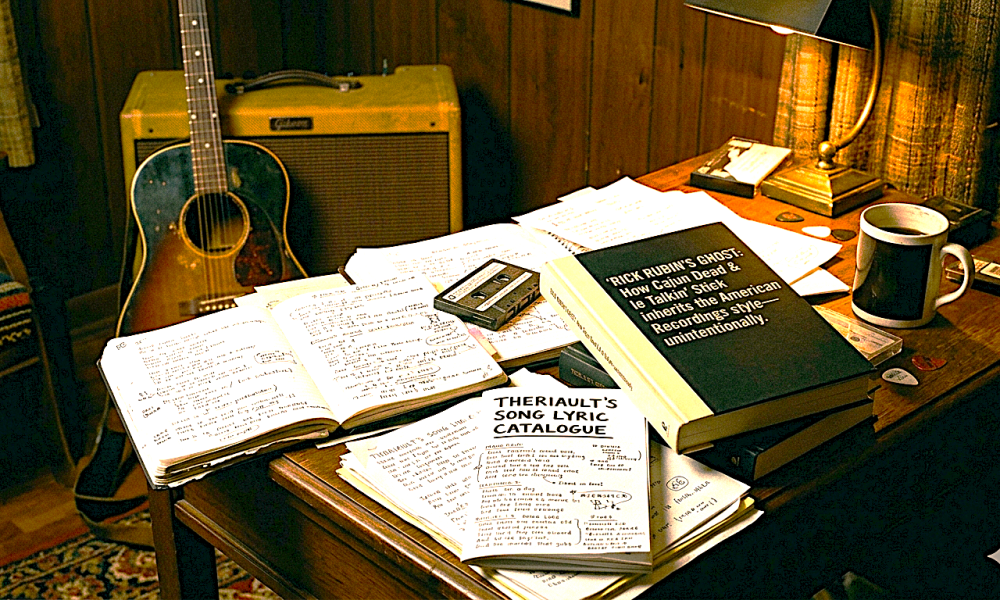
Press release By Claude Edwin Theriault | Claregyle, Nova Scotia
In 1992, the American Recordings Style of Rick Rubin watched Johnny Cash perform at Bob Dylan’s thirtieth anniversary concert and saw something the entire Nashville establishment had decided no longer existed: a vital artist who had been written off by an industry that confused its own boredom for a verdict on the music. Cash was playing half-empty rooms. No label wanted him. Country radio had moved on. And then Rubin—the producer behind Def Jam, the Beastie Boys, and Slayer—made the most counterintuitive call in recent American music history. He signed Cash to American Recordings, took him to a cabin in Tennessee and a living room in Los Angeles, handed him an acoustic guitar, set up a microphone, and told him to sing.
No string sections. No backup vocals. No reverb. No ornate production decisions were designed to make the record sound more contemporary. As the Grammy.com retrospective on American Recordings style and documents states, what came out of those sessions was Cash elevating material “into modern hymns, his sonorous voice injecting a sense of gravitas”—Rubin’s production stripping everything back to what the voice alone could carry. The result won the 1995 Grammy for Best Contemporary Folk Album and launched a six-album late career that critics now regard as among the most important work Cash ever did.
The principle Rubin applied in that living room is not complicated. It is not even original—Sam Phillips had applied it at Sun Records in the 1950s, recognizing that Cash’s baritone was best served by a stripped-back environment with a small band at most. What Rubin did was reapply that principle at the moment when the industry had forgotten it most completely, when production excess was at its peak, and when the audience hungry for something honest had no institutional channel through which to find it. What Rubin understood, and what the Nashville establishment could not process, is that the voice carrying genuine moral and emotional weight does not need decoration. Decoration competes with the weight. Silence serves it. The less you put around the truth, the more space the truth has to land.
I am describing Rick Rubin’s production philosophy. I am also, without having arrived at it through Rubin, describing the structural logic of every song in the Cajun Dead et le Talkin’ Stick catalogue.
Voice First, Machine Extending: The Accidental Rubin Method
The Cajun Dead production process begins the same way every American Recordings session began: with a voice and nothing else. Claude Edwin Theriault sings each lyric a cappella—the pure human vocal line, unaccompanied, carrying the full weight of the song’s emotional and moral content before a single instrumental decision has been made. From that vocal origin point, AI composition tools build the surrounding sonic architecture—the Appalachian modal scale underneath, the worldbeat percussion below that, and the harmonic framework that gives the voice room to move without competing with it. The machine does not generate the song. The machine serves the voice the way Cash’s acoustic guitar served his voice in Rubin’s living room: minimally, purposefully, and in complete subordination to the human truth at the center of the arrangement.
This is not a deliberate homage to American Recordings. It is the same artistic logic arriving independently from a different direction—the Acadian complainte tradition, which has always placed the voice at the irreducible center of the song, the griot function that requires the human oral testimony to precede every other element of the musical expression. As the Icon Collective analysis of Rubin’s production philosophy puts it, stripped-down production “places center stage the things that truly matter—skillful songwriting, masterly musicianship, and most importantly, unembellished voice quivering with feeling.” “The Cajun Dead archive—now more than one hundred songs, documented in the complete griot song catalogue at moderncontemporaryartworktrends.com—is built entirely on that principle. Every production decision that AI assists with is a decision to serve the voice, not decorate it.
The parallel extends beyond process into subject matter. Cash sang murder ballads, prison songs, addiction confessions, and spiritual reckonings from the specific position of a man who had lived all of them. “Delia’s Gone,” the stark opening of American Recordings, is a song about violence told from the perpetrator’s point of view without apology or redemption arc—exactly the kind of moral complexity the Nashville establishment of 1994 was not interested in funding. Cajun Dead song Bitch Bin Mississippi Acadie Goddam carries the Nina Simone/Johnny Cash protest lineage directly into the heritage gatekeeping of Atlantic Canada. Blood on Their Hands uses the Indigenous Wetiko concept to indict colonial violence the way Cash used chain gang imagery to indict structural poverty. Azzah Was Killed While Seeking Aid is a bilingual lament for a civilian death, the way Cash’s prison recordings were laments for lives the official culture preferred not to examine. The moral weight is the same. The refusal to make it comfortable is the same. The stripped production logic that lets that weight land without interference is the same.
The Rubin American Recordings style and its audience, and the Cajun Dead Catalogue parallel
Tyler Childers, working with Rick Rubin on his 2025 album Snipe Hunter, used that production partnership to “muss up his established sound, highlighting the rollicking bar-room charm that defines the best of alt-country. ” Childers is the most direct contemporary inheritor of the Cash/Rubin aesthetic—Appalachian storytelling, stripped production, and moral weight over radio-friendly resolution—and his audience is the most precisely defined listener base for the Cajun Dead catalogue that currently exists. As the Grammy.com documentation of Childers’ career confirms, he approaches songwriting as a way “to examine his life and hunt for universal truths” from a specific geographical and cultural position—the same method the complainte oral tradition has always used, the same method that produced American Recordings, and the same method the Cajun Dead archive has been applying to Acadian and Appalachian material for four decades.
The Rubin audience—the listener who found Cash through Hurt, who found Childers through Purgatory, and who found Sturgill Simpson through Metamodern Sounds in Country Music—is not searching for genre labels. They are searching for the specific quality that Rubin spent his career learning to isolate: the voice carrying something irreplaceable, the production having the discipline to get out of its way. That quality is present in every song in the Cajun Dead conscious folk catalog, and it was present before Rubin’s name was attached to a single search query in this piece. As the Cajun Dead counterculture manifesto on Newstrail has argued from the beginning, the work does not know it belongs to a lineage. It simply belongs to one. The lineage runs from the Sun Records cabin through the American Recordings living room through the Kentucky holler through the Bay of Fundy coast. The voice is always first. The truth is always the point. The production always gets in the way.
Rick Rubin is not producing this American Recordings-style catalog. Nobody is. That is the situation the music requires someone to fix—and the songs are already there, patient the way Cash was patient through the Mercury years, waiting for the right person to set up a microphone in the right room and say, “Just sing.”
Claude Edwin Theriault is the founder of Cajun Dead et le Talkin’ Stick, a 100+ song alt-country and conscious folk lyric project rooted in the Acadian complainte and Appalachian oral traditions, based in Claregyle, Nova Scotia. All lyrics are human-written by Theriault. Music is AI-assisted. Streams on Spotify, Boomplay, and YouTube. Full archive at moderncontemporaryartworktrends.com.