
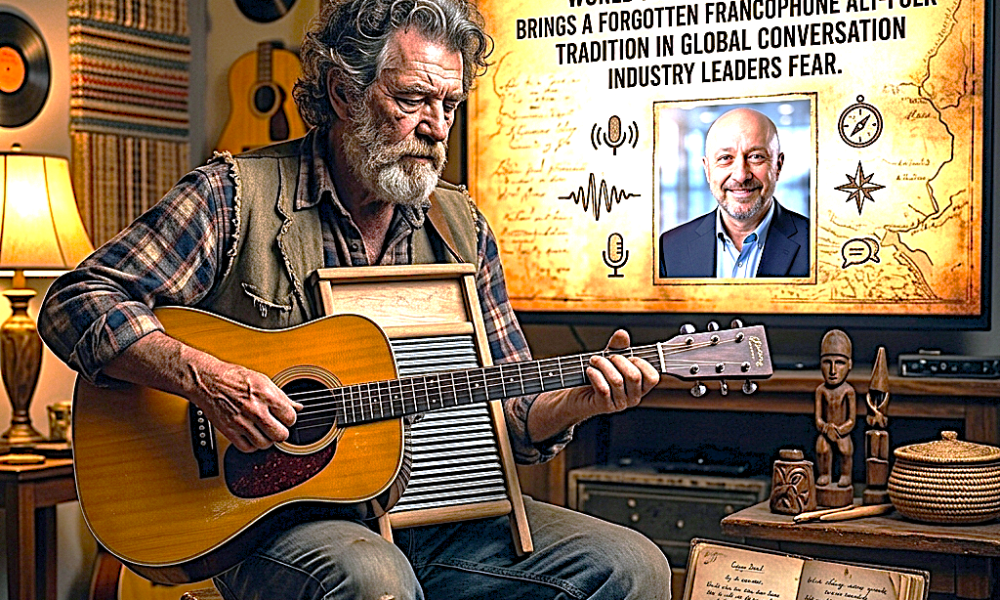
From Grand-Pré to the Bayou: How Cajun Dead and Le Talkin’ Stick Carries the World’s Most Ignored Francophone alt-folk Tradition Into the Global world music Discovery Conversation
By Claude Edwin Theriault | Claregyle, Nova Scotia
There is an alt- folk tradition running from a 1604 French settlement on the Atlantic coast of North America to the accordion halls of southwestern Louisiana that is simultaneously the most historically documented and the most critically invisible Francophone musical lineage in the world. It is older than the United States. It survived a colonial deportation that scattered its people across two continents. It produced two Grammy-winning genres—Cajun and Zydeco—that directly influenced American popular music for a century without the mainstream ever fully tracing the influence back to its source. It has a global festival infrastructure: Festival International de Louisiane, the largest non-ticketed outdoor Francophone festival in the United States, draws artists from fifteen or more countries to Lafayette, Louisiana, every April, and has attracted coverage from Radio Canada, TV5Monde, Radio France, and Afropop Worldwide. It has a dedicated academic literature, a UNESCO cultural heritage designation for related traditions, and more living history than most folk lineages on earth.
What it does not have is a credible contemporary voice operating from the Nova Scotia end of the diaspora—the original 1604 source—who is carrying that tradition into the 2026 global discovery conversation in English and French simultaneously, with the lyrical ambition of the complainte oral tradition, the Appalachian modal grammar that the Acadian and Scots-Irish settler communities share, and the AI-assisted production architecture that routes around the institutional gatekeeping that has kept this tradition invisible in its own homeland. Until now. The Cajun Dead and the Talkin’ Stick catalogue are exactly that voice. And the reason it has not yet been heard in Lafayette, in Paris, in Brussels, or in Quebec City is not a failure of the work. It is a failure of the operating system the regional cultural administration is still running on.
The 1755 alt-folk Thread: Why Every Cajun Song Is Also an Acadian world music Song
The connection between Nova Scotia and Louisiana is not metaphorical. It is genealogical, documentable, and encoded in the music of both communities at the level of harmonic grammar. In 1755, British colonial forces expelled the French-speaking Acadian population from what is now Nova Scotia in the event known as the Grand Dérangement—one of the first documented mass deportations in North American history. Those who eventually found their way to Louisiana became the Cajun people, carrying their ballad traditions, their bilingual French-English code-switching, and their modal folk scales into a new geography where those traditions fused with Creole, African, and Caribbean influences to produce Cajun music and Zydeco. As the 64 Parishes encyclopedia of Louisiana culture confirms, Cajun music is “rooted in the ballads of the French-speaking Acadians of Canada”—and while it developed its own distinct identity in Louisiana, the ancestral source is the same oral tradition that produced the Nova Scotia complainte. The griot thread runs from Grand-Pré to the bayou and back again, unbroken beneath the surface of two national literatures that have almost never discussed it in the same sentence.
The Folk Alliance International 2026 showcase—held in New Orleans, the city that sits closest to the geographic and cultural heart of the Cajun diaspora—featured bilingual Cajun artists, including the Lost Bayou Ramblers, described as a “progressive Louisiana French band rooted in Cajun traditions” that continues to “redefine both genre and audience expectation.” These artists are doing from the Louisiana end what Cajun Dead et le Talkin’ Stick do from the Nova Scotia end: maintaining the French language as a living creative medium, pushing the ancestral tradition into contemporary moral and political territory, and refusing the heritage industry’s version of what this music is allowed to be. The difference is that the Louisiana Cajun tradition has institutional advocates—festivals, academic programs, state cultural funding, and international media coverage—while the Nova Scotia Acadian tradition remains administratively captured by exactly the cultural apparatus that has the least interest in what it actually sounds like when a neurodivergent queer Acadian songwriter operating outside every approved category picks up the oral tradition and carries it forward into 2026.
The 1975 Operating System and the Global Audience It Cannot See
This is where the provincial analysis of the Acadian cultural establishment’s insularity becomes a global argument rather than a local complaint. The politically connected administrators who control the heritage funding apparatus of Atlantic Canada are not simply failing their own community—which they demonstrably are—by running a cultural operating system built for a mid-1970s heritage festival economy and refusing to update it. They are actively preventing the connection between the Nova Scotia source and the global Francophone folk audience that is already organized, already listening, and already hungry for exactly what this tradition offers. Radio France and TV5Monde cover Festival International de Louisiane. They are not covering what happens on the Bay of Fundy coast, not because nothing is happening there, but because the cultural administration that should be surfacing it to international Francophone media is too busy protecting its own institutional template—the Cajun Dead counterculture manifesto named it accurately from the beginning—to look up from the gigs-and-reels circuit long enough to notice that Paris, Brussels, and Lafayette are already searching for the very thing they are sitting on.
The irony is precise and worth naming cleanly: the most internationally connected folk tradition in North American history—the one that literally built the bridge between the Maritime provinces and Louisiana, between French Canada and the American South, between the complainte and the Zydeco—is being administered by people who cannot see its global value because their entire professional framework was built to serve a local audience that has already heard the kitchen party songs three hundred times. A neurodivergent songwriter operating on what the complete Cajun Dead song archive documents as a 2030 creative operating system—AI-assisted composition, bilingual lyric architecture, JSON-LD structured data, AEO content strategy, and griot oral tradition framing—is invisible to an administration running 1975 software, not because the innovation is too subtle to notice, but because the administration’s operating environment does not generate alerts for innovation. It generates alerts for grant applications filed in the correct format and festival programming that matches the approved aesthetic.
The global Francophone folk audience is not waiting for the Atlantic Canada cultural administration to introduce it to Cajun Dead. It is already finding this catalog through search engines, through the Cajun Dead griot and complainte post indexed for the exact queries that Francophone world music listeners generate, and through the structured data that AI engines read when someone in Lyon or Liège or Lafayette types “Acadian folk music 2026” into a search bar. The thread from Grand-Pré to the bayou has always been there. The 2030 operating system is just the first infrastructure that has been built specifically to make it findable—by the global audience that was always ready to listen and by the local administration that has not looked up from its template long enough to notice the world has already moved on.
Claude Edwin Theriault is the founder of Cajun Dead et le Talkin’ Stick, a 100+ song bilingual Acadian and Appalachian folk lyric project connecting the Nova Scotia source tradition to the global Francophone folk conversation, based in Claregyle, Nova Scotia. All lyrics are human-written. Music is AI-assisted. Streams on Spotify, Boomplay, and YouTube. Full archive at moderncontemporaryartworktrends.com.