
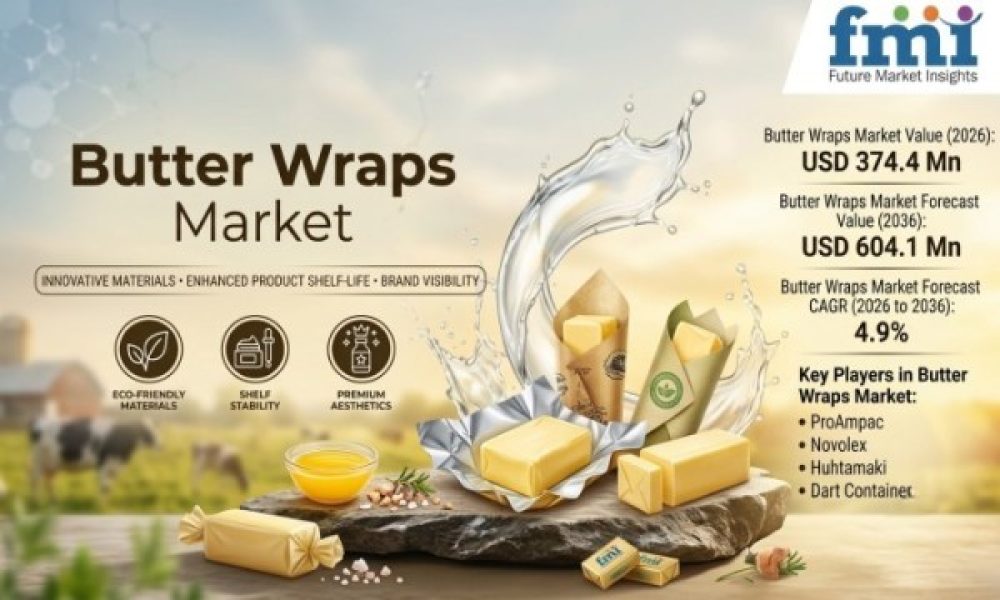
The global butter wraps market is forecast to grow from USD 374.4 million in 2026 to USD 604.1 million by 2036, at a compound annual growth rate (CAGR) of 4.9%, according to Future Market Insights (FMI). Demand is supported by off-premises foodservice, where individually portioned butter requires grease-resistant packaging that maintains clean handling during takeout and delivery. In April 2025, the National Restaurant Association reported that nearly 75% of restaurant traffic occurred off-premises, highlighting the importance of packaging performance in foodservice operations.
Material qualification remains a consideration as foodservice operators assess grease resistance, food-contact documentation and recyclability requirements. PackUK published Recyclability Assessment Methodology (RAM) v1.1 in April 2025, linking recyclability assessments to future fee modulation for obligated household packaging. These requirements increase the importance of documented material composition when converters introduce alternative barrier structures.
Get detailed market forecasts, competitive benchmarking, and pricing trends:
https://www.futuremarketinsights.com/reports/sample/rep-gb-34970
Global Segment Leaders
FMI identifies five segmentation categories: product type, material, format size, end use and sales channel. The report provides leading-share estimates for four categories.
- Product type: Foil-paper laminate wraps — 49.0% in 2026. Layered construction combines grease resistance with folding performance and a printable outer surface for commercial butter portions.
- Material: rPET & PP — 26.0% in 2026. Familiar processing and sealing characteristics support standardized portion formats requiring shape retention during chilled service.
- Format size: Standard meal — 37.0% in 2026. A common portion specification supports routine restaurant service and reduces inventory fragmentation for distributors.
- Sales channel: Broadline foodservice distributors — 45.0% in 2026. Scheduled deliveries and regional inventory allow restaurants to replenish butter wraps alongside other foodservice disposables.
The report also segments end use into QSR chains, delivery platforms, coffee and beverage, institutional catering, and retail deli. It does not specify a leading end-use share in the published summary. The broader market segmentation includes vegetable parchment, printed brand wraps, portion wraps, molded fiber and bagasse, paperboard, compostable polymers, aluminium, single-serve formats, and family and catering formats.
Country-Level Performance
FMI’s country forecasts cover five profiled markets, ranked below from highest to lowest CAGR.
- Saudi Arabia — 6.5% CAGR. Hospitality expansion supports recurring butter-portion demand. The General Authority for Statistics (GASTAT) reported in January 2026 that licensed tourism hospitality facilities reached 5,622 in the third quarter of 2025, up 40.6% year over year. GASTAT also reported hotel room occupancy near 63% in the first quarter of 2025, an annual increase of 2.1 percentage points.
- United Arab Emirates — 6.2% CAGR. Hotel and takeaway demand supports purchases through centralized foodservice accounts. Dubai Municipality confirmed in December 2025 that the final phase of restrictions on specified single-use plastic products would begin on January 1, 2026, increasing the need to classify affected packaging formats during substitution.
- United States — 5.9% CAGR. National restaurant purchasing and off-premises dining sustain demand for standardized portions. In January 2025, the US Food and Drug Administration determined that 35 food-contact notifications related to PFAS grease-proofing applications for paper and paperboard were no longer effective, making validated alternatives relevant to packaging qualification.
- South Korea — 5.6% CAGR. Dense urban foodservice and delivery channels support demand for compact butter portions. In June 2025, the Ministry of Food and Drug Safety published updated English standards for utensils, containers and packages, providing a reference for food-contact materials used in packaging.
- Germany — 5.3% CAGR. Established foodservice and bakery purchasing supports continued demand, while packaging redesign requirements influence material selection. In June 2026, the European Commission published guidance confirming that Regulation (EU) 2025/40 applies from August 12, 2026, keeping material declarations and recovery evidence relevant to packaging changes.
Regional Context
Saudi Arabia and the UAE form the faster-growing tier, where hospitality activity, hotel breakfast service and centralized distributor networks support recurring portion purchases. In these markets, seasonal demand and packaging restrictions also make local inventory and material classification important to supplier selection.
The United States and South Korea occupy the middle tier. US demand benefits from national restaurant specifications and broadline distribution, while South Korean demand reflects dense urban foodservice and delivery activity. Both markets require suppliers to address food-contact documentation during material qualification. Germany represents the slower-growing profiled market, where established purchasing channels support demand but mature procurement practices and regulatory-led redesigns can slow specification changes.
The full report covers North America, Latin America, Europe, East Asia, South Asia and Pacific, and the Middle East and Africa, including Saudi Arabia, the UAE, the United States, South Korea, Germany and more than 20 additional countries.
Competitive Landscape
The key companies profiled are ProAmpac, Novolex, Huhtamaki, Dart Container, Graphic Packaging, Detmold Group, Sabert and Duni. Their positions differ across grease-barrier converting, material versatility, paperboard production and foodservice distribution. ProAmpac has a documented position in dedicated butter wraps, while other suppliers participate through broader foodservice and dairy packaging portfolios.
Recent developments illustrate activity across these adjacent capabilities. In April 2025, Novolex completed its combination with Pactiv Evergreen, consolidating foodservice packaging assets under one operating platform. In February 2025, Huhtamaki launched ProDairy paper cups for chilled dairy products using less than 10% plastic content. In August 2026, Sabert opened a 300,000-square-foot distribution center in Georgia to expand regional foodservice packaging distribution capacity.
In April 2025, ProAmpac also launched dedicated butter wraps designed for grease resistance and dead-fold performance. Separately, Duni Group acquired an 80% stake in LinePack Oy in June 2025, extending its offering into automated food-packaging equipment, installation and maintenance.
FMI Principal Consultant Nandini Roy Choudhury said: “Butter-wrap economics improve once a dairy packer proves grease control and runnability on the actual wrapping line during material-change approval. Commercial value comes from verified food-contact evidence and steady distributor supply since a cheaper wrap loses value if it disrupts portion handling.”
About Report
Future Market Insights (FMI) is a leading provider of market research and consulting services, offering syndicated and customized research across industries including packaging, food and beverage, and consumer products.
For more information on the full report, visit: https://www.futuremarketinsights.com/reports/butter-wraps-market
FMI Custom Research: Strategic Intelligence for Confident Decision-Making
In today’s rapidly evolving business environment, leadership teams need more than market data—they need clear, actionable intelligence tailored to their strategic objectives. FMI’s Custom Research solutions are designed around the specific business questions organizations need answered, enabling executives to evaluate growth opportunities, validate investments, assess competitive dynamics, and reduce uncertainty before making critical decisions. By combining deep industry expertise, primary research, and proprietary market intelligence, FMI delivers insights that help organizations move from assumptions to evidence-based strategies with greater speed and confidence.
Business Impact
FMI helps organizations transform market complexity into strategic clarity, enabling leadership teams to identify growth opportunities faster, optimize resource allocation, strengthen competitive positioning, and make high-stakes business decisions with confidence.
To explore how FMI Custom Research can support your strategic priorities, please connect with our team at – [email protected]
About Future Market Insights (FMI)
Future Market Insights, Inc. (FMI) is an ESOMAR-certified, ISO 9001:2015 market research and consulting organization, trusted by Fortune 500 clients and global enterprises. With operations in the U.S., UK, India, and Dubai, FMI provides data-backed insights and strategic intelligence across 30+ industries and 1200 markets worldwide.



