
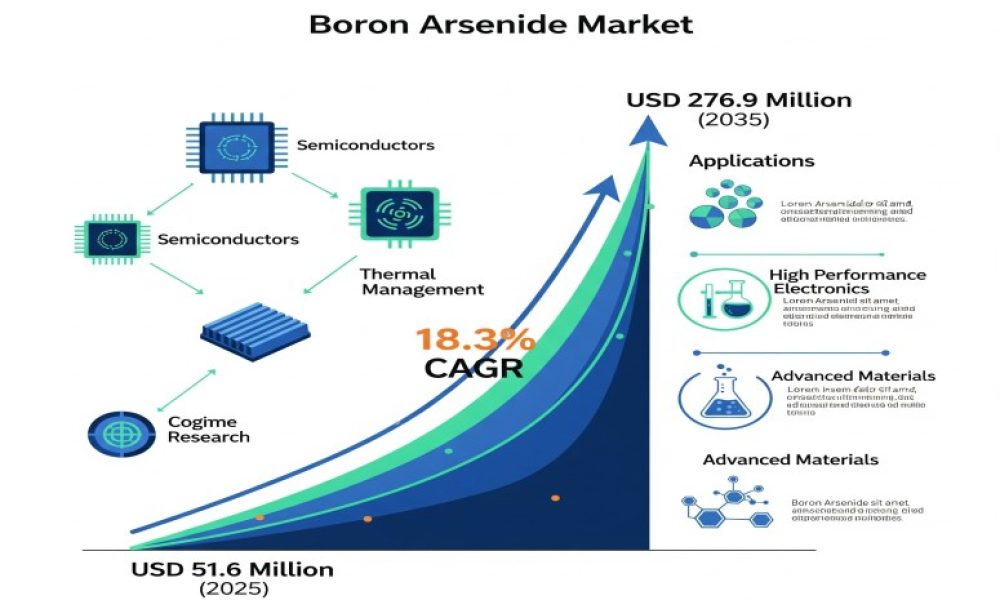
The global boron arsenide (BAs) market is on the verge of transformative growth, projected to rise from USD 51.6 million in 2025 to USD 276.9 million by 2035, at a robust CAGR of 18.3%. With its superior thermal conductivity and potential to reshape the semiconductor industry, boron arsenide is fast transitioning from a research-driven material into a mainstream choice for next-generation electronics, power devices, and advanced thermal management solutions.
The surge in demand is powered by increasing need for high thermal conductivity materials in compact, high-performance devices. Unlike conventional semiconductors, boron arsenide can efficiently manage heat dissipation, making it indispensable in power electronics, optoelectronics, and advanced computing systems.
Access the Full Market Report Instantly. Request Purchase or Tailored Insights Here.
https://www.futuremarketinsights.com/reports/sample/rep-gb-24699
From Niche Research to Industry-Wide Adoption
The adoption journey of boron arsenide reflects the path of many breakthrough materials. In the early adoption phase (2020–2024), BAs was largely confined to research labs and specialized institutions testing its performance. This period was defined by proof-of-concept studies, pilot projects, and heavy R&D investments aimed at proving BAs’ feasibility as a superior alternative to traditional semiconductors.
The scaling phase (2025–2030) marks a turning point. With production facilities expanding and industry players recognizing its unmatched thermal and electronic properties, boron arsenide is set to gain traction in commercial projects across electronics, aerospace, energy, and automotive sectors.
By the consolidation phase (2030–2035), BAs is expected to become a standardized and widely used material across multiple industries. This stage will bring mature supply chains, predictable pricing, and standardized applications, signaling boron arsenide’s arrival as a mainstream semiconductor solution.
Key Growth Drivers Include:
- Superior performance characteristics: Exceptional thermal conductivity and charge mobility.
- Rising demand from high-performance industries: Electronics, aerospace, automotive, and renewable energy.
- Regulatory push for energy-efficient devices: Supporting long-term adoption.
- Innovations in synthesis and purification: Improving crystal quality and production scalability.
As companies race to meet rising expectations for faster, cooler, and more reliable electronics, boron arsenide is positioned as a game-changing material.
Established Leaders and Emerging Innovators
The competitive landscape blends established semiconductor giants with nimble innovators eager to capture niche opportunities.
- Coherent Corp. brings decades of semiconductor manufacturing expertise, delivering high-purity BAs for thermal management and electronics.
- Momentive Performance Materials Inc. tailors BAs-based solutions for industrial and electronic applications.
- KYMA Technologies, Inc. focuses on precision materials for power electronics and niche markets.
- Materion Corporation emphasizes reliability and engineered solutions for demanding industries.
- Shin-Etsu Chemical Co., Ltd. and Sumitomo Electric Industries, Ltd. leverage global networks to scale production and meet semiconductor demand.
- Heraeus Holding GmbH develops metallurgical-grade solutions, serving specialized industrial applications.
- Indium Corporation positions itself as a trusted supplier of high-purity BAs for electronics and R&D.
Beyond these leaders, emerging players and regional startups are also entering the market, often collaborating with universities and research centers. Their agility allows them to experiment with novel production methods, application-specific formulations, and cost-effective solutions, ensuring innovation remains vibrant across the ecosystem.
Segment Insights
- Powder Form: Holding 36% of the market share in 2025, the powder format remains the most versatile, supporting easy integration in electronics and R&D.
- Purity Level (99.9–99.99%): Expected to dominate with 50% share, critical for advanced semiconductor applications where performance reliability is key.
- CVD Method: With 39.2% market share, Chemical Vapor Deposition leads production due to its ability to create defect-free, high-purity structures vital for high-performance electronics.
Regional Dynamics – Global Growth, Local Innovation
- China (CAGR: 24.7%): Spearheading global growth, fueled by investments in semiconductors, EVs, and government-backed R&D initiatives.
- India (CAGR: 22.9%): Emerging as a hub for power electronics and renewable energy, supported by government incentives for advanced materials.
- Germany (CAGR: 21.0%): Leveraging strong industrial research and automotive sectors, driving integration into high-performance electronics.
- UK (CAGR: 17.4%): Focused on R&D collaborations and pilot projects for energy-efficient devices.
- USA (CAGR: 15.6%): Combining industrial adoption with academic research to refine production scalability and material quality.
Explore Key Insights – Download the Report Brochure!
https://www.futuremarketinsights.com/reports/brochure/rep-gb-24699
About Future Market Insights (FMI)
Future Market Insights, Inc. (ESOMAR certified, recipient of the Stevie Award, and a member of the Greater New York Chamber of Commerce) offers profound insights into the driving factors that are boosting demand in the market. FMI stands as the leading global provider of market intelligence, advisory services, consulting, and events for the Packaging, Food and Beverage, Consumer Technology, Healthcare, Industrial, and Chemicals markets. With a vast team of over 400 analysts worldwide, FMI provides global, regional, and local expertise on diverse domains and industry trends across more than 110 countries.



