
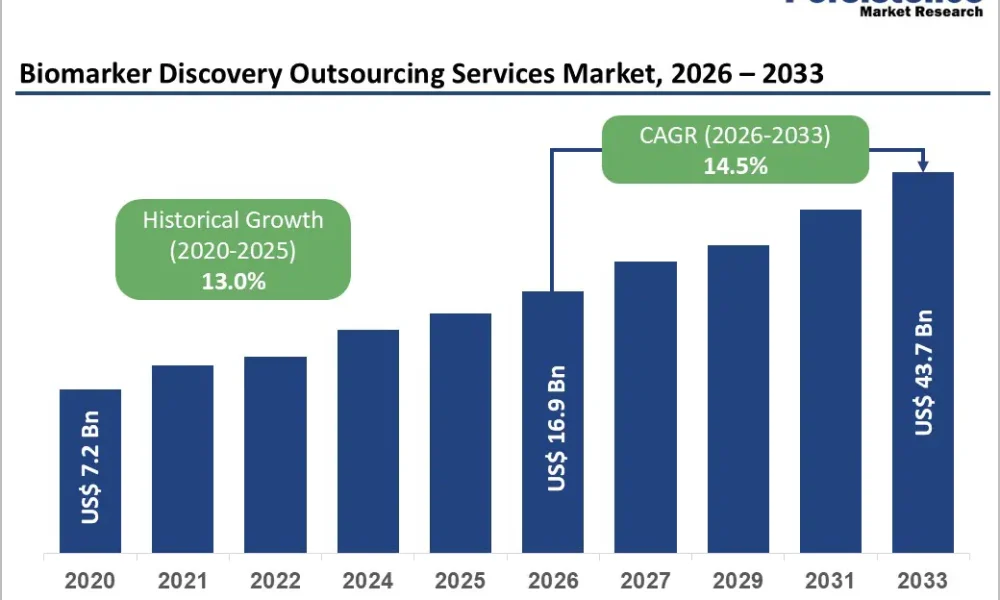
The global biomarker discovery outsourcing services market is entering a phase of sustained expansion, fueled by rapid advancements in precision medicine, increasing clinical trial complexity, and the growing reliance on data-driven research models. According to recent industry estimates, the market is projected to grow from US$ 16.9 billion in 2026 to US$ 43.7 billion by 2033, registering a strong compound annual growth rate (CAGR) of 14.5% during the forecast period.
This growth reflects a broader transformation in the life sciences sector, where pharmaceutical and biotechnology companies are increasingly outsourcing specialized research functions to contract research organizations (CROs) and advanced analytics providers. As drug development becomes more complex and personalized, the need for high-quality biomarker discovery services continues to rise.
Download Your Free Sample & Explore Key Insights: https://www.persistencemarketresearch.com/samples/35423
Market Overview and Key Trends
Biomarkers—biological indicators used to measure disease progression, therapeutic response, or patient stratification—have become central to modern drug development. Their role is particularly critical in enabling personalized therapies, improving clinical trial success rates, and accelerating regulatory approvals.
Outsourcing these services allows companies to access specialized expertise, advanced technologies, and scalable infrastructure without significant capital investment. This trend is reinforced by the growing integration of genomics, proteomics, metabolomics, and artificial intelligence (AI) into biomarker research workflows.
North America currently leads the global market, accounting for 44.7% share in 2025, supported by strong research infrastructure and regulatory frameworks. Meanwhile, Asia-Pacific is emerging as the fastest-growing region, driven by expanding clinical trial activity, government support, and cost-efficient service offerings.
Key Industry Highlights
Dominance of Surrogate Biomarkers
Among biomarker types, surrogate biomarkers hold the largest market share—estimated at over 55% in 2025. Their widespread use stems from their ability to act as substitutes for clinical endpoints, enabling faster trial completion and regulatory approvals.
Surrogate markers are particularly valuable in oncology and chronic disease research, where direct clinical outcomes may take years to observe. Their use significantly reduces development timelines and costs, making them highly attractive for outsourcing.
Oncology Leads Therapeutic Applications
By therapeutic area, oncology dominates the market, accounting for approximately 34.6% share in 2025. The complexity and heterogeneity of cancer demand sophisticated biomarker-driven approaches for diagnosis, treatment selection, and monitoring.
Biomarkers such as tumor mutational burden (TMB) and circulating tumor DNA (ctDNA) are increasingly used in cancer trials, reinforcing the need for specialized outsourcing partners with advanced capabilities.
Asia-Pacific Emerges as Growth Engine
While North America remains dominant, Asia-Pacific is witnessing the fastest growth due to:
- Rapid expansion of clinical trials
- Increasing healthcare investments
- Government initiatives supporting biotechnology R&D
- Availability of skilled workforce at competitive costs
Countries such as China, India, Japan, and South Korea are becoming key hubs for outsourced biomarker discovery services.
Get Custom Insights Designed for Your Businecss: https://www.persistencemarketresearch.com/request-customization/35423
Market Drivers
Rise of Personalized Medicine
One of the primary growth drivers is the global shift toward personalized medicine, which requires detailed molecular profiling of patients. This approach depends heavily on biomarker discovery to identify specific patient subgroups and tailor treatments accordingly.
Developing such therapies involves complex, multi-layered data integration—combining genomic, proteomic, and metabolomic insights. Many pharmaceutical companies lack the in-house capabilities to handle these requirements, prompting them to outsource to specialized service providers.
Additionally, the emergence of multi-analyte biomarker panels and companion diagnostics is further increasing demand for outsourcing services. Strategic collaborations between pharmaceutical firms and diagnostic companies are becoming more common to accelerate innovation.
Increasing R&D Investments
Rising investments in biopharmaceutical research and development are also fueling market growth. Governments and private organizations worldwide are allocating significant funding to support advanced research in disease biology and therapeutic development.
As R&D pipelines expand, companies are under pressure to reduce costs and improve efficiency—making outsourcing an attractive option.
Growing Clinical Trial Complexity
Modern clinical trials are becoming increasingly complex, involving diverse patient populations, multiple endpoints, and advanced technologies. Biomarker integration adds another layer of complexity, requiring specialized expertise in assay development, validation, and data analysis.
Outsourcing enables sponsors to manage these complexities more effectively while ensuring compliance with regulatory standards.
Market Restraints
Regulatory Challenges
Despite strong growth prospects, the market faces notable challenges, particularly in the form of stringent regulatory requirements. Regulatory bodies such as the U.S. Food and Drug Administration (FDA) and the European Medicines Agency (EMA) require biomarker assays to meet rigorous validation standards.
These requirements often demand:
- High levels of analytical accuracy
- Standardized protocols
- Compliance with global quality certifications
Many outsourcing providers struggle to meet these standards across multiple geographies, leading to delays and increased operational costs.
Global Regulatory Variability
Differences in regulatory frameworks across regions further complicate outsourcing workflows. For example, Europe’s In Vitro Diagnostic Regulation (IVDR) imposes strict requirements on clinical evidence and documentation for biomarker assays.
Such variations can result in longer approval timelines and increased complexity in managing global clinical trials.
Emerging Opportunities
Shift Toward Multi-Omics and Spatial Biomarkers
The industry is moving beyond traditional single-analyte biomarkers toward multi-omics and spatial biomarkers, which provide deeper insights into disease mechanisms.
Technologies such as spatial transcriptomics and high-throughput proteomics are enabling researchers to analyze biological systems at unprecedented resolution. However, these technologies require significant investment and expertise, creating opportunities for specialized outsourcing providers.
Integration of Artificial Intelligence
AI and machine learning are playing an increasingly important role in biomarker discovery. These technologies enable:
- Faster data analysis
- Improved pattern recognition
- Enhanced predictive capabilities
Outsourcing firms that integrate AI into their platforms are gaining a competitive edge by offering more efficient and accurate services.
Expansion in Emerging Markets
Emerging markets present significant growth opportunities due to:
- Increasing clinical trial activity
- Improving healthcare infrastructure
- Rising demand for advanced diagnostics
Outsourcing providers are expanding their presence in these regions to capitalize on growing demand and cost advantages.
Checkout Now & Download Complete Market Report: https://www.persistencemarketresearch.com/checkout/35423
Regional Insights
North America
North America continues to dominate the market, driven by:
- Strong presence of pharmaceutical and biotechnology companies
- Advanced research infrastructure
- High clinical trial activity
- Significant government funding
The region’s leadership is further reinforced by its focus on innovation and early adoption of advanced technologies.
Europe
Europe remains a key market due to its robust R&D ecosystem and collaborative research environment. Countries such as Germany, the United Kingdom, and France serve as major hubs for clinical research.
Public investment and harmonized regulatory frameworks support the growth of biomarker discovery outsourcing services in the region.
Asia-Pacific
Asia-Pacific is the fastest-growing region, supported by:
- Large patient populations
- Increasing number of clinical trials
- Government incentives for R&D
- Cost-effective service offerings
The region is expected to play a crucial role in shaping the future of the global market.
Competitive Landscape
The biomarker discovery outsourcing services market is highly competitive, with leading players focusing on:
- Advanced analytics platforms
- AI-driven solutions
- Integrated service offerings
- Strategic collaborations
Companies are investing heavily in genomics, proteomics, and multi-omics technologies to enhance their capabilities and improve service quality.
Key players in the market include:
- Laboratory Corporation of America Holdings
- Celerion
- Charles River Laboratories
- Eurofins Scientific
- ICON plc
- Evotec
- Parexel International
- Thermo Fisher Scientific Inc.
- Proteome Sciences
These companies are actively pursuing partnerships and acquisitions to strengthen their market position and expand their global footprint.
Recent Industry Developments
Recent strategic moves highlight the growing importance of technology and innovation in the market:
- In September 2025, GHO Capital acquired Scientist.com to enhance AI-powered research orchestration capabilities and streamline R&D processes.
- In October 2024, Thermo Fisher Scientific showcased its expanded biopharma services and advanced technologies at a major industry event, emphasizing integrated solutions for drug development and biomarker discovery.
Such developments underscore the industry’s focus on improving efficiency, collaboration, and data-driven decision-making.
Future Outlook
The biomarker discovery outsourcing services market is poised for significant growth over the next decade, driven by technological advancements, increasing adoption of personalized medicine, and expanding clinical research activities.
As the industry evolves, outsourcing providers will play a critical role in enabling innovation, reducing costs, and accelerating drug development timelines. Companies that invest in advanced technologies, regulatory compliance, and global expansion are likely to emerge as market leaders.
In conclusion, the convergence of biology, data science, and technology is reshaping the landscape of biomarker discovery. Outsourcing services are at the forefront of this transformation, offering scalable and specialized solutions that meet the growing demands of modern healthcare and pharmaceutical research.




