Definition
Battery-grade anhydrous iron phosphate (FePO₄) is a high-purity inorganic compound primarily used as a precursor for lithium iron phosphate (LiFePO₄) cathode materials in lithium-ion batteries. Known for its exceptional purity, typically exceeding 99.5%, uniform particle size distribution, and minimal impurity content, battery-grade FePO₄ plays a crucial role in determining the electrochemical performance, energy density, and cycling stability of lithium-ion batteries.
Key characteristics include:
- High purity: Essential for optimal battery efficiency and stability.
- Uniform particle size: Ensures consistent electrochemical behavior and processing efficiency.
- Low impurities: Elements like sodium and sulfur are controlled below 50ppm.
- Thermal and chemical stability: Supports long-lasting battery operation over thousands of cycles.
Applications span across industries:
- Electric Vehicles (EVs): As the core cathode precursor in LFP batteries, supporting over 10 million EVs sold globally in 2024.
- Energy Storage Systems (ESS): Used in residential, commercial, and utility-scale energy storage solutions.
- Consumer Electronics: Batteries for portable devices, laptops, and tools.
- Industrial Applications: Backup power systems, robotics, and specialized machinery requiring high-performance batteries.
Recent innovations include nanoscale particle synthesis, coating technologies, and doping methods, which enhance energy density and cycling performance. These advancements are critical as the world moves toward sustainable energy and electric mobility, making battery-grade FePO₄ a cornerstone material in the LFP battery supply chain.
Recent Developments in the Battery Grade Anhydrous Iron Phosphate Market
The Battery Grade Anhydrous Iron Phosphate (AIP) market is experiencing a transformative phase, largely driven by the booming demand for Lithium Iron Phosphate (LFP) batteries. A key trend is the development of more efficient and cost-effective production methods to meet this escalating demand, particularly from the electric vehicle (EV) sector. Manufacturers are focusing on process optimization to enhance purity and particle size, which are critical factors for battery performance. Additionally, there is a global push to diversify the supply chain away from its current concentration in a single region, with new production facilities and partnerships emerging in North America and Europe. This is leading to significant investments in domestic production capabilities to ensure a stable supply of this crucial precursor material for the rapidly expanding LFP battery industry.
Major Distribution Channels
The distribution of Battery Grade Anhydrous Iron Phosphate is primarily handled through a highly specialized, business-to-business (B2B) model. The most significant channel is direct sales from manufacturers to large-scale battery cell producers, particularly those focused on LFP chemistry. These are typically long-term, high-volume contracts that are essential for the vertically integrated supply chains of major battery companies. A secondary but growing channel involves specialized chemical distributors and value-added resellers. These partners serve smaller battery manufacturers, research and development institutions, and firms developing niche energy storage solutions, providing them with technical support and smaller quantities of the material. The global nature of the market means that logistics and supply chain management are critical, with major players and distributors strategically located to serve key battery manufacturing hubs, particularly in Asia, Europe, and North America.
Market Size
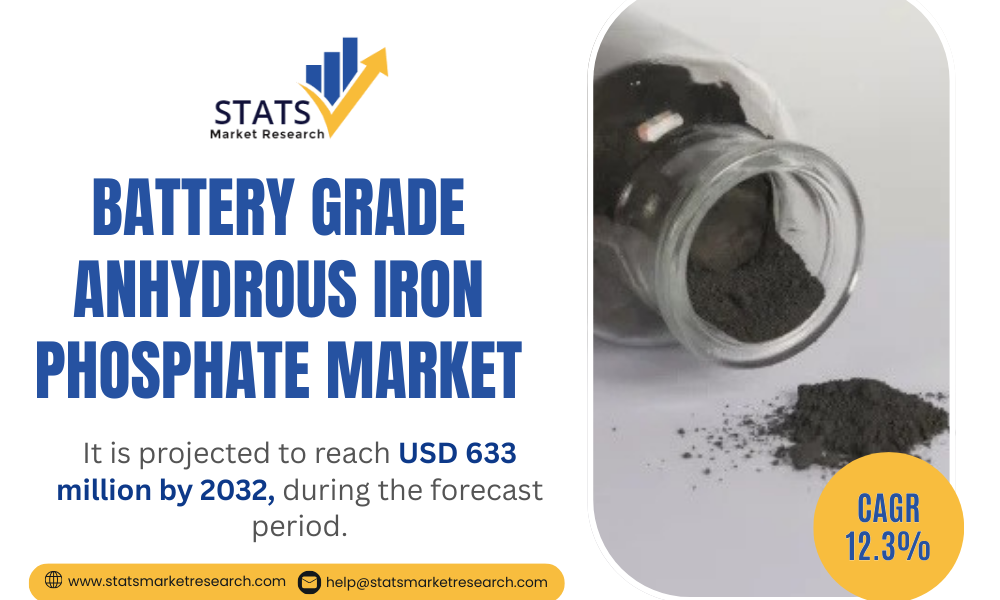
Global Battery Grade Anhydrous Iron Phosphate market was valued at USD 286 million in 2024 and is projected to grow from USD 320 million in 2025 to USD 633 million by 2032, exhibiting a CAGR of 12.3% during the forecast period.
Download FREE Sample of this Report @ https://www.statsmarketresearch.com/download-free-sample/8060116/global-battery-grade-anhydrous-iron-phosphate-forecast-market
Key Insights:
- Rapid EV adoption: EV sales surpassed 10 million units globally in 2024, with LFP batteries capturing over 60% market share in China.
- Energy storage growth: ESS installations are increasing at ~30% annually, driving demand for high-performance cathode materials.
- Geographic concentration: China dominates production capacity with over 60% of global output, while North America and Europe are scaling up to reduce import dependency.
- Technological progress: Nanoscale FePO₄ with particle sizes below 100nm enhances battery energy density to ~200Wh/kg, a 15% improvement over conventional cathodes.
Historical trends show consistent growth due to EV penetration and energy storage adoption, with projections indicating that battery-grade FePO₄ demand will double by 2032, driven by both volume growth and performance optimization requirements.
Market Dynamics
Drivers
Rising Demand for LFP Batteries:
- Global transition to sustainable energy fuels demand for LFP batteries in EVs and ESS.
- LFP batteries are preferred due to:
- Superior thermal stability
- Longer lifespan (2000+ cycles)
- Lower production costs compared to nickel-based chemistries
Government Policies and Incentives:
- U.S. Inflation Reduction Act ($369 billion clean energy package) encourages domestic battery material production.
- China’s 14th Five-Year Plan targets a 300% increase in LFP production capacity by 2025.
- Europe is investing in localized production facilities to secure supply chains.
Technological Advancements:
- Nanoscale FePO₄ synthesis improves dispersibility, purity (>99.9%), and energy density.
- Coating and doping methods expand application in high-performance EV batteries and grid storage systems.
Restraints
High Production Costs:
- Energy-intensive processes, especially high-temperature calcination (~800°C), increase costs 20–30% above conventional materials.
- Strict impurity limits for raw materials, such as sodium and sulfur below 50ppm, raise manufacturing complexity.
Supply Chain Vulnerabilities:
- Over 75% of global phosphate rock production is concentrated in five countries.
- Trade restrictions and geopolitical factors lead to price fluctuations (up to 40%) in battery-grade phosphoric acid.
Competition from Alternative Chemistries:
- Nickel-rich NMC batteries offer higher energy density (>250Wh/kg) for premium EVs.
- Sodium-ion batteries could reduce costs by 30–40%, posing competitive pressure.
Opportunities
Grid-Scale Energy Storage:
- Global energy storage capacity is projected to exceed 1,000GWh by 2030.
- LFP batteries demonstrate long cycle life (15–20 years) and high safety standards, capturing ~40% of projected FePO₄ demand.
Localized Production Ecosystems:
- U.S. and Europe planning $20 billion+ investments in LFP material facilities.
- Reduced logistics costs (~5–8% of delivered price) and access to government incentives favor local production.
Recycling and Circular Economy:
- Hydrometallurgical processes recover >95% of lithium and iron from spent batteries.
- Recycled FePO₄ reduces carbon footprint by 60–70% compared to virgin materials.
- Closed-loop systems could supply up to 30% of total demand by 2030.
Challenges
Stringent Quality Control:
- Particle size must remain within ±5% of specifications, with trace metal impurities <10ppm.
- High rejection rates (~15–20%) during production ramp-ups increase operational costs.
Intellectual Property Barriers:
- 500+ LFP cathode material patents filed in 2024.
- New entrants face licensing, litigation, and development constraints.
Lithium Price Volatility:
- Lithium carbonate prices have fluctuated 300% in three years, impacting LFP cost advantage.
- Producers must implement raw material hedging and alternative sourcing strategies.
Regional Analysis
Asia-Pacific:
- China dominates production (~60% global output).
- EV and ESS adoption is driving nanoscale FePO₄ demand.
North America:
- Government incentives under IRA foster domestic production.
- EV and grid storage growth create localized demand for FePO₄.
Europe:
- Investments in LFP battery material facilities to reduce import reliance.
- Renewable energy adoption fuels ESS demand.
Latin America & Middle East/Africa:
- Emerging opportunities in industrial and EV segments.
- Supply chain investments expected to increase market penetration.
Competitor Analysis
The market is moderately consolidated, with top players controlling a significant share and differentiating through technology, capacity expansion, and strategic partnerships.
- Baichuan New Material Co., Ltd. (China): Vertically integrated, focuses on nanoscale material for high-performance batteries.
- Guizhou Phosphate Group Co., Ltd. (China): Access to phosphate resources ensures cost advantage and production scale.
- Wanrun New Energy Technology Co., Ltd. (China): Expanded 50,000-ton facility to meet EV demand.
- Hebei Anerzhe New Energy Materials Co., Ltd. (China): Proprietary synthesis methods improve particle uniformity.
- Jinmao Titanium Industry Co., Ltd. (China): Strategic mergers integrating cathode and FePO₄ production.
- Hunan Yuneng New Energy Materials Co., Ltd. (China): Secured long-term supply contracts with major battery producers.
Get the Complete Report & TOC @ https://www.statsmarketresearch.com/global-battery-grade-anhydrous-iron-phosphate-forecast-market-8060116
Global Battery Grade Anhydrous Iron Phosphate: Market Segmentation Analysis
This report provides a deep insight into the global Battery Grade Anhydrous Iron Phosphate market, covering all its essential aspects. This ranges from a macro overview of the market to micro details of the market size, competitive landscape, development trend, niche market, key market drivers and challenges, SWOT analysis, value chain analysis, etc.
The analysis helps the reader to shape the competition within the industries and strategies for the competitive environment to enhance the potential profit. Furthermore, it provides a simple framework for evaluating and assessing the position of the business organization. The report structure also focuses on the competitive landscape of the Global Battery Grade Anhydrous Iron Phosphate. This report introduces in detail the market share, market performance, product situation, operation situation, etc., of the main players, which helps the readers in the industry to identify the main competitors and deeply understand the competition pattern of the market.
In a word, this report is a must-read for industry players, investors, researchers, consultants, business strategists, and all those who have any kind of stake or are planning to foray into the Battery Grade Anhydrous Iron Phosphate market in any manner.
Market Segmentation (by Application)
- Automobile
- Consumer Electronics
- Energy Storage Systems
- Industrial
- Others
Market Segmentation (by Type)
- Nanoscale
- Sol-gel synthesized
- Hydrothermal synthesis
- Others
- Microscale
- Solid-state reaction
- Co-precipitation method
- Others
Key Company
- Baichuan New Material Co., Ltd. (China)
- Guizhou Phosphate Group Co., Ltd. (China)
- Wanrun New Energy Technology Co., Ltd. (China)
- Hebei Anerzhe New Energy Materials Co., Ltd. (China)
- Jinmao Titanium Industry Co., Ltd. (China)
- Hunan Yuneng New Energy Materials Co., Ltd. (China)
- Hubei Yunxiang Juneng New Energy Technology Co., Ltd. (China)
- Shandong Xindongneng Lithium Battery Technology Co., Ltd. (China)
Geographic Segmentation
- North America
- Europe
- Asia-Pacific
- Latin America
- Middle East & Africa
FAQ
Q1: What is the current market size of Battery Grade Anhydrous Iron Phosphate?
A1: The market was valued at USD 286 million in 2024 and is projected to reach USD 633 million by 2032, growing at a CAGR of 12.3%.
Q2: Which are the key companies operating in the Battery Grade Anhydrous Iron Phosphate market?
A2: Key companies include Baichuan New Material, Guizhou Phosphate Group, Wanrun New Energy, Hebei Anerzhe, Jinmao Titanium, Hunan Yuneng, Hubei Yunxiang Juneng, and Shandong Xindongneng.
About Us
☎️ International: +1 (332) 2424 294
📄 Website: www.statsmarketresearch.com
Join us on LinkedIn:- https://www.linkedin.com/company/statsmarketresearch




