
Bakery Ingredients Market Outlook
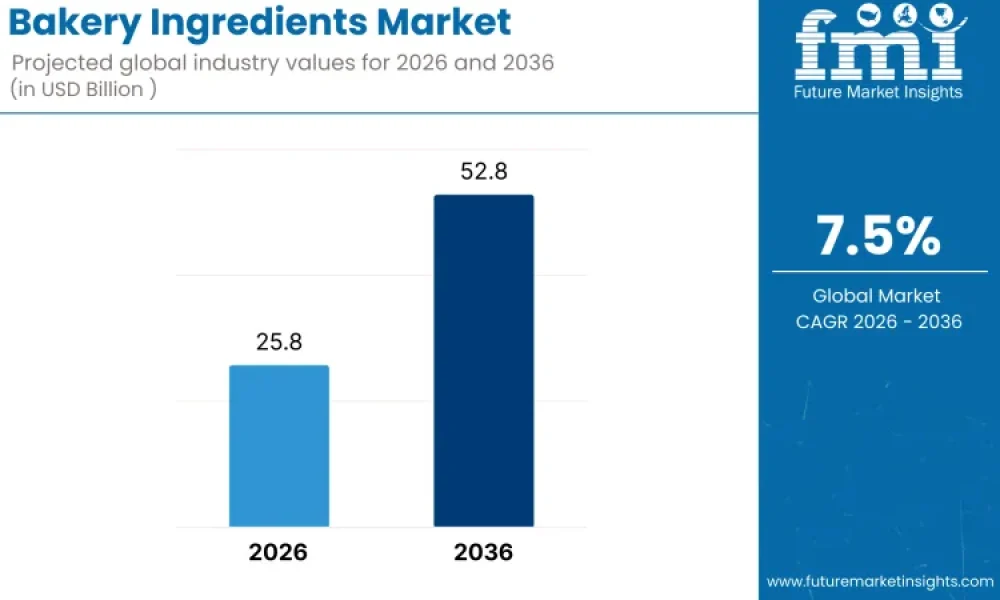
The global bakery ingredients market is entering a high-growth phase as food manufacturers and commercial bakeries accelerate adoption of advanced formulation technologies aligned with clean-label, quality, and efficiency requirements. Valued at USD 25.8 billion in 2026, the market is projected to reach USD 52.8 billion by 2036, expanding at a robust compound annual growth rate (CAGR) of 7.5% over the forecast period.
This expansion reflects structural changes across global baking ecosystems. Industrial bakeries, retail chains, and foodservice operators are increasingly focused on consistency, shelf-life performance, nutritional enhancement, and scalable production—factors that elevate the strategic importance of functional bakery ingredients.
Formulation Innovation Shapes Market Demand
Bakery ingredients are no longer viewed as basic inputs. They now function as performance-enabling systems that directly influence texture, volume, freshness, machinability, and consumer appeal. As baking operations scale and automate, ingredient reliability and compatibility with high-speed production lines have become critical selection criteria.
Dry forms dominate global usage due to their operational advantages in commercial baking environments. Extended shelf life, simplified logistics, and flexible application across multiple product categories make dry ingredients the preferred choice for manufacturers managing high-volume output across distributed facilities.
Request for Sample Report | Customize Report | Purchase Full Report – https://www.futuremarketinsights.com/reports/brochure/rep-gb-416
Market Snapshot
- Market Value (2026): USD 25.8 billion
- Forecast Value (2036): USD 52.8 billion
- Forecast CAGR (2026–2036):5%
- Leading Form Segment: Dry ingredients
- Leading Application Segment: Bread
- High-Growth Regions: North America, Europe, Asia Pacific
Emulsifiers Anchor Ingredient Demand
Among ingredient types, emulsifiers account for 28.7% of global market share, underscoring their central role in modern baking operations. Emulsifiers enable stable blending of water and fats, delivering uniform doughs and batters while improving volume, crumb structure, and softness in finished products.
Their functionality also enhances machinability, making them indispensable in automated, high-speed baking lines. As manufacturers seek cost-effective ways to extend shelf life without compromising quality, emulsifiers remain a core component of commercial bakery formulations.
Enzymes, fibers, starches, and specialty fats also maintain strong demand, particularly as bakeries develop cleaner labels, reduced-sugar profiles, and fiber-enriched products to meet evolving consumer health expectations.
Bread Applications Drive Volume Stability
By application, bread accounts for 42.1% of global demand, reflecting its role as a staple food category across developed and emerging markets. Bread production requires standardized ingredient performance to ensure consistency across batches, regions, and distribution channels.
While cakes, pastries, cookies, and biscuits support premium and specialty segments, bread remains the volume anchor for bakery ingredient suppliers, particularly in industrial and retail baking operations where scale, efficiency, and cost control are paramount.
Automation and Health Trends Reshape Adoption
Two converging trends are reshaping bakery ingredient adoption globally. First, food manufacturing automation is driving demand for ingredient systems that perform consistently across advanced production environments. Ingredient suppliers increasingly align formulations with digital monitoring platforms, quality assurance systems, and automated mixing and baking equipment.
Second, consumer health awareness is influencing ingredient selection. Demand is rising for fiber enrichment, clean-label emulsifiers, reduced-additive systems, and transparent labeling. Bakery ingredients now support nutritional positioning alongside functional performance, expanding their role in product differentiation.
Regulation, Cost, and Scalability Considerations
Food safety regulations, labeling requirements, and additive approvals significantly influence ingredient adoption strategies. Manufacturers must balance investment in advanced ingredient technologies with compliance costs and production infrastructure compatibility.
Scalability remains a key challenge, particularly in cost-sensitive markets where ingredient pricing affects retail affordability. As a result, suppliers focus on delivering multifunctional ingredients that reduce formulation complexity while maintaining performance and compliance standards.
Country-Level Growth Highlights
Growth dynamics vary across regions, shaped by urbanization, retail expansion, and evolving food consumption patterns:
- India:2% CAGR, driven by urbanization, organized retail growth, and packaged bakery consumption
- China:8% CAGR, supported by expanding bakery culture and premium product adoption
- Brazil:8% CAGR, reflecting retail modernization and industrial baking expansion
- France:3% CAGR, anchored in artisanal baking innovation and premium formulations
- USA:1% CAGR, driven by clean-label demand and specialty bakery development
Competitive Landscape Focuses on Functionality and Scale
The bakery ingredients market remains highly competitive, with global players emphasizing formulation science, supply chain reliability, and regulatory expertise. Leading companies include Cargill Inc., Archer Daniels Midland Company, DuPont de Nemours Inc., Ingredion Incorporated, and Tate & Lyle PLC, alongside regional and specialty ingredient providers.
Competition increasingly centers on delivering scalable, health-aligned ingredient systems that integrate seamlessly into automated baking environments while supporting clean-label and quality differentiation strategies.
Outlook
From 2026 to 2036, the global bakery ingredients market will continue evolving from commodity-driven supply toward technology-enabled formulation solutions. As bakeries balance efficiency, health positioning, and consistency across expanding product portfolios, demand for advanced bakery ingredients is expected to remain strong. Supported by automation, urban food demand, and clean-label momentum, the market is positioned for sustained, innovation-led growth over the next decade.
About Future Market Insights (FMI)
Future Market Insights, Inc. (FMI) is an ESOMAR-certified, ISO 9001:2015 market research and consulting organization, trusted by Fortune 500 clients and global enterprises. With operations in the U.S., UK, India, and Dubai, FMI provides data-backed insights and strategic intelligence across 30+ industries and 1,200 markets worldwide.
Contact Us:
Future Market Insights Inc.
Christiana Corporate, 200 Continental Drive,
Suite 401, Newark, Delaware – 19713, USA
T: +1-347-918-3531
For Sales Enquiries: [email protected]



