
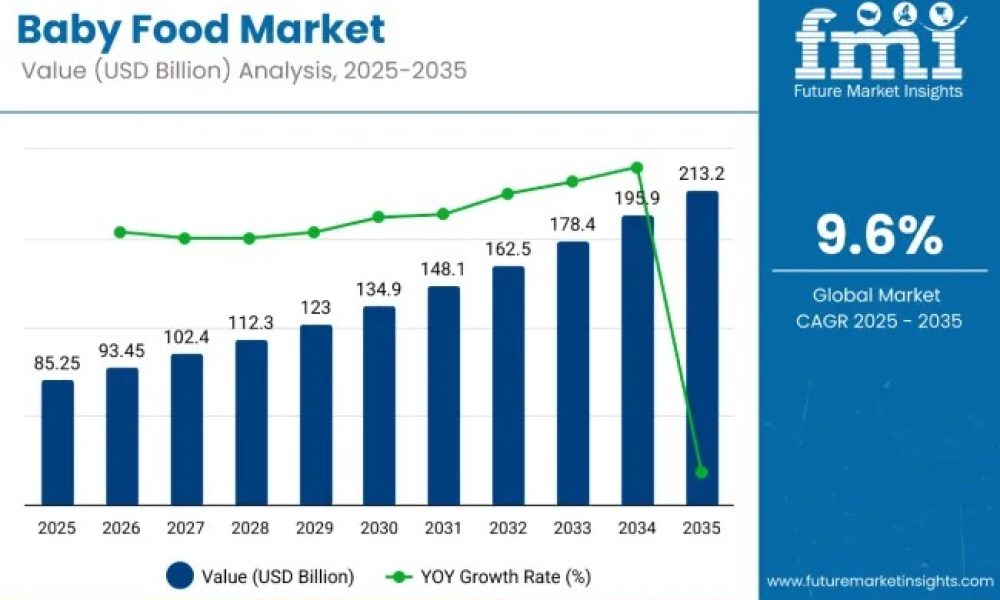
The global baby food market is on a strong upward trajectory, projected to surge from USD 85.25 billion in 2025 to USD 213.21 billion by 2035, registering a 9.6% CAGR. Demand is accelerating as formulations evolve from basic nutrition to clinical-grade infant feeding solutions, influenced by tighter pediatric guidelines across Asia-Pacific and the European Union. By 2035, specialized products for infants aged 0–24 months are expected to retain leadership, supported by growing clinical adoption.
Growing regulatory scrutiny, combined with rising parental awareness, is reshaping ingredient standards, pushing global players to strengthen traceability, nutrient precision, and toxicology controls. This shift is promoting investments in wet-blending systems, enzymatic hydrolysis, and protein-stabilization technologies for clinically sensitive formulations.
Explore trends before investing – request a sample report today! https://www.futuremarketinsights.com/reports/sample/rep-gb-4777
Quick Market Snapshot
- Market Value (2025): USD 85.25 billion
- Forecast Value (2035): USD 213.21 billion
- CAGR (2025–2035): 9.6%
- Top-Growing Country: Australia (11.3% CAGR)
- Leading Product Segment: 0–24 months special milk formula
Investment Hotspots: Formula, Retail, Flavour, and Packaging
Growth concentration in 2025 is highest across special milk formulas, supermarkets, unflavoured variants, and bag-in-box packaging systems.
Special Milk Formula – 18.2% Market Share (2025)
This segment benefits from prescription mandates and hospital-based feeding protocols. Key differentiators include:
- DHA & ARA inclusion for neurodevelopment
- Pharmaceutical-grade cold chain compatibility
- Strict lot coding for batch traceability
- Compliance with Codex nutrient thresholds
Supermarkets – 32.8% Sales Share (2025)
Wider product availability, end-cap infant sections, real-time electronic shelf labels, and efficient click-and-collect lanes make supermarkets the largest distribution channel.
Unflavoured Variants – 40% Share (2025)
Minimal additive use simplifies compliance and lowers heavy-metal risk, with single-ingredient purées preferred during feeding transitions.
Bag-in-Box Packaging – 35% Share (2025)
Nitrogen-flushed liners and pallet-efficient designs enhance storage stability and export suitability.
Global Leaders: Australia, Germany, and the United States Set the Pace
- Australia (11.3% CAGR): Stringent FSANZ controls and dual export certifications drive premium-grade production.
- Germany (10.4% CAGR): Elevated lactose, pesticide, and sweetener regulations fuel non-GMO and biodynamic adoption.
- United States (9.3% CAGR): FDA’s Closer to Zero program accelerates reformulation and builds trust through tighter metal thresholds.
- India (8.2% CAGR): Nutrition programs like POSHAN Abhiyaan strengthen rural penetration and institutional procurement.
- China (7.5% CAGR): QR-led traceability frameworks and Free Trade Zone fast lanes support import and domestic innovation.
Certification, Compliance, and Traceability Tighten Market Controls
National regulatory bodies—FDA (U.S.), EFSA (EU), FSSAI (India)—continue enforcing stricter norms on infant food composition, contaminants, and labelling. Compliance trends include:
- Mandatory allergen and nutrient disclosure
- Adoption of ISO 22000 food safety systems
- Increased use of digital traceability platforms (TraceOne, iFoodDS)
- Organic certifications (USDA, EU Organic, India Organic) rising across premium lines
These controls are prompting companies to introduce cleaner ingredient lists, with retailers in Germany and France already using independent labs before approving new SKUs.
Per Capita Spending Trends
Developed economies exhibit significantly higher per capita spending due to strong brand trust, busy lifestyles, and preference for organic and fortified products. Meanwhile, developing markets such as India, Indonesia, and Brazil are witnessing steady growth driven by urbanization and rising awareness of evidence-based infant nutrition.
Subscribe for Year-Round Insights → Stay ahead with quarterly and annual data updates – https://www.futuremarketinsights.com/checkout/4777
Competitive Landscape
The market remains moderately fragmented with a healthy blend of global giants and fast-growing specialized brands. Key participants include: Nestlé, Abbott, Danone, Anand Milk Union Limited, Mead Johnson Nutrition India/Reckitt Benckiser, Manna Foods, Pristine, Mighty Steps, The Great Banyan, Tiny Spoons, Nurture Inc., Heinz, Hain Celestial, Hero Group, Ella’s Kitchen, Plum Organics, Sprout, and others.
Recent developments include:
- Nestlé India launching 14 sugar-free Cerelac variants.
- Danone India introducing AptaGrow with 37 nutrients and prebiotics.
- Manna Foods expanding its natural, sprouted ragi-based baby snacks.
About Future Market Insights (FMI)
Future Market Insights, Inc. (FMI) is an ESOMAR-certified, ISO 9001:2015 market research and consulting organization, trusted by Fortune 500 clients and global enterprises. With operations in the U.S., UK, India, and Dubai, FMI provides data-backed insights and strategic intelligence across 30+ industries and 1200 markets worldwide.



