
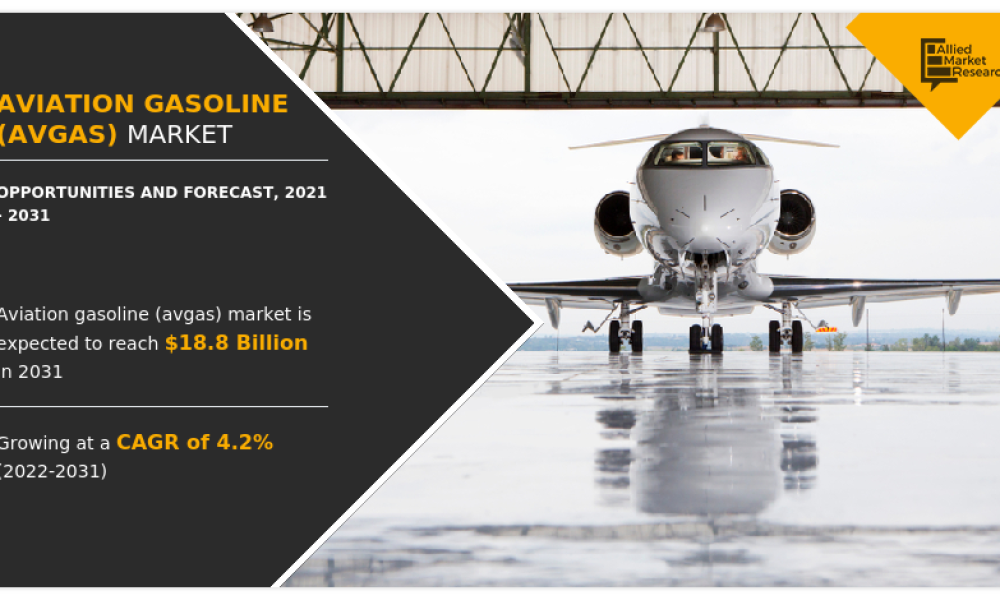
According to a new report published by Allied Market Research, titled, “Aviation Gasoline Market,” The aviation gasoline (avgas) market size was valued at $12.5 billion in 2021, and aviation gasoline (avgas) industry is estimated to reach $18.8 billion by 2031, growing at a CAGR of 4.2% from 2022 to 2031.
Avgas (aviation gasoline) is a specialized fuel designed for aircraft equipped with spark-ignited internal combustion engines. It differs from conventional motor gasoline—commonly referred to as “mogas” in aviation contexts—which is used in ground vehicles. Avgas is primarily utilized by a range of aircraft, including many military and smaller commercial planes, due to its ability to enhance fuel efficiency and reduce operational costs. As the aviation industry continues to expand, competition among avgas producers is intensifying across all sectors to meet the growing demand.
Download PDF Brochure: https://www.alliedmarketresearch.com/request-sample/A17118
The demand for efficient, cost-effective military-grade aviation fuel is rising as nations continue to strengthen their military capabilities. Simultaneously, increasing disposable incomes and a booming global tourism industry have led to higher air travel volumes, driving the demand for aviation gasoline. The market is further supported by the launch of new flight routes and substantial government investments in airport infrastructure development, both of which enhance accessibility and expand air travel networks.
However, market growth faces challenges due to fluctuating crude oil prices and growing concerns over carbon emissions, which have prompted stricter environmental regulations. In addition, the emergence of Sustainable Aviation Fuel (SAF)—produced from renewable sources such as used cooking oils, agricultural residues, and municipal solid waste—poses a competitive threat to conventional aviation gasoline, potentially limiting its future demand.
The aviation gasoline market is witnessing significant growth due to increased demand from the defense sector, which requires high-performance, low-cost fuel for military aircraft operations. Moreover, the surge in global air travel, driven by rising incomes and a rapidly expanding tourism industry, is creating a greater need for piston-engine aircraft, particularly in general aviation and regional connectivity, further stimulating demand for avgas.
Infrastructure developments such as new airport constructions and the introduction of additional flight routes are also propelling the market forward. These initiatives, often backed by government funding, aim to improve air travel accessibility and capacity, particularly in emerging economies. As aviation networks grow and expand into previously underserved regions, the requirement for reliable aviation gasoline supply is expected to increase, supporting sustained market expansion in the coming years.
For Purchase Inquiry: https://www.alliedmarketresearch.com/purchase-enquiry/A17118
The aviation gasoline market forecast is segmented on the basis of grade type, aircraft type, application, and region. Depending on grade type, it is divided into Avgas 100, Avgas 100 LL, and others. By aircraft type, the market is classified into fixed wings, rotorcraft, and others. Fixed wings market dominated the aviation gasoline market share in 2021 and is expected to remain dominant during the forecast period. By application, the market is categorized into civil, military, sports & recreational, and others. Region wise, the market is analyzed across North America, Europe, Asia-Pacific, and LAMEA.
The aviation gasoline market exhibits diverse regional dynamics driven by varying levels of aviation activity and infrastructure development. North America dominates the market due to its well-established general aviation sector, extensive military operations, and robust regulatory framework supporting aviation fuel use. Europe follows closely, benefiting from a strong network of small airports and private aviation activities. The Asia-Pacific region is witnessing rapid growth fueled by increasing demand for private and commercial aviation, especially in countries like China and India. Meanwhile, regions such as Latin America, the Middle East, and Africa are emerging markets with growing investments in aviation infrastructure, presenting significant opportunities for market expansion in the coming years.
The major companies profiled in this report include ExxonMobil Corporation, Shell plc, BP plc, TotalEnergies SE, Repsol S.A., Vitol Group, Phillips 66, Indian Oil Corporation Limited, Naftal, Hjelmco Oil AB, Chevron Corporation, Oman Oil Corporation SAOC, Sinopec Corp, Gazprom, and Sasol Limited. Rapidly industrialization, modernization, and spread of information through internet have led to the development of tourism industry which in-turn has fuelled the demand for aviation gasoline. Additional growth strategies such as expansion of production capacities, acquisition, partnership, and research & innovation in the application of unleaded aviation gasoline have led to attain key developments in the global aviation gasoline market trends.
The report provides a detailed analysis of these key players in the global Aviation Gasoline industry. These players have adopted different strategies such as new product launches, collaborations, expansion, joint ventures, and agreements to increase their market share and maintain dominant shares in different regions. The report is valuable in highlighting business performance, operating segments, product portfolio, and strategic moves of market players to highlight the competitive scenario.
Key findings of the study
- As per aviation gasoline (avgas) market analysis, North America is anticipated to exhibit CAGR of 13.2% during 2022-2031.
- As per global aviation gasoline market analysis, by grade type, the Avgas 100 segment accounted for the largest share in 2021.
- By aircraft type, fixed wings aviation gasoline was the leading segment in 2021.
- By application, civil segment was the highest revenue contributor in 2021.




