
Definition
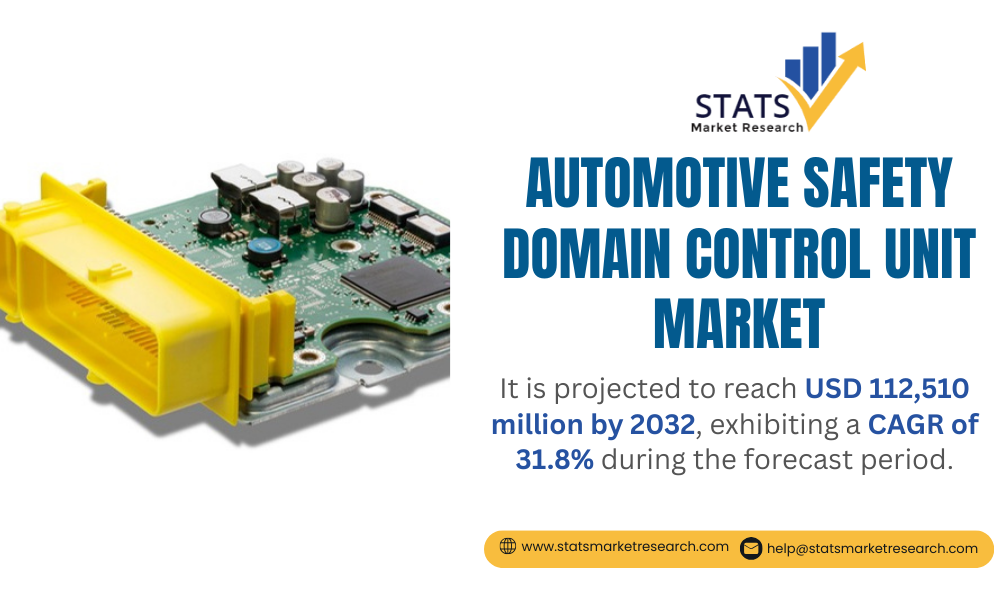
Automotive Safety Domain Control Units (DCUs) are advanced computing systems that go beyond the functionality of traditional Electronic Control Units (ECUs) by consolidating safety-related processes into centralized platforms. Unlike conventional ECUs, which manage specific tasks independently, DCUs serve as the computational backbone of modern vehicles, integrating multiple safety functions such as autonomous driving, advanced driver-assistance systems (ADAS), and cockpit control. They enable real-time decision-making by processing vast amounts of sensor data from cameras, radar, LiDAR, and vehicle-to-everything (V2X) communication systems. This ensures precise control of vehicle dynamics, hazard detection, and passenger protection, making them essential components in the evolution of software-defined vehicles.
Two primary types dominate the market: Autonomous Driving DCUs (holding 93% of market share) and Cockpit DCUs, which enhance in-cabin safety and digital experiences. By providing centralized safety intelligence, DCUs reduce system complexity, wiring requirements, and vehicle weight, while improving reliability and scalability of safety-critical applications.
Recent Developments in the Automotive Safety Domain Control Unit Market
The Automotive Safety Domain Control Unit (SDCU) market is evolving rapidly, driven by the push for advanced driver-assistance systems (ADAS) and autonomous vehicles. A major development is the shift from a distributed architecture with multiple, single-function Electronic Control Units (ECUs) to a centralized, zonal architecture. This consolidation into SDCUs reduces vehicle complexity, weight, and wiring, while also enabling more efficient over-the-air (OTA) software updates. These advanced units are integrating artificial intelligence (AI) and machine learning to process massive amounts of data from various sensors—like radar, LiDAR, and cameras—for real-time decision-making, improving the vehicle’s ability to perceive and react to its environment. The market is also seeing a greater emphasis on functional safety (e.g., ASIL compliance) and cybersecurity to protect these complex, interconnected systems from threats.
Major Distribution for Automotive Safety Domain Control Units
The distribution of Automotive SDCUs is almost exclusively a business-to-business (B2B) model. The primary customers are Original Equipment Manufacturers (OEMs), which are the car manufacturers themselves. These companies source SDCUs from major Tier-1 automotive suppliers, who are the key players in the market. The distribution channels are characterized by direct sales and strong, long-term partnerships between suppliers and OEMs. The aftermarket is a smaller segment for distribution, but most of the market is driven by new vehicle production. The market is concentrated in regions with high EV and autonomous vehicle production, particularly Europe, North America, and the Asia-Pacific region, with China emerging as a significant hub for both production and adoption.
Market Size
Global Automotive Safety Domain Control Unit Market was valued at USD 16,960 million in 2024 and is projected to grow to USD 22,140 million in 2025, ultimately reaching USD 112,510 million by 2032. This represents an extraordinary CAGR of 31.8% during the forecast period.
This rapid growth is fueled by several key factors: stringent global safety regulations, surging consumer demand for ADAS, rising adoption of autonomous driving technologies, and the automotive industry’s transition to centralized electronic and electrical (E/E) architectures. Passenger vehicles remain the largest application segment, accounting for 95% of global demand, while commercial vehicles are witnessing increased adoption due to rising safety mandates in logistics and fleet operations.
From a regional perspective, Europe dominates the market with 40% share, followed by Asia-Pacific (30%) and North America (28%), reflecting the concentration of safety regulations, premium automakers, and technological innovation hubs in these regions. The rise of electric vehicles (EVs) and hybrid platforms further strengthens market expansion, as these platforms are built with centralized architectures that are highly compatible with safety DCUs.
Download FREE Sample of this Report @ https://www.statsmarketresearch.com/download-free-sample/8058752/global-automotive-safety-domain-control-unit-forecast-market
Market Dynamics (Drivers, Restraints, Opportunities, and Challenges)
Drivers
Rising Demand for Autonomous Vehicles
Autonomous Driving DCUs are the cornerstone of vehicle automation, holding 93% of global DCU share. With OEMs and tech firms investing heavily in autonomy, global development budgets for self-driving technologies have increased by 42% year-over-year since 2020. As vehicles transition toward SAE Levels 3-5 automation, safety DCUs that integrate and process data in real time become indispensable.
Stringent Safety Regulations
Policies such as the European Union’s General Safety Regulation (2024), mandating lane-keeping, intelligent speed assistance, and autonomous emergency braking, are driving DCU adoption. Euro NCAP’s upcoming requirement for V2X communication from 2025 is expected to further accelerate demand.
Restraints
High Development Costs
Developing ASIL-D compliant systems (the highest Automotive Safety Integrity Level) requires investments exceeding $50 million, with timelines stretching 3–5 years. This limits participation to large Tier-1 suppliers and advanced technology firms.
Integration Complexities
Modern DCUs must manage deterministic performance across multiple safety-critical domains, integrating dozens of sensors under extreme environmental conditions, which increases design and testing costs.
Opportunities
Emerging Markets & EV Platforms
The electrification wave, with EVs expected to make up 30% of global car sales by 2030, presents greenfield opportunities for DCU adoption. Centralized architectures in EVs provide ideal conditions for domain controllers, and subscription-based ADAS features are unlocking recurring revenue streams.
Software-Defined Vehicles (SDVs)
DCUs enable over-the-air (OTA) updates for continuous safety improvements. This is paving the way for new business models, including safety feature subscriptions, positioning DCU providers to generate long-term recurring revenues.
Challenges
Supply Chain Constraints
Semiconductor shortages have extended processor lead times beyond 12 months in some cases, affecting DCU production schedules.
Cybersecurity Risks
As vehicles integrate with digital ecosystems, cyberattacks on safety-critical systems pose growing risks. Maintaining compliance with both safety and cybersecurity standards (e.g., UN R155) is complex and costly.
Talent Shortage
The industry faces a shortage of engineers with expertise in real-time systems, functional safety, and AI integration, potentially slowing adoption.
Regional Analysis
Europe (40% share) – Europe leads due to strict safety mandates, advanced testing standards, and the presence of global OEMs like BMW, Daimler, and Volkswagen. Euro NCAP safety rating requirements and General Safety Regulations are making Europe the most mature market for safety DCUs.
Asia-Pacific (30% share) – China, Japan, and South Korea are key growth hubs. China’s rapid adoption of ADAS and state support for autonomous driving technologies have enabled domestic players like Desay SV and Neusoft Reach to grow rapidly.
North America (28% share) – Strong contributions from the U.S. automotive sector, where companies like Tesla and tech firms such as NVIDIA and Qualcomm are integrating AI-driven DCUs for autonomous driving.
Rest of the World (2% share) – Emerging markets in Latin America and the Middle East are beginning to adopt safety regulations, though slower infrastructure development hampers rapid DCU penetration.
Competitor Analysis
The market is semi-consolidated with top Tier-1 suppliers leading adoption. Bosch and Continental together command over 35% of global revenue. ZF Friedrichshafen and Aptiv are also strong players, leveraging acquisitions to expand their portfolios. Emerging Chinese firms are reshaping competition with domestic dominance and aggressive international expansion. Meanwhile, tech firms like Tesla and Baidu are pursuing vertically integrated solutions, challenging traditional suppliers.
Key competitive trends include:
- Increased OEM-tech collaboration for hardware-software integration.
- Stronger focus on cybersecurity as a differentiator.
- Transition toward zonal architectures, reducing the need for multiple DCUs per vehicle.
Global Automotive Safety Domain Control Unit Market: Segmentation Analysis
This report provides a deep insight into the global Automotive Safety Domain Control Unit market, covering all its essential aspects. This ranges from a macro overview of the market to micro details of the market size, competitive landscape, development trend, niche market, key market drivers and challenges, SWOT analysis, value chain analysis, etc.
The analysis helps the reader to shape the competition within the industries and strategies for the competitive environment to enhance the potential profit. Furthermore, it provides a simple framework for evaluating and assessing the position of the business organization. The report structure also focuses on the competitive landscape of the Global Automotive Safety Domain Control Unit Market. This report introduces in detail the market share, market performance, product situation, operation situation, etc., of the main players, which helps the readers in the industry to identify the main competitors and deeply understand the competition pattern of the market.
In a word, this report is a must-read for industry players, investors, researchers, consultants, business strategists, and all those who have any kind of stake or are planning to foray into the Automotive Safety Domain Control Unit Market in any manner.
Market Segmentation (by Application)
- Passenger Vehicle
- Commercial Vehicle
Market Segmentation (by Type)
- Autonomous Driving DCU
- Cockpit DCU
Key Company
- Robert Bosch GmbH (Germany)
- Continental AG (Germany)
- ZF Friedrichshafen AG (Germany)
- Aptiv PLC (Ireland)
- Visteon Corporation (U.S.)
- Desay SV Automotive (China)
- Neusoft Reach (China)
- Magna International (Canada)
- Tttech Auto (Austria)
- Veoneer (Sweden)
- Baidu Apollo (China)
- Tesla AD Platform (U.S.)
- Hirain Technologies (China)
- iMotion (China)
Get the Complete Report & TOC @ https://www.statsmarketresearch.com/global-automotive-safety-domain-control-unit-forecast-market-8058752
Geographic Segmentation
- Europe
- Asia-Pacific
- North America
- Rest of the World
FAQ
What is the current market size of the Automotive Safety Domain Control Unit Market?
The global market size was valued at USD 16,960 million in 2024 and is projected to reach USD 112,510 million by 2032, growing at a CAGR of 31.8%.
Which are the key companies operating in the Automotive Safety Domain Control Unit Market?
Major players include Bosch, Continental, ZF Friedrichshafen, Aptiv, Visteon, Desay SV, Neusoft Reach, Magna International, Baidu Apollo, Tesla AD Platform, Veoneer, and others.
What are the key growth drivers in the Automotive Safety Domain Control Unit Market?
The main drivers are rising demand for autonomous driving, strict safety regulations (EU, NCAP, etc.), and the transition toward centralized vehicle architectures.
Which regions dominate the Automotive Safety Domain Control Unit Market?
Europe leads with 40% share, followed by Asia-Pacific (30%) and North America (28%).
What are the emerging trends in the Automotive Safety Domain Control Unit Market?
Key trends include cybersecurity integration, software-defined vehicles with OTA updates, zonal architecture adoption, and partnerships between OEMs and tech firms for advanced AI-driven DCUs.
About Us
☎️ International: +1 (332) 2424 294
📄 Website: www.statsmarketresearch.com
Join us on LinkedIn:- https://www.linkedin.com/company/statsmarketresearch




