
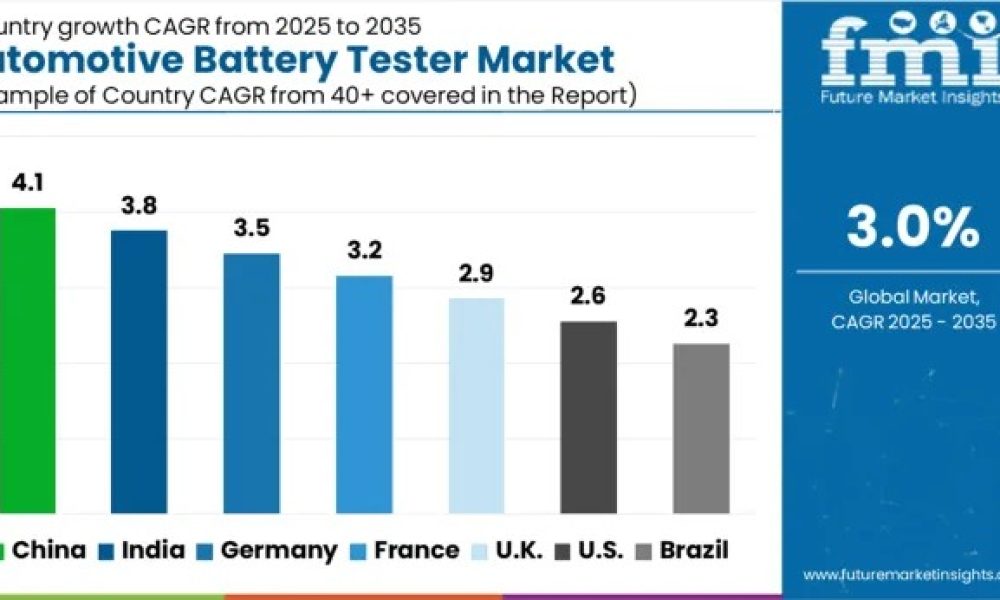
The automotive battery tester market represents a steady yet strategic growth segment within the global automotive diagnostics and service equipment landscape. With an estimated value of USD 0.9 billion in 2025 and a projected expansion to USD 1.2 billion by 2035, the market is progressing at a moderate CAGR of 3.0%, reflecting a measured but persistent demand for battery health monitoring solutions across passenger, commercial, and electric vehicles. While growth is not explosive, it is underpinned by structural shifts in vehicle electrification, regulatory oversight, and preventive maintenance practices, making battery testers indispensable tools for manufacturers, workshops, and fleet operators alike.
Regional Dynamics Shape Adoption
Regional trends illustrate stark contrasts in market maturity and adoption. Asia-Pacific emerges as the primary growth engine, benefiting from rapid automotive production, strong electrification initiatives, and rising awareness of battery maintenance. China leads the region, capturing over a third of demand with a CAGR of 4.1%, fueled by domestic manufacturers offering portable, smart diagnostic testers compatible with lead-acid and lithium-ion chemistries. India follows closely, growing at 3.8%, driven by two-wheeler electrification, expanding passenger vehicle sales, and fleet maintenance needs.
Europe represents a mature market environment, where high adoption of diagnostic infrastructure, stringent safety regulations, and fleet electrification create stable, moderate growth. Germany, with a 3.5% CAGR, exemplifies the region’s reliance on precision battery diagnostics and multifunctional testers, particularly in EV and hybrid fleet segments. The UK grows more conservatively at 2.9%, reflecting steady deployment in commercial and passenger vehicle service sectors.
Get access to comprehensive data tables and detailed market insights — request your sample report today!
North America exhibits a mixed growth profile, with the USA at 2.6% CAGR. Market expansion is primarily driven by technological upgrades, retrofitting in existing fleets, and regulatory compliance, while slower new vehicle production moderates overall uptake. Across all regions, these differences underscore the need for tailored strategies, from high-volume adoption in Asia-Pacific to innovation-focused service solutions in Europe and North America.
Technology and Application Trends
The simple testers segment, accounting for 41.6% of market revenue in 2025, dominates due to cost-effectiveness, ease of use, and quick diagnostic capability. These devices are particularly valuable in workshops and for individual vehicle owners seeking immediate insights into battery health without complex setup. Meanwhile, OEM applications capture 56.2% of revenue, reflecting the integration of battery testing into production quality assurance and warranty management. The emphasis on delivering vehicles with reliable electrical systems reinforces OEM reliance on advanced battery diagnostics.
The portable mobility segment represents 63.4% of market revenue, highlighting the growing demand for field-deployable solutions. Lightweight, connected testers with digital displays, Bluetooth functionality, and cloud-enabled reporting allow technicians to perform diagnostics in workshops, roadside assistance, and fleet operations efficiently. This mobility-driven adoption trend is critical as maintenance moves beyond centralized service centers, especially for electric and hybrid vehicle fleets.
Drivers and Innovation in the Market
Several factors converge to drive market growth:
- Electrification and Hybrid Adoption: Rising EV and hybrid vehicle production increases reliance on precise battery diagnostics, particularly for high-voltage lithium-ion systems. Fleet operators, commercial transport services, and public transit entities increasingly deploy battery testers to maintain performance and safety standards.
- Preventive Maintenance and Reliability: Workshops and fleet services adopt battery testing as part of routine preventive maintenance to avoid unexpected breakdowns and optimize battery lifecycle, further reinforcing the role of testers in service protocols.
- Technological Advancements: Modern testers now integrate digital interfaces, IoT connectivity, and automated reporting. Multifunctional devices that combine battery, alternator, and starter analysis improve service efficiency while supporting diverse battery chemistries, including lead-acid, lithium-ion, and hybrid modules.
- Regulatory and Compliance Pressures: Global safety and efficiency standards, alongside emission-reduction initiatives, reinforce the need for accurate battery diagnostics, particularly for EVs and hybrid vehicles.
Competitive Landscape
The automotive battery tester market is populated by specialized diagnostic solution providers and integrated service players. Midtronics, Inc. leads with precision battery analysis systems for conventional and hybrid vehicles. Bosch Automotive Service Solutions delivers integrated hardware-software solutions for professional workshops. Companies like Schumacher Electric Corporation and Clore Automotive target small garages and DIY users, balancing affordability with essential diagnostics. Associated Equipment and Autometer Products focus on commercial and heavy-duty vehicles, while IEC and MotoBatt prioritize rapid testing and design innovation. Market competition revolves around accuracy, connectivity, device portability, compatibility with emerging battery chemistries, and after-sales support, positioning technologically advanced and user-centric offerings as key differentiators.
Outlook
The automotive battery tester market is poised for steady, strategically significant growth. As electrification accelerates and vehicle powertrains become increasingly complex, reliable diagnostics will remain central to maintenance, safety, and regulatory compliance. Asia-Pacific will continue to drive volume expansion, while Europe and North America focus on technology integration and fleet management. Innovation in portability, connectivity, and multifunctionality will be the decisive factor for market participants aiming to capture both OEM and aftermarket opportunities, ensuring that battery testing remains a cornerstone of automotive service and performance assurance in the decade ahead.
About Future Market Insights (FMI)
Future Market Insights, Inc. (FMI) is an ESOMAR-certified, ISO 9001:2015 market research and consulting organization, trusted by Fortune 500 clients and global enterprises. With operations in the U.S., UK, India, and Dubai, FMI provides data-backed insights and strategic intelligence across 30+ industries and 1200 markets worldwide.



