
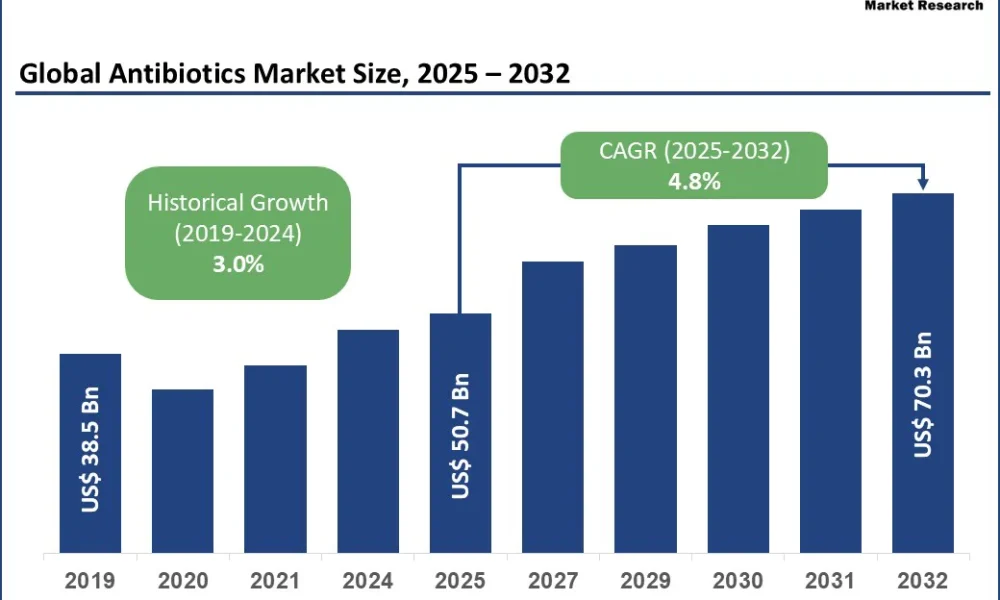
The global antibiotics market is poised for steady growth over the coming decade, reflecting both rising healthcare demands and technological innovations in drug development. As per recent projections, the market is estimated to reach a value of US$ 50.7 billion in 2025, with expectations of climbing to US$ 70.3 billion by 2032, exhibiting a compound annual growth rate (CAGR) of 4.8% between 2025 and 2032. This upward trajectory is underpinned by the increasing prevalence of bacterial infections, the emergence of multidrug-resistant pathogens, and the growing focus on innovative therapeutic solutions. The market’s expansion is further fueled by supportive government policies, proactive antibiotic stewardship programs, and substantial investments in research and development aimed at overcoming antimicrobial resistance (AMR).
Among the different application segments, respiratory tract infections lead the market, commanding approximately 54.2% of revenue share in 2025. This dominance is largely attributable to lingering health impacts of the COVID-19 pandemic, seasonal viral outbreaks, and the rising incidence of chronic respiratory conditions requiring targeted antibiotic interventions. Geographically, North America remains the dominant region, capturing nearly 36% of market share in 2025 due to regulatory incentives such as the Generating Antibiotic Incentives Now (GAIN) Act and mature stewardship frameworks. Conversely, Asia Pacific is projected to be the fastest-growing region, with a CAGR exceeding 7.0% through 2032, driven by a high infectious disease burden, expanding healthcare infrastructure, and proactive government measures in countries like India and China that support both production and consumption of antibiotics.
Download Your Free Sample & Explore Key Insights: https://www.persistencemarketresearch.com/samples/35610
Key Highlights from the Report
• The global antibiotics market is expected to grow from US$ 50.7 billion in 2025 to US$ 70.3 billion by 2032.
• Respiratory tract infections dominate applications, with an estimated 54.2% revenue share in 2025.
• North America leads the market in revenue share due to advanced regulatory frameworks and innovation-friendly policies.
• Asia Pacific is the fastest-growing region, fueled by rising disease prevalence and expanding healthcare access.
• Penicillin remains the leading drug class, holding an estimated 26% market share due to its broad-spectrum efficacy.
• Significant breakthroughs in AI-driven antibiotic discovery and precision therapies are shaping future market trends.
Market Segmentation
The antibiotics market can be segmented based on drug class, application, formulation, and end-user. In terms of drug class, penicillin maintains dominance with around 26% revenue share in 2025, due to its efficacy against a broad range of infections and affordability. Cephalosporins, macrolides, fluoroquinolones, and tetracyclines form other significant segments, with increasing adoption of novel derivatives to combat resistant bacterial strains.
From an application perspective, respiratory tract infections are the leading segment, followed by urinary tract infections, skin and soft tissue infections, gastrointestinal infections, and other systemic infections. The dominance of respiratory infections is reinforced by innovations in inhaled antibiotic formulations and rapid diagnostic tools, improving both efficacy and patient compliance. End-user segmentation spans hospitals, clinics, home care settings, and research institutions. Hospitals remain the largest consumers, reflecting their high patient throughput and treatment of severe, multi-drug-resistant infections. Additionally, the rise of outpatient care and telemedicine has spurred demand for home-administered antibiotic treatments, expanding market reach beyond traditional healthcare facilities.
Regional Insights
North America remains the largest antibiotics market, driven by strong pharmaceutical R&D, favorable reimbursement policies, and well-established stewardship programs. The U.S., in particular, benefits from regulatory frameworks like the GAIN Act, accelerating approval for critical antibiotics such as ceftaroline and delafloxacin. Canada mirrors this trend, emphasizing innovation and broad access to advanced therapies.
In Europe, mature healthcare systems and stringent regulatory oversight shape the market. Germany, France, and the U.K. lead antibiotic consumption, supported by outcome-based procurement strategies and streamlined approval pathways by the European Medicines Agency (EMA). The continent is also witnessing increased adoption of combination therapies and precision antibiotics aimed at tackling multi-drug resistance.
Asia Pacific is the fastest-growing region, with India and China serving as both major producers and consumers of antibiotics. Government initiatives promoting local production, expansion of healthcare infrastructure, and improved insurance coverage are key growth drivers. In addition, national AMR action plans, digital surveillance programs, and community outreach initiatives are ensuring access while controlling resistance levels, positioning the region as a central hub for the global antibiotics market.
Get Custom Insights Designed for Your Business: https://www.persistencemarketresearch.com/request-customization/35610
Market Drivers
A primary driver of market growth is the surge in demand for novel antibiotics due to rising antimicrobial resistance (AMR). Traditional antibiotics are increasingly ineffective against resistant bacterial strains, prompting innovations in broad-spectrum and precision antibiotics. Advances in synthetic biology, AI-driven drug discovery, and precision fermentation are accelerating the development of next-generation antibiotics with improved safety profiles and targeted action mechanisms. Government initiatives and regulatory frameworks supporting antibiotic stewardship further incentivize pharmaceutical companies to invest in research, adaptive drug delivery systems, and formulation innovations. Additionally, the persistent global burden of bacterial infections, highlighted by millions of fatalities annually, underscores the critical need for effective antibiotics, thereby creating sustained market demand.
Market Restraints
Despite promising growth, the antibiotics market faces substantial challenges primarily stemming from stringent regulatory requirements and economic barriers. Agencies like the U.S. FDA and India’s CDSCO impose rigorous clinical trial standards, demanding evidence of safety and efficacy that often extend development timelines and increase costs. For example, drugs like iclaprim, despite extensive phase 3 trials, were rejected due to insufficient effectiveness, illustrating the high-risk nature of antibiotic development. Economic disincentives, coupled with regulatory complexity, delay market entry and reduce incentives for pharmaceutical companies to pursue novel antibiotic candidates, thereby constraining overall market expansion.
Market Opportunities
AI-driven precision antibiotics represent a significant opportunity for market participants. By leveraging machine learning algorithms, pharmaceutical companies can predict bacterial resistance mechanisms, optimize compound efficacy, and streamline R&D timelines. Collaborative licensing and strategic partnerships further accelerate commercialization. Notable initiatives, such as Phare Bio’s AI-powered antibiotic platform supported by ARPA-H funding, aim to develop preclinical candidates and establish open-source databases for antibiotic research. This integration of AI in drug discovery presents a high-value revenue stream while addressing the critical challenge of combating multi-drug-resistant bacterial infections globally.
Checkout Now & Download Complete Market Report: https://www.persistencemarketresearch.com/checkout/35610
Company Insights
• Abbott Laboratories
• AbbVie Inc.
• Armata Pharmaceuticals Inc.
• Aspen Pharmacare Holdings Ltd.
• Astellas Pharma Inc.
• Aurobindo Pharma Ltd.
• Bayer AG
• F. Hoffmann-La Roche Ltd.
• Flynn Pharma Ltd.
• GlaxoSmithKline Plc
• Incepta Pharmaceuticals Ltd.
• Johnson and Johnson Services Inc.
• Lupin Ltd.
• Mayne Pharma Group Ltd.
• Melinta Therapeutics LLC
• Merck KGaA
• Pfizer Inc.
• Sanofi SA
• Takeda Pharmaceutical Co. Ltd.
• Teva Pharmaceutical Industries Ltd.
Recent developments in the antibiotics market highlight ongoing innovation and regulatory milestones. In September 2025, researchers from the University of Pennsylvania utilized the APEX deep learning algorithm to identify over 12,000 antimicrobial peptides, several demonstrating potent in vivo efficacy by targeting bacterial electrical signaling. Additionally, in August 2025, GSK received FDA priority review for its oral antibiotic gepotidacin, aimed at treating drug-resistant gonorrhea, marking a potential first-in-class therapy that could redefine treatment protocols.
Conclusion
The global antibiotics market is poised for significant expansion, driven by rising bacterial infections, technological breakthroughs in drug discovery, and supportive government policies. North America continues to dominate in terms of market share, while Asia Pacific is emerging as the fastest-growing region due to high demand and production capacity. Market growth is supported by innovations in drug classes like penicillin and cephalosporins, targeted applications in respiratory tract infections, and the increasing integration of AI-driven precision therapies. However, challenges such as stringent regulatory frameworks and economic barriers remain significant. Opportunities abound in the development of next-generation antibiotics through AI-enabled platforms, strategic collaborations, and adaptive drug delivery systems, ensuring that the antibiotics market remains both resilient and dynamic through 2032.




