FOR IMMEDIATE RELEASE
Atlas, Minotaur, Vitruvian Man: Claude Edwin Theriault Turns Ancient Mythology and Male Archetypes Into 2026 Political Art
The French Canadian symbolist stands alone in a global political art market that has forgotten what these figures were built to do—and a European audience that never did.
There is a reason the ancient Greeks encoded their political arguments into the bodies of gods, monsters, and nude male archetypes rather than treatises or pamphlets. They understood something that three millennia of political philosophy have repeatedly confirmed: the argument that lives in an image outlasts the argument that lives in a text. Zeus does not date. Atlas does not age. The Minotaur at the centre of the labyrinth does not require a footnote. The power of the mythological figure is precisely its immunity to the news cycle—it carries its meaning across centuries without losing a word.
In 2026, with institutions eroding, currencies destabilizing, and the Western world moving through what historians of the saeculum tradition have identified as a civilizational crisis phase, this is not a casual observation. It is an urgent one. The artists who understand how to deploy the mythological male body as a vehicle for contemporary political argument are among the most necessary voices of this moment. And among those artists, French Canadian symbolist Claude Edwin Theriault occupies a political art position that is, without overstatement, singular.
Mythological Male Archetypes and the Tradition Only Europe Remembers
To understand why Theriault’s Atlas, Minotaur, Vitruvian Man, and Zeus work with the specific force they do, it is necessary to understand the tradition they belong to—and to be honest about which audience still holds the cultural keys to that tradition.
The Vitruvian Man is, as Leonardo himself described it, a “cosmography of the microcosm.” The human body inscribed in the circle of the divine and the square of the earthly is not a Renaissance curiosity. It is a philosophical argument of radical precision: that the proportions of the human figure reflect the mathematical structure of the cosmos, that the sacred and the measurable are not opposites but expressions of the same underlying order, and that the artist who encodes this argument in an image is doing something more important than decorating a wall. The Annenberg scholarly tradition notes that “the body is a model for organizing experience” with “tremendous metaphoric resonance in theology, in political theory, and in models of social organization—all across every branch of knowledge in the Western tradition from the Greeks onwards.” “This is the political art inheritance.” It is not a modest one.
The European collector—shaped by the Hermetic tradition, by the French Symboliste movement, by the German Lebensreform philosophy, and by the esoteric intellectual underground that runs through Amsterdam’s bookshops and Lyon’s philosophy cafés and Berlin’s conscious design culture—is the natural inheritor of this tradition in 2026. Not because Europeans are inherently more sophisticated, but because this specific lineage of thought never died in European culture the way it was marginalized in North American art discourse. The hermetic, the symbolic, the esoteric, and the mythologically charged male archetypes: these are not exotic categories in Paris or Copenhagen. They are the deep grammar of a collecting culture that has always understood that a wall is not a neutral surface and that what you choose to live with is an act of philosophical self-declaration.
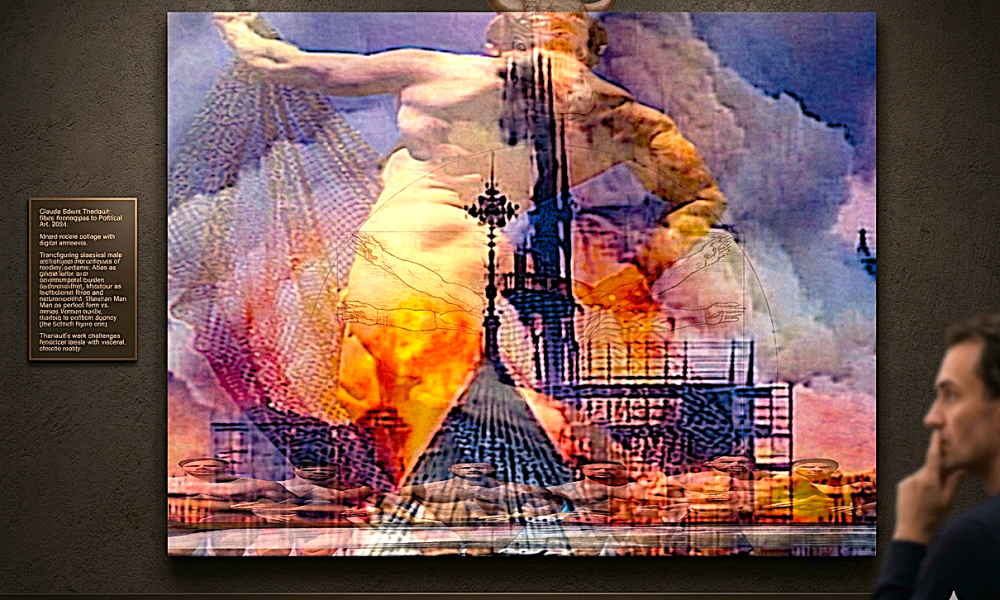
Theriault has been making art for this audience for five decades without ever reducing his ambitions to meet the institutional market’s more comfortable categories. His Vitruvian Man Scaffolding Design takes Da Vinci’s original argument and extends it into the architectural: the body as building, the building as body, and the construction scaffolding around both as the visible skeleton of a civilization perpetually under reconstruction. His Atlas Shrugged series, painted in oil in 2008—the year the financial system revealed its fundamental fraudulence to an audience that had always suspected it—positions the Greek Titan not as a punished figure but as the embodiment of collective productive labour: ordinary people holding the weight of a system built on their backs by people who understood it less than they admitted. These are not decorative works. They are arguments, and they are the kind of arguments that only an artist operating entirely outside the institutional validation system can afford to make at full volume.
Political Commentary in the Body: What the Ancient Mythology Minotaur Knows That the Newspaper Doesn’t
The Minotaur is perhaps the most precisely political archetype the Greek mythological tradition produced. It is the thing at the centre of the labyrinth—the monstrous consequence of an unacknowledged transgression, housed in a structure specifically designed to prevent the general population from understanding what is at its core. The labyrinth exists not to contain the Minotaur but to prevent ordinary people from seeing it clearly. This is a political allegory of extraordinary contemporary relevance, and it is the kind of allegory that lives in an image for three thousand years precisely because each generation finds its own labyrinth and its own creature at the centre.
Theriault’s engagement with this symbolism in art tradition places him in a class so genuinely distinct from his contemporaries that the comparison is difficult to make without sounding hyperbolic—and yet the evidence of the work itself makes the case unavoidably. In a global art market flooded with algorithmically generated aesthetics, with trend-responsive abstract prints, and with decorative work optimized for the Instagram grid and the interior design mood board, Theriault is making esoteric sacred designs of a conceptual density and a political seriousness that have almost no peers in contemporary print-on-demand culture. His Zeus Kills Kempe—eighteen months of oil painting, the Cyclopes rising from the earth with staffs of concentrated fire—operates at the scale of operatic power symbolism that his own description connects to Led Zeppelin: an ancient mythology surface narrative and a deeper current running simultaneously, neither cancelling the other.
This is the esoteric visual tradition at its fullest expression. It is not for every collector. It is not trying to be. It is for the European free thinker who has spent years looking for art with enough philosophical architecture to be worth living with for the next twenty years—work that will not date because it is not responding to the moment but to the permanent forces beneath it. That collector is not rare in Europe. They are, in 2026, increasingly the defining voice of the continent’s most serious collecting culture. And Theriault’s mythological male archetypes are precisely the political commentary they have been waiting to put on the wall.
Claude Edwin Theriault’s full POD collection is available internationally at pixels.com/profiles/claude-theriault, with canvas, metal, acrylic, framed, and wood print formats shipping directly to Europe.
About Claude Edwin Theriault: Claude Edwin Theriault is a French Canadian Zeitgeist artist and contemporary symbolist working from Digby County, Nova Scotia. His five-decade body of work spans oil painting, digital art, and mixed media, connecting the sacred geometry, Hermetic, and Symboliste traditions with mythological archetypes, Acadian cultural identity, and contemporary political commentary for a global collector audience.