

Anchoring And Fixing Market Overview
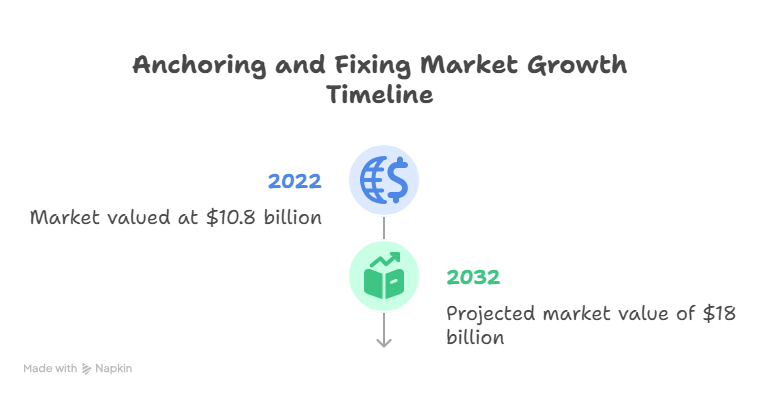
The global anchoring and fixing market, valued at $10.8 billion in 2022, is projected to reach $18 billion by 2032, growing at a compound annual growth rate (CAGR) of 5.3% from 2023 to 2032. Anchoring and fixing solutions are essential for securing and stabilizing components in construction and infrastructure projects, ensuring structural integrity and safety. Anchoring involves using devices or structures to prevent movement, while fixing focuses on making components stable, secure, or functional. These solutions are critical in industries like construction, where they are used in buildings, bridges, and roads, and in other sectors such as aerospace and automotive, where lightweight and durable materials are vital.
𝐃𝐨𝐰𝐧𝐥𝐨𝐚𝐝 𝐏𝐃𝐅 𝐒𝐚𝐦𝐩𝐥𝐞@ https://www.alliedmarketresearch.com/request-sample/A236102
The market’s growth is driven by rapid urbanization, increasing construction activities, and stringent safety regulations. Advancements in materials science and the integration of smart technologies further enhance the appeal of anchoring and fixing products, positioning them as indispensable for modern infrastructure development.
Anchoring And Fixing Market Drivers
Several factors propel the anchoring and fixing market. Rapid urbanization, particularly in Asia-Pacific, fuels demand for new cities and expanded urban areas, driving construction projects that require robust anchoring and fixing solutions. The global construction industry, encompassing residential, commercial, and industrial sectors, directly impacts market growth. As construction activities rise, the need for reliable products to ensure structural stability increases.
Stringent building codes and safety standards enforced by regulatory authorities worldwide are a key driver. Compliance with these regulations is essential for ensuring the safety and durability of structures, boosting demand for high-quality anchoring and fixing products. For instance, cementitious fixing solutions are often mandated for their strength and reliability, particularly in industrial applications like manufacturing facilities and power plants.
Advancements in materials science contribute significantly to market growth. Innovations in lightweight, durable materials, such as composites and bio-based options, enhance the performance of anchoring and fixing solutions. These advancements are particularly valuable in industries like aerospace, where weight reduction improves fuel efficiency, and in construction, where durable materials withstand environmental stresses.
The growing emphasis on sustainability presents another driver. Eco-friendly anchoring and fixing solutions, made from recycled or low-impact materials, appeal to environmentally conscious consumers and businesses. Additionally, the integration of smart technologies, such as IoT sensors, enables real-time monitoring of anchoring systems, improving safety and reducing maintenance costs through predictive analytics.
𝐄𝐧𝐪𝐮𝐢𝐫𝐞 𝐁𝐞𝐟𝐨𝐫𝐞 𝐁𝐮𝐲𝐢𝐧𝐠@ https://www.alliedmarketresearch.com/purchase-enquiry/A236102
Anchoring And Fixing Market Challenges
The anchoring and fixing market faces several challenges. Regulatory compliance, particularly environmental regulations, adds complexity to projects. The use of environmentally friendly materials and proper waste disposal practices can limit material choices and increase costs. Safety standards also necessitate additional equipment and measures, further raising project expenses.
High initial costs for advanced anchoring and fixing solutions can be a barrier, especially for small and medium-sized enterprises (SMEs) in developing regions. The complexity of integrating smart technologies into existing systems may also require specialized expertise, increasing operational costs and potentially slowing adoption.
The COVID-19 pandemic disrupted the market, causing supply chain interruptions due to lockdowns and factory closures. Construction project delays and labor shortages reduced demand for anchoring and fixing products, particularly in commercial sectors. While residential construction saw growth, the overall impact varied by sector, posing challenges for market recovery.
Anchoring And Fixing Market Opportunities
The anchoring and fixing market offers significant opportunities, particularly in the context of sustainability and technological innovation. The development of eco-friendly solutions, such as recycled or bio-based materials, aligns with global sustainability goals, attracting environmentally conscious buyers. These materials reduce environmental impact while maintaining performance, appealing to both residential and industrial sectors.
The integration of smart technologies, such as IoT-enabled sensors, presents a transformative opportunity. These systems provide real-time data on the performance of anchoring and fixing solutions, enabling proactive maintenance and reducing the risk of structural failures. Data analytics can optimize design and maintenance processes, enhancing efficiency and safety.
Anchoring And Fixing Market Segmentation
The market is segmented by product type, sector, and region.
By Product Type
The market includes cementitious fixing, resin fixing, and others. Cementitious fixing dominated in 2022 due to its strength and reliability in construction and industrial applications, driven by urbanization and regulatory requirements.
By Sector
The residential sector led in 2022, fueled by population growth and urban development. Infrastructure projects, like bridges and high-rise buildings, also drive demand. Regulatory compliance and technological advancements further boost market growth.
By Region
Asia-Pacific dominated in 2022, driven by rapid urbanization and economic growth in countries like China and India. North America and Europe follow, supported by strict regulations and advanced construction sectors. LAMEA shows moderate growth due to emerging industrial activities.
Competitive Landscape
Key players include Bayshield International IBM, Bostik (Arkema), Elmrr, Five Star Products Inc., Fosroc Inc., Gantrex, GCP Applied Technologies Inc., GRUPA SELENA, Henkel AG & Co. KGaA, and LATICRETE International Inc. Strategic investments and agreements are common, such as GCP Applied Technologies’ $2.3 billion acquisition by Saint-Gobain in December 2021.
Anchoring And Fixing Market Dynamics
Urbanization, regulatory compliance, and material innovations drive demand for anchoring and fixing solutions. Smart technologies enhance reliability, while environmental regulations push for sustainable materials. However, high costs, regulatory complexity, and pandemic-related disruptions pose challenges. Opportunities lie in eco-friendly products, smart technology integration, and emerging market growth.
Key Benefits for Stakeholders
- Quantitative Analysis: Insights into market segments, trends, and forecasts from 2023 to 2032.
- Porter’s Five Forces Analysis: Evaluates buyer and supplier dynamics for strategic decisions.
- Segmentation Insights: Identifies opportunities across product types, sectors, and regions.
- Regional Mapping: Tracks revenue contributions by country.
- Competitive Benchmarking: Assesses key players’ strategies.
- Comprehensive Data: Combines expert inputs and market data for robust analysis.
Future Outlook
The anchoring and fixing market is poised for steady growth through 2032, driven by urbanization, regulatory standards, and technological advancements. Sustainable materials and smart technologies will enhance market appeal, while Asia-Pacific’s rapid development offers significant opportunities. Despite challenges like high costs and regulatory complexity, the market’s focus on durability, safety, and sustainability ensures its critical role in global construction and infrastructure projects.




