
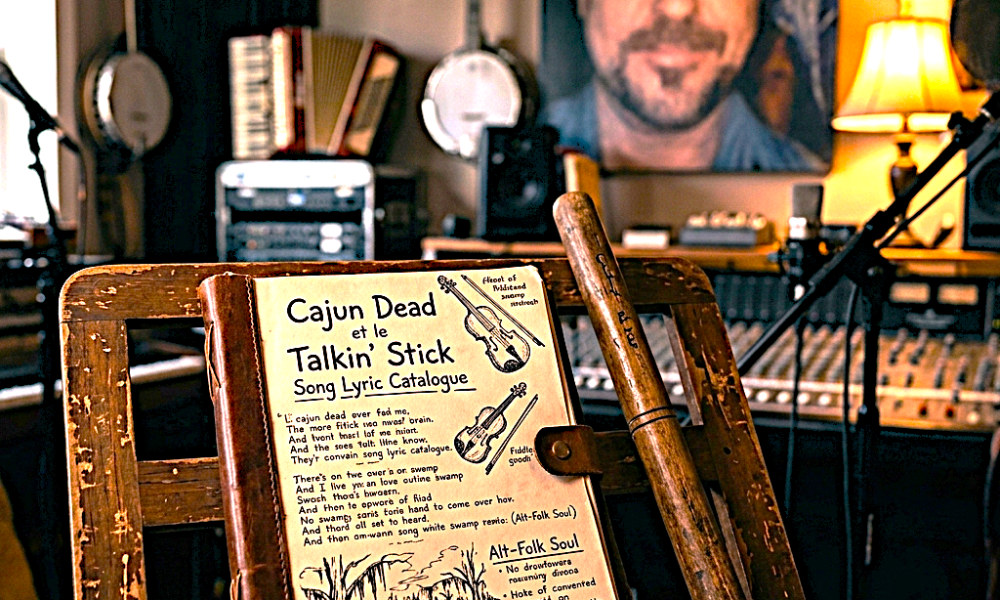
Alt-Folk and Alt-Country at the Inflection Point: Why Cajun Dead et le Talkin’ Stick Is the Answer to a Music Industry That Forgot How to Feel
By Claude Edwin Theriault | Claregyle, Nova Scotia
The industry has a name for what happened to mainstream music in 2025. They call it the “slop crisis.” That is not my language—that is the language music business analysts used when they realized that streaming platforms were receiving over fifty thousand fully AI-generated tracks every single day, that bot farms were inflating play counts on songs no human had chosen to hear, and that the algorithm had become so efficient at optimizing for familiarity that it had inadvertently produced a landscape where nothing felt like anything at all. Hair. Demographics. Makeup. Sonic wallpaper music industry engineered to keep you in a playlist without ever once making you stop what you are doing and actually listen. By the end of 2025 you could not tell, in a blind test, whether a given mainstream track had been made by a human being or a text prompt. Industry surveys confirmed it: ninety-seven percent of respondents could not accurately assess whether the music they were hearing was human-made or machine-generated. The slop crisis was not about bad taste. It was about the systematic removal of the one quality that makes music worth having: the irreducible presence of a person who meant it.
I have been making music outside the system for long enough that none of this surprised me. What surprised me was how quickly the industry’s own analysts started writing what amounts to the argument for everything the Cajun Dead et le Talkin’ Stick Appalachia-inspired Alt-Folk catalogue was built to be.
Mainstream Music Inflection Point 2026: When Hair and Demographics Replaced Soul
The evidence is not anecdotal. Epidemic Sound’s 2026 music trend analysis documents the reaction directly: audiences crave organic music. Real instruments, stirring storytelling, and a sense of grounded, authentic minimalism represent the other side of the coin from what the algorithm has been serving. The phrase “other side of the coin” is doing a great deal of work in that sentence. It is describing a complete structural reversal—a cultural appetite that has swung so hard away from the processed and the manufactured that the industry is now using words like “grounded” and “human” as the primary descriptors of what listeners are searching for in 2026. These are not folk music words. These are desperation words. Words that only become necessary when the dominant mode of music production has so thoroughly engineered the humanity out of the product that humanity itself becomes a differentiator.
The iMusician State of the Music Industry 2026 report is even more direct: “Fans may gravitate toward songs and artists that convey authenticity, creating a space where real emotional expression in music becomes even more valuable.” That sentence — real emotional expression in music becomes even more valuable — is the most important sentence published about the music business in years, and it was buried in an industry trade report that most mainstream labels will never read carefully enough to understand what it is actually saying. It is saying that the algorithm created a scarcity of the very thing music was invented to provide. It is saying that in 2026, the song that makes you feel something is not the baseline expectation of a functioning music industry. It is a luxury item. It is exceptional. It is the thing that has to be searched for rather than encountered.
I did not need a market report to tell me this. I needed it to be said in language the progressive listener searching for something real could use to understand why they are searching in the first place.
Alt-Folk Alt-Country Authenticity: The USP That Cannot Be Manufactured
The unique selling proposition of alt-folk and alt-country in 2026 is not sound, style, or subgenre. It is the quality that the slop crisis removed from mainstream music and that no algorithm, AI system, or demographic targeting exercise can simulate: the specific gravity of a human being who has something to say and says it in the only form available to them. That is not a marketing position. That is a structural fact about what happens when you build a catalog from scratch, outside of institutional support, with nothing to recommend you except the songs themselves and the specific irreplaceable vantage point from which they were written.
The Cajun Dead et le Talkin’ Stick catalogue — eighty-plus songs documented in the conscious folk catalogue at moderncontemporaryartworktrends.com — was not built to compete with the mainstream. It was built as a structural refusal of the values that created the slop crisis in the first place: the belief that music’s function is demographic targeting, that a song’s value is measured in streams per day, and that the listener is a consumption unit to be optimized for rather than a human being to be spoken to honestly. Every song in the catalog names something specific. Every song takes a position. Not a performed position—the kind that has been market-tested and focus-grouped into inoffensiveness—but an actual one. The kind that the heritage industry of Atlantic Canada has spent years refusing to fund precisely because it is too specific, too honest, and too uncomfortable to be useful as a tourist brochure.
That discomfort is the USP. Not the genre label. Not the sonic palette. The fact that when you press play, something is actually at stake. As argued in the Cajun Dead et le Talkin’ Stick counterculture manifesto, the project defines itself by its refusal to be swept into the illusions of the modern music industry. It does not optimize for the algorithm. It does not ask what the streaming platform’s editorial team would prefer. It asks what the community needs to hear that nobody else is willing to say, and it builds the song around that. In 2026, with the slop crisis having clarified exactly what mainstream music sacrificed in exchange for algorithmic efficiency, that refusal is no longer a counterculture gesture. It is the most commercially logical position an independent artist can occupy. The audience is not searching for better demographics. They are searching for someone who means it. The alt-folk and alt-country tradition was built on exactly that. In the inflection point year, it is finally being heard.
Claude Edwin Theriault is the founder of Cajun Dead et le Talkin’ Stick, an alt-folk alt-country conscious music project based in Claregyle, Nova Scotia. The full 80+ song catalog streams on Spotify, Boomplay, and YouTube. Full catalogue at moderncontemporaryartworktrends.com.