
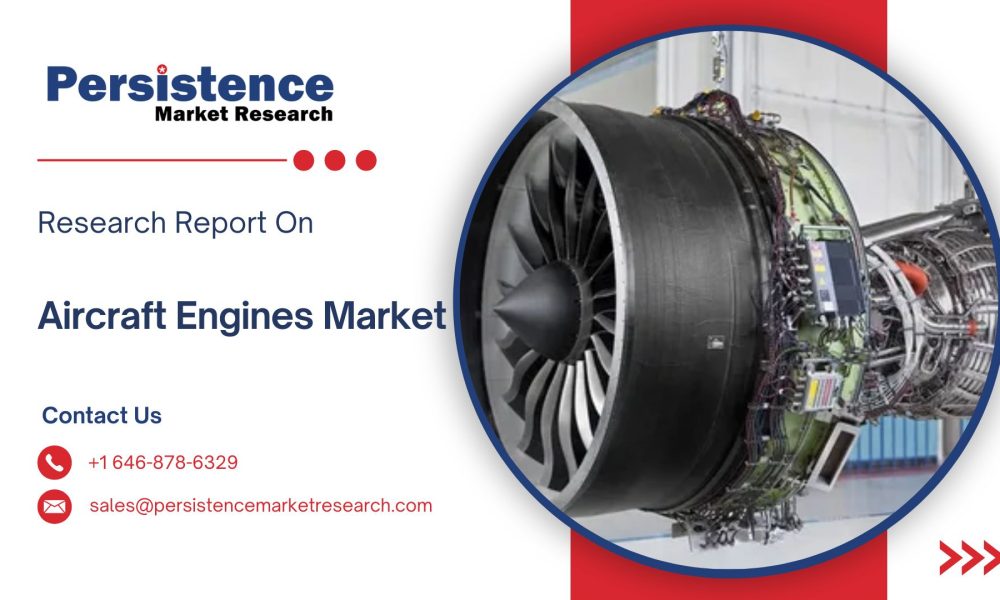
The global aircraft engines market is poised for a period of strong and sustained expansion, with a projected market size increasing from USD 76.8 billion in 2025 to USD 157.5 billion by 2032, reflecting a compound annual growth rate (CAGR) of 10.8% during the forecast period of 2025 to 2032.
This growth is underpinned by a confluence of market drivers including increasing global air travel demand, the continued replacement of aging aircraft fleets, growing investments in fuel-efficient and hybrid-electric propulsion systems, and the emergence of next-generation aircraft technologies. Additionally, rising defense budgets, expansion of commercial aviation in emerging markets, and a push toward sustainable aviation solutions are propelling significant demand for modern aircraft engines across both civil and military segments.
Request Sample Copy of Report: https://www.persistencemarketresearch.com/samples/18748
Several key dynamics are driving this trajectory. The recovery and projected expansion of passenger and cargo aviation globally are generating unprecedented demand for fuel-efficient, quieter, and lower-emission engines. Aircraft manufacturers are prioritizing engine upgrades to comply with stricter environmental regulations, reduce lifecycle costs, and improve operational efficiency. Furthermore, defense modernization programs are fueling demand for high-thrust, supersonic-capable engines in fighter jets, unmanned aerial systems (UAS), and advanced rotorcraft.
Airlines’ pursuit of fuel savings, combined with rising jet fuel prices and environmental accountability, has intensified demand for next-generation propulsion systems, including geared turbofans, open-rotor concepts, hybrid-electric propulsion units, and hydrogen-fueled engines under development.
Segmentation Analysis
By Type
The aircraft engines market is segmented into turbofan, turboprop, turbojet, and piston engines, along with hybrid-electric and fully electric engines, which are in early-stage deployment.
Among these, turbofan engines dominate the commercial aviation segment, particularly in narrow-body and wide-body aircraft. They are expected to retain the largest market share throughout the forecast period, owing to their superior fuel efficiency, thrust capabilities, and technological maturity.
Turboprop engines, often used in regional and cargo aircraft, continue to demonstrate relevance in short-haul operations, especially in geographies with limited airport infrastructure. Their cost efficiency and suitability for rugged conditions support consistent adoption.
Turbojet engines find application primarily in military fighter aircraft, where thrust-to-weight ratio and supersonic capability are critical. In the defense segment, this category is witnessing a resurgence due to global rearmament trends and fifth- and sixth-generation fighter programs.
Hybrid-electric engines are emerging as the fastest-growing segment due to their potential to revolutionize propulsion systems with low-emission, high-efficiency alternatives. While currently limited to demonstrators and small aircraft, they represent a significant shift in propulsion innovation and are attracting substantial research and investment.
By Vehicle/Product/Service Type
By platform, the market is segmented into commercial aircraft, military aircraft, general aviation, and unmanned aerial vehicles (UAVs).
Commercial aircraft engines constitute the majority of demand, supported by large-scale aircraft orders from global airlines, regional carriers, and cargo operators. The replacement of aging fleets with more fuel-efficient aircraft—particularly in Asia-Pacific, the Middle East, and North America—is a major market driver.
Military aircraft engines represent a critical and growing segment, driven by rising geopolitical tensions, defense modernization initiatives, and procurement of next-gen fighter jets and strategic bombers. Engines for combat aircraft, drones, and helicopters are experiencing heightened demand across NATO and Indo-Pacific countries.
General aviation, which includes business jets, trainers, and recreational aircraft, is also undergoing growth, aided by rising interest in private aviation and the recovery of business travel.
UAV engines are gaining ground in both defense and commercial sectors. With the increasing utility of drones in surveillance, reconnaissance, logistics, and disaster response, engine makers are focusing on compact, high-endurance propulsion systems tailored for UAV platforms.
By Propulsion / Technology / Channel
From a technology perspective, the industry is experiencing a shift toward geared turbofans, variable cycle engines, and next-gen turbine blade cooling technologies, aimed at optimizing performance and thermal efficiency.
Hybrid-electric propulsion and fully electric engines are in the developmental and prototype phases, with commercial applications expected post-2030. Innovations in battery energy density, power-to-weight ratios, and thermal management are critical to making electric propulsion viable at scale.
In terms of sales channels, the market operates largely through direct sales to OEMs and governments, with aftermarket services—including MRO (maintenance, repair, and overhaul)—accounting for a growing share of revenue, as OEMs adopt service-based business models to ensure revenue continuity across engine lifecycles.
Request Customization of Report: https://www.persistencemarketresearch.com/request-customization/18748
Regional Insights
Leading Regions
North America remains the largest regional market, anchored by the presence of major OEMs, defense contractors, and MRO providers. The U.S., in particular, is a global leader in both civil and military aircraft engine demand, driven by its large commercial aviation network, defense spending, and technological capabilities.
Europe is another significant region, with strong participation in international aerospace programs and home to key engine manufacturers. Regulatory pressures for sustainability, combined with aviation recovery and government-backed innovation programs, are fueling growth.
Asia-Pacific is rapidly emerging as a major hub for engine demand, particularly in countries such as China, India, and Southeast Asia. The region’s growing middle-class population, expanding airline fleets, and military modernization initiatives are positioning it as a key growth engine.
Fastest-Growing Region
Asia-Pacific is projected to be the fastest-growing region in the aircraft engines market. The region’s surging air traffic, ongoing urbanization, and rapid defense procurement programs are driving demand across commercial and military aviation segments. Moreover, domestic OEMs in China and India are increasingly investing in indigenous engine development, further amplifying regional momentum.
Unique Features and Innovations in the Market
Technological innovation is reshaping the aircraft engine landscape. The integration of advanced materials, digital twin technologies, and real-time diagnostics is enabling engines to operate more efficiently, predict failures, and minimize downtime.
The use of AI and machine learning for predictive maintenance, performance optimization, and autonomous flight control is revolutionizing both commercial and defense aviation. These technologies support the shift from reactive to proactive maintenance, reducing lifecycle costs and increasing aircraft availability.
IoT-enabled sensors embedded in engines facilitate real-time monitoring of parameters such as vibration, temperature, fuel burn, and emissions. This data is critical for ensuring operational efficiency and complying with environmental regulations.
Emerging propulsion technologies such as open-rotor architectures, variable cycle engines, and hydrogen combustion engines are pushing the boundaries of propulsion science. These innovations aim to deliver step-change improvements in fuel economy, noise reduction, and emissions performance.
5G and edge computing are playing a growing role in engine-to-ground connectivity, enabling faster decision-making and seamless integration with fleet management platforms.
Market Highlights
Adoption of next-generation aircraft engines is being driven by several compelling factors:
- Fuel Efficiency and Emissions Reduction: Airlines are investing in engines that offer lower fuel consumption and CO₂ emissions to meet climate goals and reduce operational costs.
- Regulatory Compliance: Emission norms from organizations such as ICAO, EASA, and the FAA are compelling OEMs and operators to transition toward cleaner propulsion systems.
- Lifecycle Cost Optimization: Engines with higher time-on-wing, lower maintenance needs, and digital support systems are gaining preference.
- Fleet Modernization and Replacement Cycles: Airlines and military forces are replacing older aircraft with newer models powered by efficient engines.
- Sustainability Initiatives: Public and private sectors are jointly investing in sustainable aviation technologies, including engines capable of burning sustainable aviation fuels (SAFs) or hydrogen.
The market is also benefiting from government-backed R&D initiatives, public-private partnerships, and aerospace stimulus packages aimed at advancing green aviation technologies.
Key Players and Competitive Landscape
The aircraft engines market is dominated by a select group of global players with extensive technological expertise, certification experience, and manufacturing capabilities. These companies are investing heavily in R&D to maintain technological leadership and secure long-term contracts.
General Electric Aviation (GE Aerospace)
A leading supplier of both commercial and military engines, GE continues to expand its LEAP engine program (through CFM International), while advancing technologies such as composite fan blades and ceramic matrix composites for higher efficiency. Its XA100 adaptive cycle engine, developed for the U.S. Air Force, is a key innovation in the defense segment.
Rolls-Royce Holdings plc
Rolls-Royce is known for its Trent engine family, which powers wide-body aircraft. The company is also pioneering hybrid-electric propulsion through its ACCEL project and investing in sustainable aviation initiatives including hydrogen propulsion and electric flight demonstrators.
Pratt & Whitney (a Raytheon Technologies Company)
P&W is leading in geared turbofan (GTF) technology, offering significant fuel and noise reductions. Its military engines, including the F135 used in the F-35 fighter jet, play a critical role in U.S. and allied defense programs. The company is expanding its aftermarket services footprint globally.
Safran Aircraft Engines
In partnership with GE through CFM International, Safran is instrumental in the LEAP engine program. The company is also working on the RISE (Revolutionary Innovation for Sustainable Engines) initiative, targeting 20% efficiency improvement with open-fan technology.
MTU Aero Engines
MTU is a key player in the European engine market, participating in programs such as Eurofighter and contributing to GTF production. The company is active in hybrid propulsion development and future engine architecture research.
Honeywell Aerospace and Rolls-Royce North America
These firms play a vital role in regional jet, rotorcraft, and UAV engine supply, with strengths in compact propulsion systems and advanced digital integration.
Strategically, these players are focusing on long-term partnerships with airframers, expanding their aftermarket service offerings, and investing in digital transformation to enhance operational support and customer engagement.
Buy Now: https://www.persistencemarketresearch.com/checkout/18748
Future Opportunities and Growth Prospects
Looking ahead, the aircraft engines market is positioned for dynamic evolution. Key growth opportunities include:
- Sustainable Aviation Fuel (SAF) Compatibility: Engine designs compatible with SAFs will be in high demand as global airlines target net-zero carbon goals.
- Hydrogen Propulsion: Hydrogen-fueled engines, while still experimental, represent a disruptive opportunity for zero-emission aviation.
- Urban Air Mobility (UAM) and eVTOL Propulsion: Electric and hybrid propulsion systems for urban air vehicles open new markets for engine developers.
- Modular Engine Designs: Next-gen engines with modular architecture will enable quicker upgrades, easier MRO operations, and tailored configurations.
- Autonomous Flight and Integrated Propulsion Control: Smart engines with embedded AI and self-diagnostics will enable predictive performance management.
- Defense Engine Modernization: Global defense rearmament is fueling long-term demand for next-gen engines for fighter jets, bombers, and unmanned platforms.
Moreover, regulatory evolution, including environmental taxation, aircraft noise limitations, and global emissions caps, will continue to steer the industry toward greener propulsion technologies.
Conclusion
The aircraft engines market stands at the intersection of aviation recovery, sustainability imperatives, and propulsion innovation. With a projected valuation of USD 157.5 billion by 2032, the market presents strong opportunities for OEMs, suppliers, airlines, and defense organizations to capitalize on rising demand and technological transformation.
As the industry embraces next-generation propulsion systems and a digital-first operating model, stakeholders must align with regulatory shifts, sustainability commitments, and global infrastructure upgrades to secure competitive advantage in a rapidly evolving aerospace ecosystem.




