
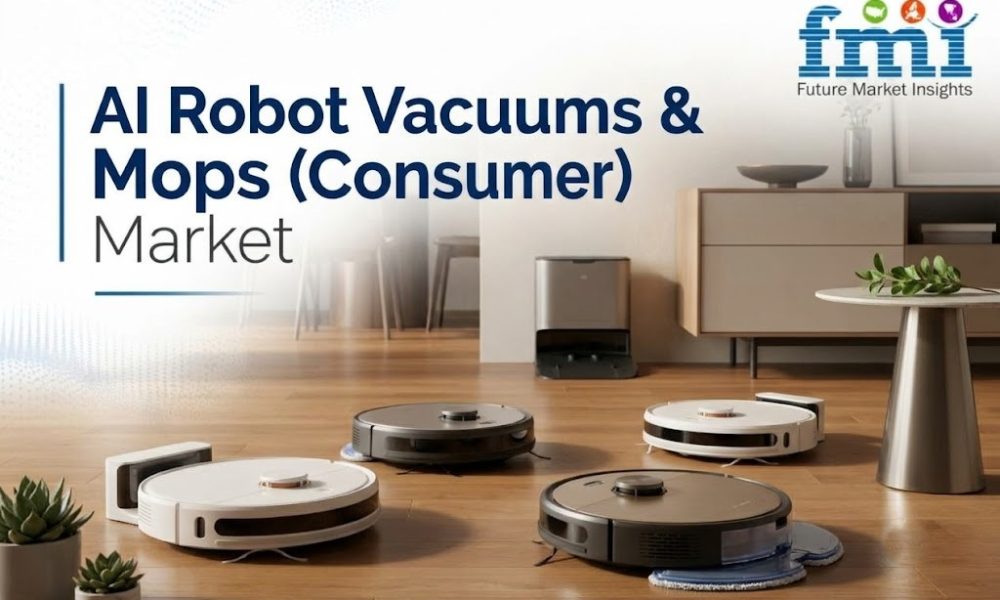
The global AI robot vacuums and mops (consumer) market is projected to grow from USD 7.2 billion in 2026 to USD 18.7 billion by 2036, expanding at a compound annual growth rate (CAGR) of 10.0%, according to Future Market Insights (FMI). Market growth is supported by rising demand for autonomous household cleaning, smart-home integration, and robotic devices that reduce the time and effort required for routine floor maintenance.
Consumers are increasingly evaluating robotic cleaning products based on navigation accuracy, cleaning consistency, and the ability to operate with minimal supervision. Features such as automatic dust emptying, mop washing and drying, and object recognition are influencing purchasing decisions. However, premium pricing, battery limitations, software support requirements, and navigation challenges in complex homes remain important considerations for buyers.
AI Robot Vacuums & Mops Market: Key Growth Drivers
Demand is being supported by the growing adoption of connected household appliances and the need to simplify everyday cleaning. According to Eurostat’s April 2025 publication, 14% of EU internet users used smart-home appliances during 2024. This adoption trend provides context for the increasing role of connected devices in household routines.
Automatic emptying systems, scheduled cleaning, and improved obstacle detection help reduce the need for frequent household intervention. Consumers are also looking for products that can manage different floor types and complete cleaning cycles with fewer interruptions.
Get detailed market forecasts, competitive benchmarking, and pricing trends: https://www.futuremarketinsights.com/reports/sample/rep-gb-34029
Robot Vacuums Lead Product Demand
By product, robot vacuums are estimated to account for 58.0% of the market in 2026. Their leading position reflects familiar household use, broad retail availability, and straightforward maintenance requirements.
Vacuum-mop combinations are also attracting interest from households with hard floors and frequent cleaning needs. These products combine vacuuming and mopping in a single scheduled cycle, while automated mop care and carpet protection can reduce the need for manual intervention.
Manufacturers are increasingly competing on completed cleaning performance rather than suction power alone. Product designs that offer reliable navigation, effective floor coverage, and convenient maintenance can help consumers assess the value of higher-priced models.
LiDAR Navigation Strengthens Autonomous Cleaning
By technology, LiDAR navigation is projected to hold a 44.0% market share in 2026. Its position is supported by repeatable room mapping, scheduled cleaning, and the ability to select specific rooms.
Camera-based object recognition and hybrid navigation systems also contribute to performance in homes with cables, furniture, and other obstacles. Reliable navigation is important because repeated interruptions can reduce the convenience of unattended cleaning.
Mid-range products are expected to account for 42.0% of the market in 2026. These models appeal to consumers seeking mapping, app controls, and effective cleaning without paying for every premium docking feature. Replacement-part availability, warranty coverage, and long-term maintenance costs remain important factors in purchase decisions.
Country Markets Show Different Growth Patterns
Country-level forecasts indicate varying adoption patterns through 2036, reflecting differences in housing, connected-appliance adoption, retail access, and consumer preferences.
- South Korea: Expected to grow at a CAGR of 11.0%, supported by connected-home integration and rapid product development.
- United States: Projected to expand at 10.5%, with national retail access and product choice supporting demand.
- European Union: Forecast to grow at 10.0%, supported by demand for space-efficient products and connected household appliances.
- Japan: Expected to record a CAGR of 9.0%, with compact designs suited to smaller homes influencing product preferences.
These markets present different priorities for manufacturers. South Korean consumers benefit from established appliance ecosystems, while US buyers have access to extensive retail channels. Japanese demand favors compact equipment, and European buyers increasingly need products that combine practical installation with dependable software support.
Access the Complete Report in PDF Format: https://www.futuremarketinsights.com/reports/brochure/rep-gb-34029
Competitive Landscape
The competitive landscape includes Roborock, ECOVACS, Dreame Technology, iRobot, SharkNinja, Samsung Electronics, LG Electronics, and Narwal.
Competition centers on navigation accuracy, automated dock functions, mopping performance, connected-home compatibility, product pricing, and after-sales service. Robotics specialists compete through frequent product launches and advanced cleaning systems, while established appliance brands can connect robotic cleaners with their wider smart-home ecosystems.
Long-term software updates, affordable replacement parts, and responsive customer support are also important competitive factors. Manufacturers must balance feature development with reliability and ownership costs to maintain consumer confidence.
Analyst Perspective
“Consumer expectations for robotic vacuum cleaners are shifting toward dependable day-to-day performance rather than feature-rich product launches. Buyers value products that reduce routine cleaning effort, fit comfortably into available living space, and remain reliable throughout years of ownership. Brands that support their products with long-term software updates, readily available replacement parts, and responsive customer service are likely to strengthen customer satisfaction and encourage repeat purchases.”
— Rahul Pandita, Principal Analyst at Future Market Insights
AI Robot Vacuums & Mops Market: Report Scope
The report examines the market by product, technology, price tier, sales channel, end user, and region. Product categories include robot vacuums, vacuum-mop combinations, and dedicated mopping robots. Technology coverage includes LiDAR navigation, vision-based AI navigation, and hybrid systems.
Price tiers cover entry-level models below USD 300, mid-range products priced from USD 300 to USD 800, and premium models above USD 800. Sales channels include online retailers, retail chains, and direct brand stores, while end users include households, small offices, and hospitality settings. The forecast period extends from 2026 to 2036, with market values presented in USD billions.
Business Impact
FMI helps organizations transform market complexity into strategic clarity, enabling leadership teams to identify growth opportunities faster, optimize resource allocation, strengthen competitive positioning, and make high-stakes business decisions with confidence.
To explore how FMI Custom Research can support your strategic priorities, please connect with our team at – [email protected]
About Future Market Insights (FMI)
Future Market Insights, Inc. (FMI) is an ESOMAR-certified, ISO 9001:2015 market research and consulting organization, trusted by Fortune 500 clients and global enterprises. With operations in the U.S., UK, India, and Dubai, FMI provides data-backed insights and strategic intelligence across 30+ industries and 1200 markets worldwide.



