
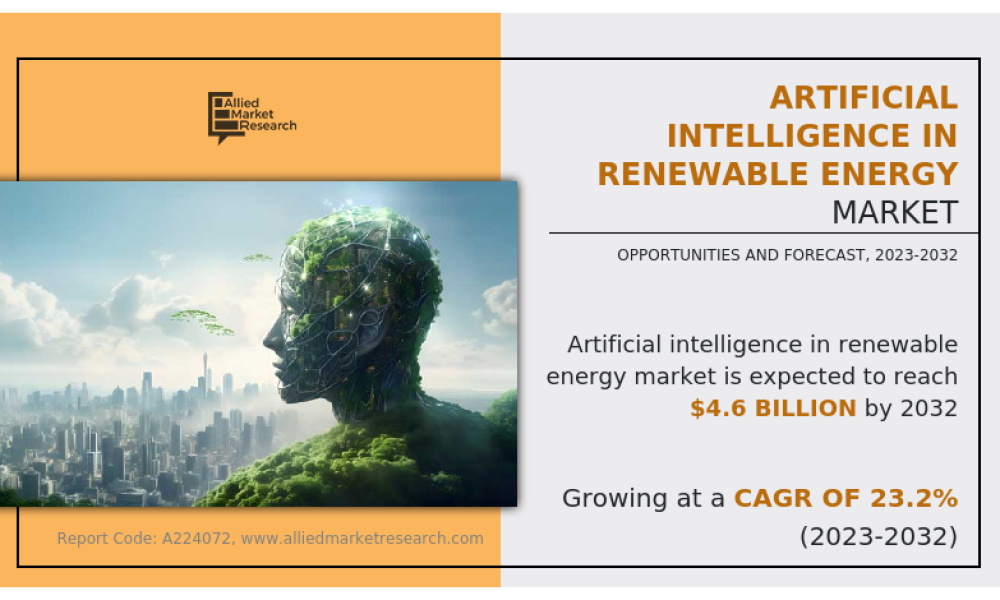
According to a new report published by Allied Market Research, titled, “Artificial Intelligence in Renewable Energy Market,” The AI in renewable energy market size was valued at $0.6 billion in 2022, and is estimated to reach $4.6 billion by 2032, growing at a CAGR of 23.2% from 2023 to 2032.
Artificial intelligence (AI) is transforming the renewable energy sector by revolutionizing how resources like solar and wind power are harnessed and managed. In solar energy systems, AI-driven algorithms are utilized to track the sun’s position, optimize the angle of solar panels, and forecast cloud movements, significantly enhancing energy output. Similarly, in wind energy, AI plays a crucial role in predicting wind patterns, adjusting turbine orientation for maximum efficiency, and identifying potential mechanical issues in real time. These advancements collectively improve the overall efficiency, reliability, and performance of renewable energy systems.
Download PDF Brochure: https://www.alliedmarketresearch.com/request-sample/A224072
The AI in renewable energy market presents significant opportunities, particularly in optimizing the charging and discharging cycles of energy storage systems like batteries. By leveraging AI, excess renewable energy generated during periods of low demand can be stored and then released when demand peaks or renewable output drops. This intelligent management enhances grid stability and supports the seamless integration of variable energy sources such as solar and wind. AI solutions also play a key role in forecasting energy demand and coordinating the distribution of power from multiple generation sources, thereby improving overall grid efficiency and reliability.
In the built environment and industrial sectors, AI-driven systems enhance energy efficiency through smart management of lighting, HVAC systems, and appliances. These systems learn user behaviors and adjust energy consumption accordingly, leading to significant energy savings. Predictive maintenance powered by AI also reduces energy losses and prevents equipment failures in industrial facilities. Additionally, AI-based demand-side management tools encourage consumers to shift energy use to off-peak hours, easing strain on the grid and promoting cost savings.
However, the growth of AI in renewable energy must be carefully managed to avoid unintended consequences. If not properly regulated or deployed, AI systems could pose risks to privacy, cybersecurity, and even the environment. On the positive side, AI can also help mitigate environmental impacts by predicting and addressing potential conflicts between renewable infrastructure and ecosystems—for example, by anticipating wildlife migration patterns and adjusting energy operations accordingly. This dual role highlights AI’s potential not only to advance renewable energy integration but also to support sustainable environmental stewardship.
The adoption of AI technologies is significantly enhancing the efficiency and performance of renewable energy systems, thereby driving market growth. AI algorithms play a critical role in optimizing operations by analyzing sensor and device data to predict maintenance requirements, minimize downtime, and enhance system reliability. Furthermore, AI models improve the accuracy of forecasting renewable energy generation from sources like solar and wind, helping grid operators efficiently balance energy supply and demand, ultimately reducing power waste.
For Purchase Inquiry: https://www.alliedmarketresearch.com/purchase-enquiry/A224072
AI is also instrumental in managing smart grids by ensuring real-time balance between renewable and conventional energy sources. A key example is Siemens Energy’s Unified Power Flow Controller (UPFC) Plus, launched in September 2020, which utilizes AI to dynamically manage load flow in alternating-current grids. Such innovations are expected to accelerate the adoption of AI in the renewable energy sector and contribute to the market’s continued growth.
The AI in renewable energy market forecast is segmented by deployment type, component type, end-use industry, and region. Based on deployment, the market is categorized into on-premises and cloud-based solutions. By component, it is divided into solutions and services. In terms of end-use industry, the market includes energy generation, transmission, distribution, and utilities. Regionally, the market is analyzed across North America, Europe, Asia-Pacific, and LAMEA.
The AI in renewable energy market analysis key industry participants such as Alpiq, AppOrchid Inc., ATOS SE, Enel Green Power, Enphase Energy, Flex Ltd., General Electric, Origami Energy Ltd., Siemens AG, and Vestas.
Key Findings Of The Study:
- The report outlines the current AI in renewable energy market trends and future scenario of the market from 2022 to 2032 to understand the prevailing opportunities and potential investment pockets.
- By development type, the on-premises segment is the fastest-growing segment representing a CAGR of 23.4% in the market in 2022.
- By component type, the service segment is the fastest growing segment in the market.
- The energy distribution sector is experiencing rapid growth, with a significant CAGR of 23.7% projected during the forecast period.
- By region, Asia-Pacific collectively was the highest revenue contributor and fastest-growing segment in 2022 and is estimated to register a CAGR of 23.6%.




