
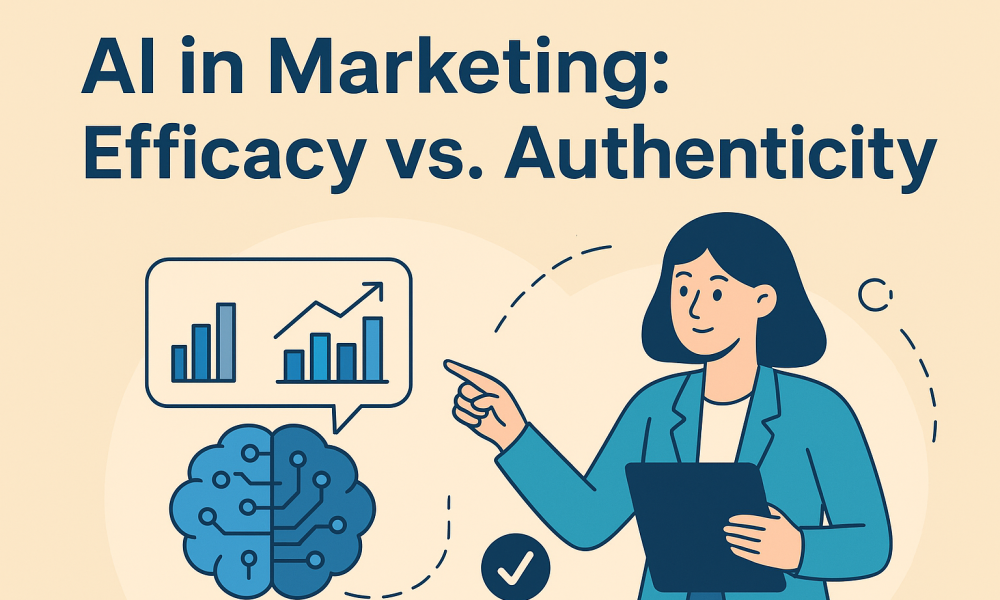
Today’s digital marketing landscape is moving very quickly, and companies are always on the lookout for ways to stay visible, compete, and stay up to date. The use of marketing powered by AI tools and automation has been one of the major forces driving strategy transformation. With the help of intelligent tools, brands are transforming their online presence by moving from predictive analytics to automated customer journeys in various ways. For a few firms, integrating AI with tools such as SEO Services has enabled greater efficiency in marketing operations than ever before. But the most challenging question this new trend raises is: Where is the line between technological efficiency and genuine human connection?
Thus, let us take a look at the evolving landscape of AI-driven marketing, then see how brands can find the perfect middle ground.
1. AI as a Catalyst for Smarter Strategy
One of the finest things about AI is its ability to rapidly and precisely process vast amounts of data. In the future, firms will depend on AI to spot trends, forecast changes, and identify opportunities, rather than spending several hours manually analyzing customer behavior. The marketers will then be attuned to the customer’s desires at a deeper level, plus know the right time and place for that to happen.
To illustrate, AI can optimize email delivery times, pinpoint the most productive keywords for search ads, or even assess which social media posts are most engaging. This collaboration of human invention and the latter benefited from data-backed intellect, resulting in marketing strategies that are both powerful and smart.
2. Improving Digital Interactions with Design and Personalization
AI is not merely changing the way communication works, but also changing the very ground of the digital experience. When AI is applied to Web design, the site’s content can be customized to specific users’ needs, navigation paths can be predicted, and even the layout can be adjusted based on users’ activity. This change results in a smoother, more pleasant browsing experience for the site’s visitors.
AI enables brands to display different website versions to users based on their profiles. Each user can be given recommendations for products, personalized calls to action, and content that matches their interests. In other words, it is not the case that the use of AI in design eliminates the need for human creativity; rather, it expertly empowers human creativity.
3. Making Communication Easier via Email Marketing
Email Marketing has been one of the most reliable and productive digital strategies for a long time, and now AI technology is giving it more strength. By using machine learning, marketers can define target audiences with great accuracy and tailor campaigns to them, as well as automatically trigger sequences based on customer activities—such as abandoned carts, clicks, and browsing history.
AI can serve as a guide, showing which subject lines are most successful, which kinds of content appeal most, and who among the subscribers is ready to buy. But the core of the victory lies in the blending of automation and the human element. The algorithms may initiate sending an email, but its content should seem personal, considerate, and genuine.
4. More Accurate Targeting with Social Media and Ads
AI has completely altered the picture of how brands can leverage Social Media Marketing and Google Ads. The companies behind Facebook, Instagram, TikTok, and YouTube, among others, depend heavily on machine learning to analyze user behavior and deliver the right content to the right audience at the right time.
AI aids marketers by:
– facilitating superior ad targeting
– providing real-time budget optimization
– raising campaign effectiveness
– forecasting trends and user preferences
To be more specific about Google Ads, automated bidding techniques, along with AI-assisted analysis of search terms, have apparently turned into essential resources. In fact, these tools enable advertisers to achieve the maximum exposure and return on investment without the need to continuously and manually adjust campaigns.
However, despite AI’s high accuracy in targeting, it is still the connection based on truth that resonates with the audience. The power of human storytelling is what transforms an ad from being ignored to attracting attention and engaging viewers.
5. Authenticity: The Anchor in an Automated World
The push by consumers for more truthful brands has coincided with AI taking over many marketing functions. The public is seeking transparency, real stories, human values, and genuine connection. Overutilization of automation can lead to content that is perceived as dull, robotic, or devoid of character, which the audience recognizes.
Thus, the brands need to manage their act very carefully:
Data and optimization through AI
Creativity, empathy, and voice through humans
AI can inform you about your target audience’s preferences, but only human intuition can determine the best way to convey that information in a meaningful way.
6. The Future: A Harmonious Blend of Human and Machine
AI is not eliminating marketers but rather, it is enhancing them. By doing so, it frees the teams from repetitive tasks and allows them to focus on developing big ideas, strategic thinking, and emotional narratives. Consequently, businesses that adopt a balanced approach will be the ones that AI tools continue to evolve with and stand out.
The most successful marketing approaches are those that fuse efficient automated processing with genuine human kindness. Their foundation will be on the strengths of AI—data processing, behavior prediction, and performance optimization—and, at the same time, allow the real people to mold the heart, character, and message of the campaign behind each one.
AI aids marketers by:
– facilitating superior ad targeting
– providing real-time budget optimization
– raising campaign effectiveness
– forecasting trends and user preferences
To be more specific about Google Ads, automated bidding techniques, along with AI-assisted analysis of search terms, have apparently turned into essential resources. In fact, these tools enable advertisers to achieve the maximum exposure and return on investment without the need to continuously and manually adjust campaigns.
However, despite AI’s high accuracy in targeting, it is still the connection based on truth that resonates with the audience. The power of human storytelling is what transforms an ad from being ignored to attracting attention and engaging viewers.
Conclusion
It is not a matter of deciding between technology and human beings in marketing influenced by AI, but rather of establishing a balance between the two. The brands that apply AI prudently across SEO Services, Website Design, Email Marketing, Social Media Marketing, and Google Ads have the chance to unlock amazing potential. However, the actual bond is still reliant on human innovation and narrative. This is also the reason why Content Marketing has gained even more significance now.




