
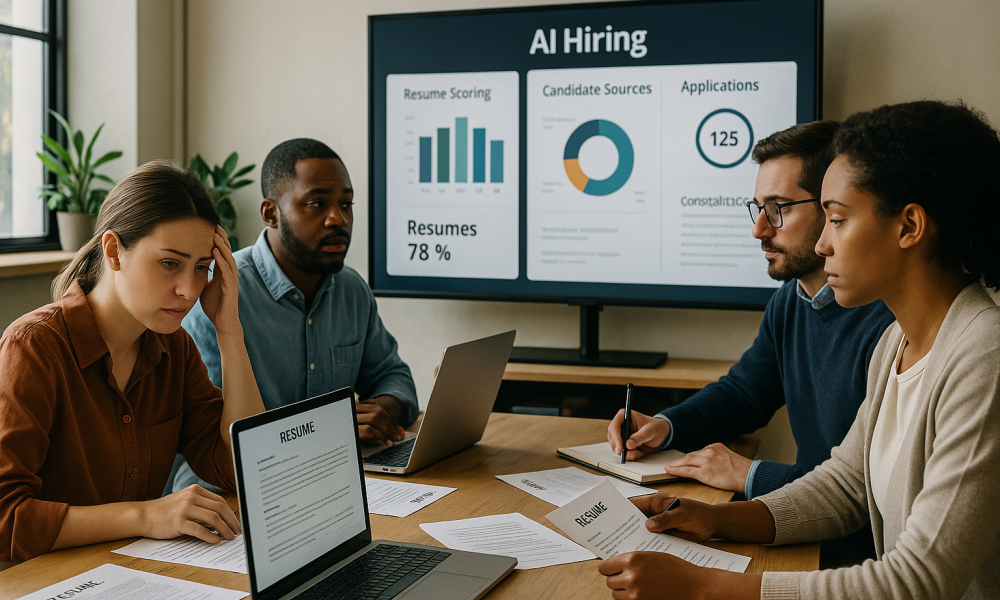
Your next hire might fool you.
Candidates now craft applications using AI. They practice interviews with chatbots. They optimize resumes for algorithms they’ll never meet.
Meanwhile, you’re probably using AI to screen them.
This creates a hall of mirrors where artificial intelligence evaluates artificial intelligence. The efficiency gains look compelling on paper. The compliance costs remain hidden until audit time.
The adoption numbers tell a stark story.
An estimated 99% of Fortune 500 companies now use some form of automation in their hiring process. That makes AI recruitment an urgent compliance issue for organizations of all sizes, including nonprofits.
The promise seems straightforward. AI-based recruitment tools can reduce time-to-hire by up to 50%, enhance candidate quality by up to 35%, and cut recruiting costs by 20-30%.
Those benefits come with strings attached.
The Bias Problem Runs Deeper Than Expected
Research from the University of Washington reveals disturbing patterns in AI hiring systems. The bias problem extends beyond simple discrimination into complex intersectional territory.
The systems never preferred what are perceived as Black male names to white male names. Yet they also typically preferred Black female names 67% of the time, versus 15% of the time for generally Black male names.
“We found this really unique harm against Black men that wasn’t necessarily visible from just looking at race or gender in isolation,” the researchers noted.
This creates legal exposure most organizations haven’t considered.
Employers must conduct annual bias audits on their automated employment decision tools. If they fail to perform the required audits within a year, they must cease using the automated employment decision tools entirely.
For nonprofits, this represents a significant resource challenge. You need the efficiency gains that AI provides. You also need to ensure compliance with evolving regulations.
The Market Split Creates New Tensions
Here’s where the contradiction becomes acute.
Compared to 2023, 2024 has seen a 68.1% increase in using AI tools for recruitment. Organizations are rapidly adopting these systems to stay competitive.
Yet, 66% of adults in the United States say they will not apply for a job that uses AI to assist in hiring decisions.
This means you’re implementing tools that may actively discourage qualified candidates from applying. The efficiency gains become meaningless if you’re not attracting the talent you need.
The skills gap compounds the problem.
While two-thirds of leaders wouldn’t hire someone without AI skills, only 39% of users have received AI training from their company. This creates a knowledge divide that particularly impacts smaller nonprofits with limited training budgets.
Compliance Costs Hit Nonprofits Hardest
The regulatory landscape moves faster than most organizations realize. The incoming political changes won’t slow this down because most AI regulatory efforts occur at the state level.
AI legislation will continue to proliferate at state and local levels. Nonprofits can’t wait for federal guidance that may never come.
The AIDA guidelines and regulations will be enforced beginning in 2025. High-impact systems used for employment will be subject to forthcoming requirements around privacy, transparency and fairness.
The human oversight challenge hits resource-constrained nonprofits particularly hard.
A World Economic Forum study found that in 85% of AI-driven hiring decisions, recruiters followed AI recommendations without questioning their fairness or accuracy. Organizations that employed human oversight along with AI experienced a 45% reduction in biased decisions.
Effective AI governance requires dedicated human resources. That’s a significant challenge for smaller organizations already operating with lean staff.
Most nonprofits don’t realize the compliance exposure that comes from using AI in hiring,” says Sean Littman, founder of GiveSuite.com, a platform helping nonprofits navigate AI governance. “We’ve seen growing demand for tools that balance automation with transparency, especially with bias audits becoming mandatory in 2025.”
What Nonprofits Need to Do Now
Compliance for nonprofits in 2025 will become more time-consuming and challenging. You’re already under increased scrutiny from government agencies, donors, and the public.
There’s growing emphasis on transparency, accountability, and ethics. AI compliance becomes both a legal requirement and a donor trust issue.
Start with documentation.
If you’re using any automated tools in hiring, document exactly what they do and how they make decisions. This includes applicant tracking systems with automated screening features.
Create a simple audit trail—track which candidates get filtered out and why. Look for patterns that might indicate bias.
Establish human checkpoints.
Don’t let AI make final hiring decisions without human review. Train your staff to question AI recommendations, especially when they consistently favor or exclude certain types of candidates.
Budget for compliance costs now. Annual bias audits will become mandatory, not optional. Plan for this expense in your 2025 budget cycle.
Consider the donor perspective.
Your hiring practices reflect your organizational values. Donors increasingly care about how you treat potential employees, not just current ones.
Be prepared to explain your hiring process in plain language. If you can’t easily describe how your AI tools make decisions, that’s a red flag.
The Path Forward
AI in hiring creates genuine efficiency gains. The technology can help small nonprofits compete for talent with larger organizations.
The key lies in implementing these tools thoughtfully rather than reflexively.
Start small. Test one AI tool at a time. Measure both efficiency gains and potential bias issues. Build your compliance processes in tandem with your technology adoption.
Remember that compliance costs are operational costs.
Factor them into your decision-making from the beginning. The cheapest AI hiring tool becomes expensive quickly if it triggers regulatory violations or donor trust issues.
The organizations that thrive will be those that balance efficiency with accountability. They’ll use AI to enhance human decision-making rather than replace it entirely.
Your next hire might fool you. But your hiring process shouldn’t fool your donors, regulators, or the communities you serve.
This article is for general information only and is not legal or tax advice.




