

Press Release
For Immediate Release
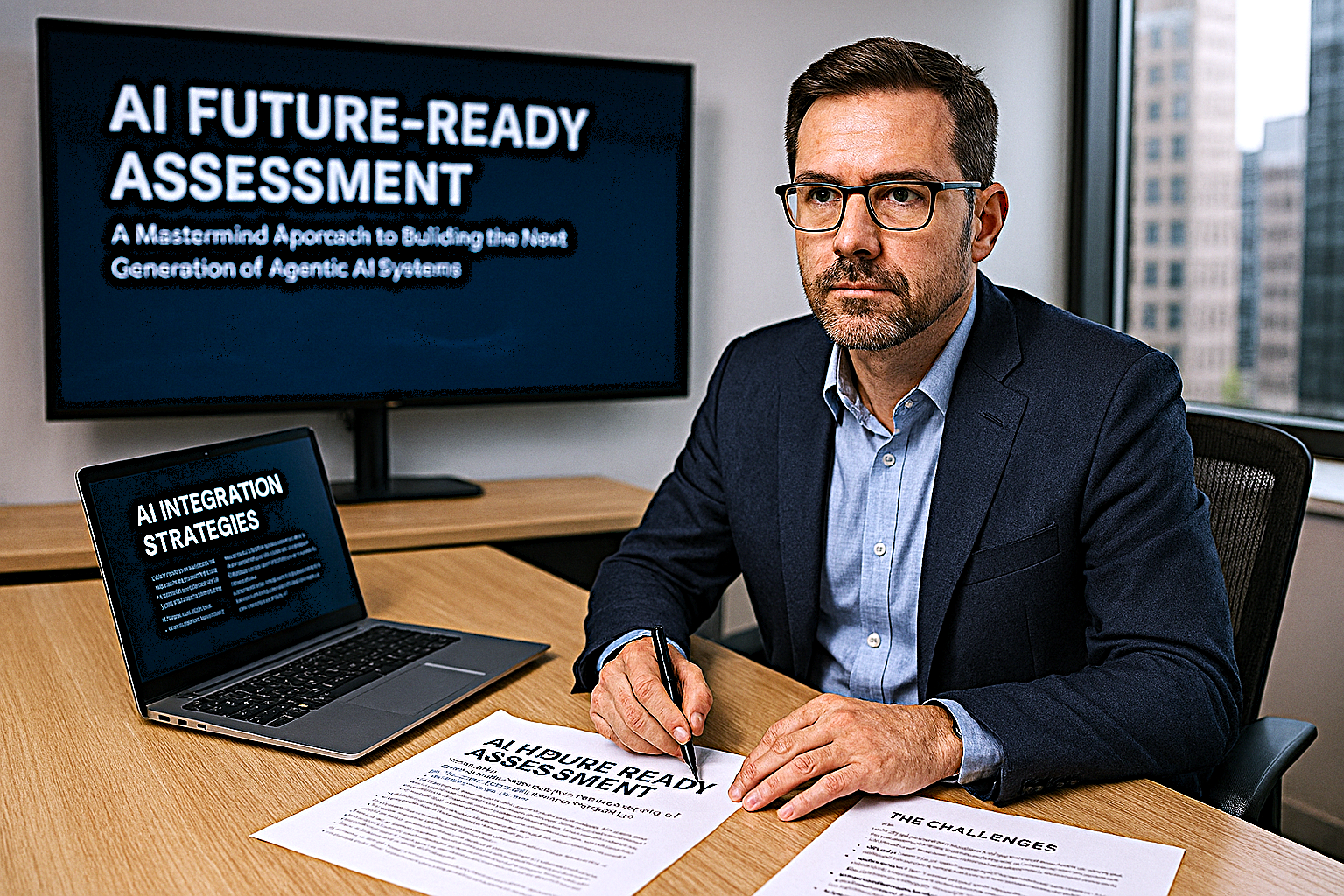
To focus his creative talents and interest in a field he finds exciting; AI strategist Theriault has joined an elite mastermind group dedicated to one of the most ambitious challenges facing modern organizations: designing the 40–50 foundational questions required to produce a clear, actionable AI roadmap. This AI Future Ready Assessment roadmap—essentially a “blueprint for automation”—is what integration teams need to build everything from simple workflows to fully agentic AI systems capable of running entire departments with human oversight.
It’s an exciting moment, but also a daunting one. Never before has a technology this transformative arrived with such speed and scale. Companies know they must adopt AI to stay competitive, yet many are unsure where to begin. The stakes are high, and the path forward requires both strategic clarity and technical precision.
Theriault’s work inside the mastermind group aims to bring that clarity to the forefront.
“Organizations don’t just need AI—they need a structured way to think about AI,” he explains. “Without the right questions, you can’t get the right map. And without the right map, integration becomes guesswork.”
This initiative is designed to eliminate that guesswork.
AI Integration Strategies: From Concept to Scalable Automation
The mastermind group’s focus is on helping organizations understand what it truly takes to implement agentic AI—systems that can autonomously handle tasks, coordinate workflows, and make decisions, all while remaining under human supervision. These agents promise to operate better, faster, and cheaper than traditional processes, but only if they’re deployed with careful planning.
That’s where the 40–50‑question framework comes in. It guides leaders through the essential considerations: data readiness, workflow mapping, compliance requirements, risk tolerance, governance structures, and the human‑AI collaboration model that will keep everything aligned.
The challenge is that AI integration is not a plug‑and‑play exercise. It requires deep alignment between business goals, technical infrastructure, and ethical safeguards. Many organizations face significant hurdles, including:
1. Integration with existing systems
Legacy CRMs, ERPs, and data warehouses often weren’t built with AI in mind. Data formats vary, silos persist, and interoperability issues can slow or even block progress.
2. Infrastructure requirements
Agentic AI systems need substantial compute power—GPUs, cloud resources, and real‑time data pipelines. Without the right infrastructure, even the best AI strategy stalls.
3. Security and governance
AI agents must follow the same rules as employees: data privacy, access controls, and compliance with regulatory frameworks. Strong governance is essential to prevent unauthorized access, data leakage, or model drift.
4. Ethical considerations
AI systems can unintentionally perpetuate bias or make decisions without proper context. Guardrails, monitoring, and evaluation frameworks are critical to ensure fairness and accountability.
5. Human‑AI collaboration
Finding the right balance between automation and human oversight remains one of the biggest challenges. Transparency in decision‑making is essential for trust, adoption, and regulatory compliance.
Theriault’s mastermind group is tackling these issues head‑on, developing a structured approach that organizations can use to evaluate readiness, identify gaps, and build a phased implementation plan.
The Challenges Ahead—and How to Overcome Them with your own personal AI Future Ready Assessment roadmap
As organizations explore deploying AI agents, they quickly discover that the road to automation is filled with both technical and ethical complexities.
Integration with data and enterprise systems
AI agents must seamlessly connect to existing data ecosystems. But data fragmentation, inconsistent formats, and siloed systems make this difficult. Without unified access, agents can’t retrieve accurate information or deliver reliable outcomes.
Compute infrastructure
Real‑time AI requires significant processing power. Many organizations underestimate the investment needed in GPUs, cloud compute, and scalable architectures. Without this foundation, AI agents can’t operate efficiently.
Security and governance
AI agents must be treated like digital employees. They need permissions, access controls, audit trails, and compliance monitoring. Organizations must enforce governance policies that track model behavior, mitigate bias, and ensure alignment with business objectives.
Ethical and transparency concerns
AI systems can unintentionally process sensitive information or reinforce societal inequalities. Maintaining transparency in how decisions are made is essential for user trust and regulatory compliance. Ethical oversight must be continuous, not a one‑time check.
Reliability and consistency
AI agents must perform reliably even when encountering scenarios not included in their training data. Ensuring consistency across edge cases is a major technical challenge.
Legacy system integration
Older systems often lack APIs or modern data structures, making AI integration complex. Organizations must carefully manage the transition to AI‑enhanced workflows while maintaining operational continuity.
A Path Forward: Unified Governance and Secure Data Access
To overcome these challenges, Theriault emphasizes that organizations need two foundational elements:
1. Secure, unified access to enterprise data
AI agents must be able to access multiple data sources efficiently and securely. This includes structured and unstructured data, internal systems, and external APIs. Without unified access, agents cannot deliver high‑value outcomes.
2. Strong governance frameworks
Governance must mirror the controls used for human employees. This includes:
- Data access policies
- Role‑based permissions
- Continuous monitoring
- Bias mitigation
- Compliance tracking
- Transparent decision‑making
With these elements in place, organizations can deploy AI agents at scale while maintaining trust, safety, and operational integrity.
Looking Ahead into your own AI Future Ready Assessment
Theriault’s work in the mastermind group represents a pivotal step toward helping organizations navigate the complexities of Agentic AI Systems adoption. By developing a structured, question‑driven framework, he aims to give leaders the clarity they need to move forward confidently.
The future of Agentic AI Systems isn’t just about technology—it’s about strategy, governance, and responsible implementation. And with the right roadmap, organizations can unlock the full potential of agentic AI systems that operate with unprecedented efficiency while keeping humans firmly in control.
As Theriault puts it, “AI isn’t here to replace people. It’s here to elevate them. But to get there, we need a plan.”
If you’d like, I can also create a shorter media‑ready version, a social‑optimized version, or a version tailored for a specific industry.