

Affordable Housing Market Analysis (2021–2031)
Affordable Housing Market Overview
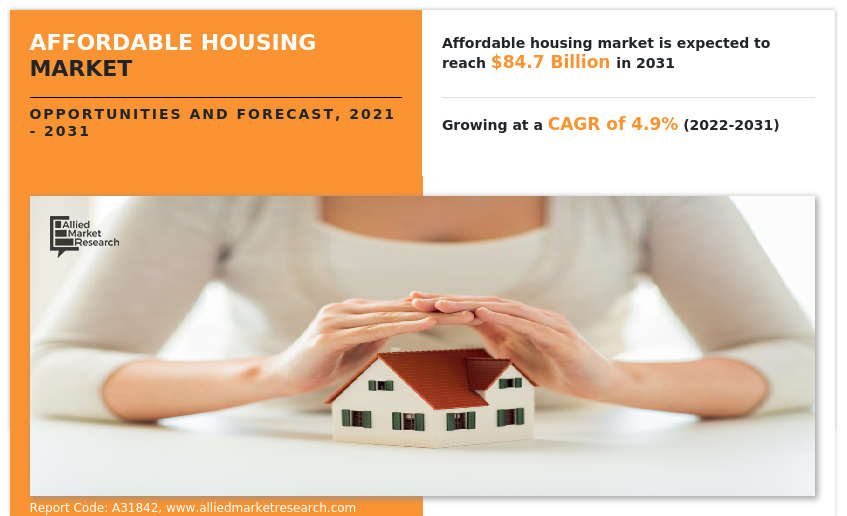
The global affordable housing market size at $52.2 billion in 2021, is expected to grow to $84.7 billion by 2031, with a CAGR of 4.9%. This growth is driven by increasing urbanization, a rising middle-class population, and government initiatives promoting accessible housing. Affordable housing caters to the needs of low- and middle-income groups, particularly in emerging economies like Brazil, China, and India, where urban migration is accelerating. The market faced setbacks during the COVID-19 pandemic but has recovered, supported by resumed construction activities and policy-driven incentives.
𝐃𝐨𝐰𝐧𝐥𝐨𝐚𝐝 𝐏𝐃𝐅 𝐒𝐚𝐦𝐩𝐥𝐞 𝐂𝐨𝐩𝐲@ https://www.alliedmarketresearch.com/request-sample/A31842
Affordable Housing Market Dynamics
Drivers
- Urbanization and Population Growth: Rapid urbanization in emerging economies, where the majority of the global population resides, is a key driver. The United Nations estimates that 68% of the world’s population will live in urban areas by 2050, up from 55% in 2018. Countries like Brazil, China, India, and Eastern European nations are witnessing significant urban migration due to employment and educational opportunities, increasing demand for affordable housing in Tier 1 cities.
- Government Initiatives: Policies aimed at providing affordable housing are fueling market growth. For instance, India’s “Housing for All by FY2023” initiative, extended through March 2023 with additional tax deductions on home loan interest, has spurred development. Similar policies in countries like China, South Korea, and Canada encourage affordable housing projects, enhancing market prospects.
- Access to Financing: Easier access to home loans and financing options is driving demand, particularly among the middle class. Financial incentives, such as tax benefits and subsidized loans, make homeownership more attainable, supporting market expansion.
Challenges
- Market Saturation in Developed Regions: Major cities in developed nations, such as Washington, D.C., have reached saturation, with high property prices and reduced foreign investment limiting affordable housing growth. This restricts market expansion in regions like North America and parts of Europe.
- Impact of COVID-19: The pandemic disrupted construction, manufacturing, and related industries in 2020, halting affordable housing projects and reducing demand. Lockdowns and supply chain disruptions further constrained the market, particularly in major economies like the U.S., Germany, and China.
𝐄𝐧𝐪𝐮𝐢𝐫𝐞 𝐁𝐞𝐟𝐨𝐫𝐞 𝐁𝐮𝐲𝐢𝐧𝐠@ https://www.alliedmarketresearch.com/purchase-enquiry/A31842
Opportunities
- Public-Private Partnerships (PPPs): Growing collaborations between governments and private developers are creating opportunities. For example, the SHAPE-EU project, launched in March 2022 by the European Affordable Housing Consortium, promotes sustainable housing and social impact, fostering market growth in Europe.
- Emerging Markets: Rapid urbanization in Asia-Pacific and LAMEA regions presents significant potential. Projects like India’s city expansions and Brazil’s urban development initiatives highlight the demand for affordable housing solutions.
- Post-Pandemic Recovery: The resumption of construction activities and full-scale operations since late 2021, driven by vaccination rollouts, has revitalized the market, offering opportunities for growth.
Impact of COVID-19
The COVID-19 pandemic significantly impacted the affordable housing market in 2020, with construction activities halted due to lockdowns and supply chain disruptions. Industries like construction, hospitality, and tourism, key drivers of housing demand, were severely affected, leading to a decline in market growth. However, by late 2021, the market began recovering as construction resumed and vaccines reduced pandemic severity. A resurgence of cases in China in early 2023 introduced temporary challenges, but the market is expected to stabilize as global conditions improve.
Affordable Housing Market Segmental Overview
By Provider
The market is segmented into government and public-private partnerships (PPPs):
- Public-Private Partnerships: Dominated in 2021 due to collaborative efforts between governments and private developers, leveraging resources to deliver affordable housing projects efficiently.
- Government: Expected to grow at the highest CAGR, driven by increased policy support and funding for affordable housing initiatives in emerging economies.
By Size of Unit
The market is divided into units up to 400 square feet, 400–800 square feet, and above 800 square feet:
- Above 800 Square Feet: Led in revenue in 2021, catering to middle-income families seeking larger, yet affordable, homes.
- 400–800 Square Feet: Projected to grow at the highest CAGR, appealing to urban migrants and young professionals due to affordability and compact design.
By Location
The market is categorized into urban and rural:
- Urban: Held the largest share in 2021, driven by high demand in cities where migration for employment and education is concentrated.
- Rural: Expected to register the highest CAGR, supported by government initiatives to develop rural infrastructure and housing to address population growth.
By Region
The market is analyzed across North America, Europe, Asia-Pacific, and LAMEA:
- Asia-Pacific: Garnered the highest revenue in 2021, driven by rapid urbanization in China, India, and South Korea. India’s urban expansion projects, such as new city developments near Gurgaon, highlight significant demand.
- LAMEA: Projected to grow at the highest CAGR, fueled by increasing urbanization and infrastructure investments in Latin America, the Middle East, and Africa.
- North America: Faces slower growth due to market saturation in major cities like the U.S., though Canada and Mexico show moderate potential.
- Europe: Benefits from initiatives like SHAPE-EU, promoting sustainable housing solutions.
𝐔𝐩𝐝𝐚𝐭𝐞 𝐎𝐧 𝐃𝐞𝐦𝐚𝐧𝐝@ https://www.alliedmarketresearch.com/request-for-customization/A31842
Competitive Landscape
Key players include:
- Dominium
- Jonathan Rose Companies
- Larsen & Toubro Ltd.
- LDG Development
- TATA Projects
- The NRP Group
- Pennrose
- Prestige Group
- Related Group
- Skanska
These companies employ strategies like acquisitions, partnerships, and business expansions to strengthen their market position. For instance, the SHAPE-EU project in Europe exemplifies collaborative efforts to enhance affordable housing development.
Regional Analysis
- Asia-Pacific: Leads due to rapid urbanization and population growth in countries like India and China. India’s “Housing for All” initiative and city expansion projects drive demand.
- LAMEA: Emerging economies in Latin America and Africa present growth opportunities as infrastructure development accelerates.
- North America: Growth is limited by high property prices and saturation in major U.S. cities, though Canada and Mexico offer potential.
- Europe: Supported by sustainable housing initiatives and partnerships, with projects like SHAPE-EU fostering growth.
Future Outlook
The affordable housing market is set for robust growth, driven by urbanization, government policies, and financing accessibility. Emerging markets in Asia-Pacific and LAMEA, along with innovative partnerships, will propel the market to $84.7 billion by 2031. Challenges like market saturation and pandemic-related disruptions are being mitigated by recovery efforts and policy support.
Key Benefits for Stakeholders
- Market Insights: Quantitative analysis of trends, segments, and forecasts from 2021 to 2031.
- Growth Opportunities: Identifies potential in emerging markets and PPPs.
- Competitive Analysis: Profiles of key players and their strategies aid strategic planning.
- Regional Insights: Detailed analysis of high-growth regions like LAMEA and Asia-Pacific.
The global affordable housing market is poised to grow from $52.2 billion in 2021 to $84.7 billion by 2031, driven by urbanization, government initiatives, and financing accessibility. While challenges like market saturation and COVID-19 impacts persist, opportunities in emerging economies and collaborative projects will sustain growth, making affordable housing a critical solution for global housing needs.




