
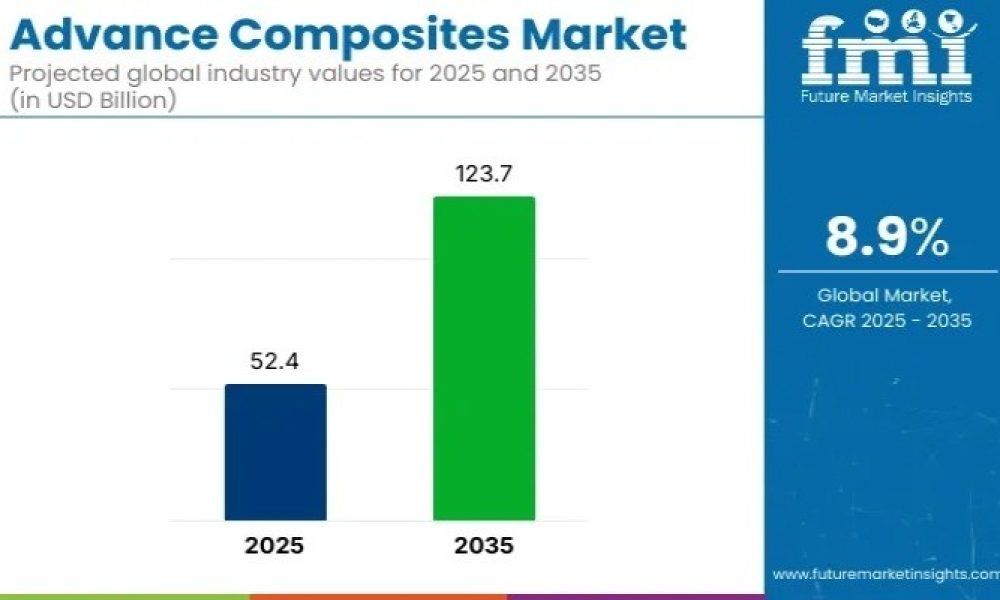
The global advanced composites market is entering a transformative decade marked by rapid innovation, sustainability-focused manufacturing, and growing applications across high-impact industries. Valued at USD 48.1 billion in 2024, the market is projected to grow to USD 52.4 billion in 2025 and further expand to USD 123.7 billion by 2035, reflecting a robust CAGR of 8.9%. Demand is primarily driven by sectors such as aerospace, automotive, construction, electronics, and renewable energy industries increasingly dependent on lightweight, durable, and high-performance materials.
Introduction: The Rise of High-Performance Composite Technology
Advanced composites engineered materials combining high-strength fibers with polymer, ceramic, or metal matrices have become essential to modern engineering. These materials offer unmatched performance benefits including superior strength-to-weight ratio, corrosion resistance, thermal stability, and fatigue endurance. Their adoption is accelerating globally as companies seek solutions that boost energy efficiency, reduce emissions, and enhance product resilience.
Subscribe for Year-Round Insights → Stay ahead with quarterly and annual data updates – https://www.futuremarketinsights.com/reports/sample/rep-gb-15185
Meaning and Importance of Advanced Composites
Advanced composites refer to carbon fiber, aramid fiber, and high-end glass fiber materials integrated with cutting-edge resin systems. Their significance lies in their ability to meet the stringent requirements of next-generation applications:
- Lightweighting of aircraft and vehicles
- Boosting efficiency in wind energy systems
- Enhancing durability of infrastructure
- Improving stealth and performance in defense equipment
- Enabling innovation in electric mobility and robotics
As sustainability becomes a global priority, composites are increasingly engineered to be recyclable, bio-based, or produced from renewable sources.
Market Outlook 2025–2035
The outlook for advanced composites remains strong, supported by rising global investments in aerospace programs, electric vehicle manufacturing, and renewable energy capacity. Key growth drivers include:
- Stricter fuel efficiency and emission norms
- Increased use of carbon fiber in mass production
- Growing adoption of smart composites featuring sensors, self-healing properties, and nanotechnology
- Automation in manufacturing such as robot-enabled filament winding, resin transfer molding, and automated fiber placement
The market is also benefiting from strategic collaborations, as seen with Hexcel Corporation, which announced groundbreaking aerospace composite demonstrations at the Paris Air Show 2025. With innovations improving aircraft efficiency and sustainability, Hexcel reinforces the industry’s long-term growth trajectory.
Advanced Composites Market Overview by Product and Application
Carbon Composites: Dominating with 54.7% Share
Carbon fiber composites remain the star performer due to their exceptional strength-to-weight ratio, stiffness, and endurance under extreme conditions. By 2025, they are expected to command nearly 54.7% of the market, driven by usage in:
- Aerospace & defense
- Automotive and EVs
- High-performance sporting goods
- Wind turbine blades
- Industrial equipment
Advancements in recycling technologies and cost-optimized production processes are making carbon composites more accessible across broader industries.
Aerospace & Defense: Leading with 38.5% Application Share
Aerospace remains the largest end-use sector, accounting for 38.5% of total demand in 2025. Composites are increasingly used for manufacturing:
- Fuselages
- Wing structures
- Engine nacelles
- Radar domes
- UAV components
- Spacecraft panels
As next-generation aircraft programs prioritize lightweighting, improved payload, and reduced fuel consumption, composite integration continues to surge.
Growth, Demand & Emerging Trends in the Advanced Composites Market
Major Industry Trends
- Shift to Sustainable Materials: Manufacturers are adopting recyclable, bio-based, and renewable composite materials to meet global environmental regulations.
- Rise of Smart Composites: Self-healing matrices, embedded sensor technologies, and nanotechnology-enhanced durability are shaping next-gen applications.
- Automation & Digital Manufacturing: AI-driven quality control, robotics, and digital twins are improving precision and cutting production costs.
- Expansion in Renewable Energy: Longer, lighter turbine blades made of carbon composites are boosting wind energy efficiency.
Challenges in the Advanced Composites Industry
High Production Costs
Premium raw materials and complex production methods limit affordability. Autoclave curing, precision tooling, and manual labor contribute to higher prices.
Limited Recycling Technologies
Traditional composites are difficult and energy-intensive to recycle. The absence of scalable, cost-effective recycling infrastructure hinders circular economy efforts.
Opportunities Driving Future Growth
- Aerospace & Automotive Expansion: With electric vehicles and next-gen aircraft on the rise, demand for lightweight materials is expected to surge.
- Renewable Energy and Infrastructure: Composites are increasingly used in wind turbines, bridges, rail systems, and shipbuilding for their corrosion-resistant and long-life characteristics. Companies investing in innovative designs, sustainability-led materials, and automation will hold competitive advantages.
Country-Wise Outlook
- USA – CAGR 9.3%: Strong aerospace, defense, and wind energy sectors continue to drive demand.
- UK – CAGR 9.1%: Growth supported by EV production, aerospace innovation, and sustainability initiatives.
- EU – CAGR 9.2%: Germany, France, and Italy lead the region with strong automotive and aerospace manufacturing bases.
- Japan – CAGR 9.4%: Advanced robotics and material science strengthen composite production and adoption.
- South Korea – CAGR 9.5%: One of the fastest-growing markets, driven by EV manufacturing, electronics, and nanocomposite research.
Competitive Landscape
The industry is led by major players investing heavily in research, sustainability, and automation technologies. Key companies include:
- Toray Industries (18–22%)
- Hexcel Corporation (14–18%)
- Solvay S.A. (10–14%)
- Teijin Limited (8–12%)
- Mitsubishi Chemical Corporation (6–10%)
- SGL Carbon, Royal DSM, Arkema, Huntsman, Owens Corning (collective 40–50%)
These companies are advancing next-generation materials, improving recyclability, and strengthening global supply chains.
Have a specific Requirements and Need Assistant on Report Pricing or Limited Budget please contact us – [email protected]
About Future Market Insights (FMI)
Future Market Insights, Inc. (FMI) is an ESOMAR-certified, ISO 9001:2015 market research and consulting organization, trusted by Fortune 500 clients and global enterprises. With operations in the U.S., UK, India, and Dubai, FMI provides data-backed insights and strategic intelligence across 30+ industries and 1200 markets worldwide.



