
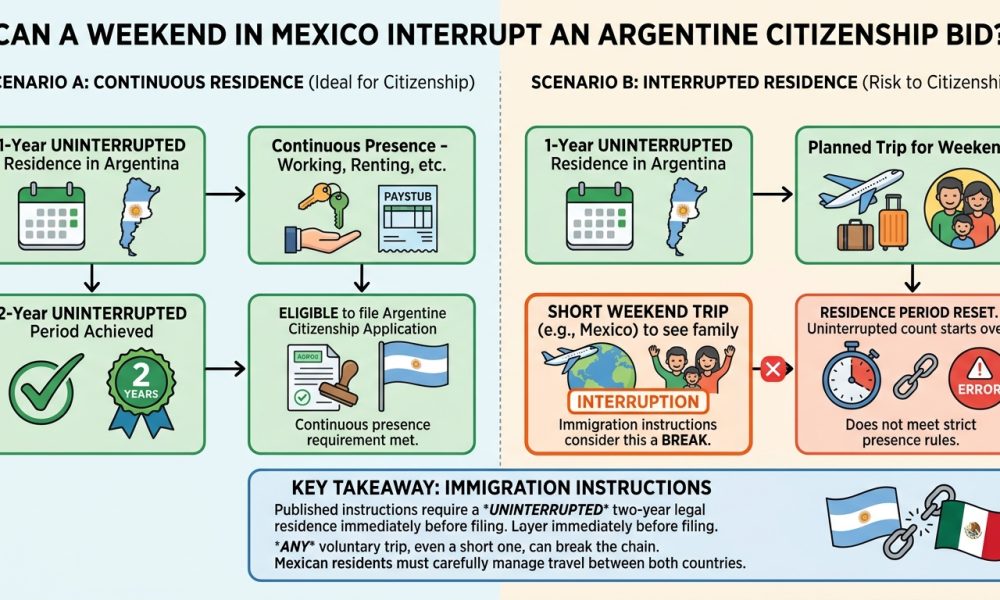
Argentina’s immigration agency currently requires two years of legal residence without any international departure for ordinary naturalization applications, meaning even a short family visit to Mexico can create difficulties. However, an ongoing constitutional dispute challenges the legal basis for that interpretation.
WASHINGTON, D.C., November 25, 2026
A Mexican citizen pursuing Argentine naturalization could face a serious setback after traveling home for a weekend, because Argentina’s published immigration instructions interpret the two-year residence requirement as uninterrupted physical presence, with no departure from the country.
The restriction creates practical challenges for residents maintaining relatives, businesses, or financial responsibilities in Mexico, while a 2026 court ruling against the presidential decree behind the policy has introduced significant uncertainty about its ultimate enforceability.
Argentina’s Immigration Agency Applies a Strict Rule
Argentina’s National Directorate of Migration currently states that qualifying foreign applicants must have held temporary or permanent residence for more than two years and remained legally and continuously in Argentina throughout the two years preceding their citizenship application.
The agency’s published naturalization requirements specify that applicants must not have departed internationally during that period, creating a restriction substantially more demanding than maintaining an address or satisfying an ordinary residence-permit condition.
Under that administrative interpretation, a Mexican national who spends nearly two years living in Buenos Aires before visiting relatives in Guadalajara could lose the ability to rely on the earlier uninterrupted period for an immediate citizenship application.
The 2025 Decree Changed the Meaning of Continuity
Decree of Necessity and Urgency 366/2025, published on May 29, 2025, amended Argentina’s citizenship framework by connecting ordinary naturalization eligibility to two years of continuous legal residence immediately before the application is submitted.
The decree expressly defines continuous residence as remaining within Argentine territory throughout the relevant period without departing abroad, making a short international trip potentially significant regardless of the traveler’s continuing employment or housing arrangements.
The same reform shifted responsibility for granting naturalization from the traditional federal judicial system to the National Directorate of Migration, creating a separate constitutional controversy that eventually reached Argentina’s higher courts.
A Weekend Trip Can Have Disproportionate Consequences
Consider a Mexican professional who receives qualifying Argentine residence on January 1, 2026, establishes a home in Buenos Aires and maintains steady employment while planning to apply for citizenship after completing the necessary residence period.
If that individual flies to Mexico City for a family celebration in December 2027 and returns after three days, the immigration agency’s published interpretation would treat the international departure as interrupting the required continuous period.
Under a straightforward application of that policy, the traveler may need another uninterrupted qualifying period before filing. However, ongoing litigation means the actual legal consequences should be assessed under the rules governing the individual case.
The Rule Does Not Distinguish Holiday Travel
The decree’s continuity language does not create an ordinary exemption for short holidays, family visits, or business meetings, so applicants should not assume an absence becomes harmless merely because it was short.
A brief visit to Uruguay, Chile, Brazil or Mexico could therefore raise the same administrative problem, because the published requirement focuses on whether the applicant departed Argentine territory during the relevant period.
This differs from residence rules in many other immigration systems that allow specified absences, making it especially important for prospective applicants to avoid importing assumptions based on their experience with European or North American naturalization procedures.
Mexico’s Family Connections Can Make Compliance Difficult
Mexican residents often maintain parents, children, professional obligations, and investments in their country of origin, making a two-year international travel restriction potentially burdensome for anyone who cannot reasonably remain abroad for every family event.
Unexpected illness, bereavement, employment emergencies or legal appointments may require travel with little notice, and the agency’s published guidance does not provide a general short-trip exception that applicants can safely assume applies.
Families evaluating Argentina as a long-term residence destination should therefore discuss realistic travel requirements before relocating, rather than discover the conflict after employment, housing and school arrangements have already been established.
The Rule Concerns Naturalization, Not Every Residence Permit
A distinction must be made between maintaining a valid Argentine immigration residence permit and satisfying the special continuity requirement for citizenship, because the rules governing prolonged absences from temporary or permanent residence are not identical to the decree’s naturalization conditions.
Someone who leaves Argentina for several days may retain valid immigration permission but still face an objection to the uninterrupted period required for naturalization, meaning continued lawful residence and eligibility to file for citizenship require separate analysis.
The Constitutional Dispute Changes the Legal Picture
On June 30, 2026, Argentina’s National Electoral Chamber declared the contested presidential decree invalid in a case involving Liping Yang, a Chinese national whose naturalization proceedings raised questions about immigration status and the proper authority to decide citizenship applications.
The June 2026 La Nación report on the electoral chamber’s ruling described the court’s objections to the executive government’s assumption of naturalization authority, a development with potentially important consequences for the legal basis of the stricter residence requirements.
The Appeal Prevents a Simple Conclusion
The Argentine government appealed the electoral chamber’s decision, and the dispute advanced to the Supreme Court in September 2026, leaving applicants without a final judicial resolution that conclusively settles the challenged administrative framework.
The pending controversy means it would be misleading to state that every short international journey permanently destroys naturalization eligibility, just as it would be misleading to promise that courts will disregard the agency’s published restrictions.
Constitutional Residence Language Remains Important
Argentina’s Constitution recognizes naturalization following two years of continuous residence, while the legal dispute concerns how that constitutional provision may be implemented and whether the executive branch could impose the contested requirements through an emergency decree.
Historically, judicial naturalization proceedings assessed actual residence and personal circumstances, whereas the 2025 administrative reform sought to establish an express prohibition on any departure during the qualifying period.
A Court Challenge Is Not an Automatic Exemption
Applicants should not interpret the lower court’s ruling as personal authorization to disregard published requirements, because the outcome of a constitutional challenge and its effect on an individual application can depend on procedural circumstances and subsequent judicial decisions.
A foreign resident planning urgent travel should obtain current Argentine legal advice before departure, especially where the person has already completed substantial residence and a short absence could affect the intended citizenship filing date.
The Starting Date Must Also Be Established
Before examining international departures, a Mexican applicant should identify the legally effective commencement of qualifying temporary or permanent residence, since an earlier tourist visit to Buenos Aires does not automatically satisfy the agency’s current naturalization requirements.
Maintaining an apartment or receiving an employment offer before formal immigration authorization may help explain settlement plans. Still, those circumstances should not replace the residence status required under the published administrative procedure.
A Pending Application Raises Different Questions
An immigration appointment, provisional certificate, or pending residence application may not carry the same legal weight as approved temporary or permanent residence, so the exact nature and validity of each document are central to determining eligibility.
Where the official residence record contains processing delays or overlapping authorizations, applicants should request clarification of their recognized immigration status instead of selecting a favorable date without supporting government evidence.
Entry and Exit Records Provide Critical Evidence
Argentine authorities may review entry and departure records when assessing the claimed continuous period, so travelers should preserve complete, accurate documentation of their journeys rather than rely solely on personal recollection or informal calendars.
Airline records, border registrations, and passport information can help establish what happened, while any discrepancy between official movement records and an applicant’s declaration should be addressed transparently through the proper legal channels.
Using Another Passport Does Not Conceal Departure
A person holding Mexican and another nationality should not assume that leaving Argentina on a different passport makes the journey irrelevant, because citizenship eligibility concerns the individual’s travel and legal residence rather than one document’s stamps.
Attempting to hide departures or submit inconsistent identity information could create additional credibility and legal problems, potentially more serious than the original question about whether a brief journey interrupts the qualifying residence period.
Emergency Travel Requires Individual Advice
A medical emergency involving a parent in Mexico may create compelling personal reasons for departure. Still, applicants should not assume that sympathetic circumstances automatically establish an exception to the decree’s strict published continuity language.
Qualified counsel can assess whether particular facts support a legal argument, procedural challenge, or other available remedy. Still, no responsible adviser should guarantee recognition of an exemption that current agency instructions do not expressly provide.
Employment Travel Needs Advance Planning
Mexican executives overseeing operations in both countries may struggle to meet an uninterrupted residence requirement, particularly when quarterly meetings, contract negotiations, or inspections require personal attendance outside Argentina during the qualifying period.
Employers and applicants should evaluate whether lawful remote participation or delegation can reduce travel requirements, without making misleading statements about where work occurred or whether international departures took place.
International Students Face Similar Complications
Students holding qualifying Argentine residence may need to attend examinations, visit family or complete professional placements abroad, creating potential conflicts between ordinary educational mobility and the agency’s demanding approach to naturalization residence.
A university enrollment certificate does not resolve those issues on its own, since the student’s immigration authorization, travel history, and applicable citizenship procedure must each be assessed under their governing requirements.
Tax Residence Is Not the Same Calculation
Spending substantial time in Argentina may create Argentine tax consequences, but satisfying a domestic income tax residence test does not automatically establish the distinct legal and physical presence conditions demanded for naturalization.
Similarly, maintaining Mexican tax obligations or an overseas investment account does not, by itself, prove that a person left Argentina, making accurate separation of residence, taxation, and nationality essential to sound cross-border financial planning.
Mexican Citizenship Can Remain Protected
Mexican nationals by birth enjoy constitutional Protection against deprivation of their Mexican nationality, meaning acquiring Argentine citizenship may be compatible with retaining Mexican citizenship, subject to applicable legal conditions and documentation requirements.
People who acquired Mexican nationality through naturalization, however, occupy a different legal position and should investigate the consequences of acquiring another citizenship before assuming that protections applicable to Mexicans by birth extend identically.
American Dual Nationals Face Separate Requirements
Some Mexican residents of Argentina also hold American citizenship, and the U.S. State Department’s dual-nationality guidance explains continuing passport obligations that remain relevant even when an individual lawfully acquires another citizenship through naturalization.
American nationality neither eliminates Argentina’s residence requirements nor changes the factual record of international departures, so applicants with multiple citizenships should review each country’s rules without assuming another passport provides special treatment.
Families Should Preserve Authentic Civil Records
Applicants considering Amicus International Consulting’s new identity services should distinguish lawful changes to personal information from misrepresenting travel or residence, because citizenship applications require consistent identities, genuine civil records, and truthful disclosure of relevant immigration history.
When an applicant has changed names or acquired additional nationality, official supporting documents should connect earlier and current records, allowing Argentine authorities to examine the individual’s complete history without relying on fabricated explanations.
Residence Planning Is More Than Counting Days
Families exploring Amicus International Consulting’s second passport services should assess whether staying in Argentina without international travel realistically fits their personal, professional, and financial circumstances during the proposed qualifying period.
A second citizenship may offer valuable international mobility after lawful approval. Still, applicants should not sacrifice essential family responsibilities based on unsupported assurances that a weekend departure will not affect the citizenship process.
The Safest Approach Is to Verify Before Traveling
A Mexican citizen nearing the end of the two years should obtain an individualized review of residence documents, departure history, and the current legal framework before purchasing international tickets or submitting a naturalization application.
Legal advice should address the agency’s published instructions and the constitutional litigation together, because concentrating exclusively on either source can produce an incomplete picture of the requirements that officials may actually apply.
The Central Question Remains Unresolved in Court
Under Argentina’s published administrative interpretation, even a weekend trip to Mexico interrupts the uninterrupted two-year period required for ordinary naturalization, making short family visits a potentially consequential decision for prospective applicants.
However, because the decree establishing that strict requirement has been challenged in court and the government appealed, the ultimate legal effect of a particular departure must be assessed against the governing law and judicial developments.
For Mexican citizens considering Argentine nationality, the responsible approach is to preserve reliable residence records, obtain current legal guidance before departure,e and avoid assuming that either an uninterrupted stay or a favorable court outcome guarantees citizenship approval.