
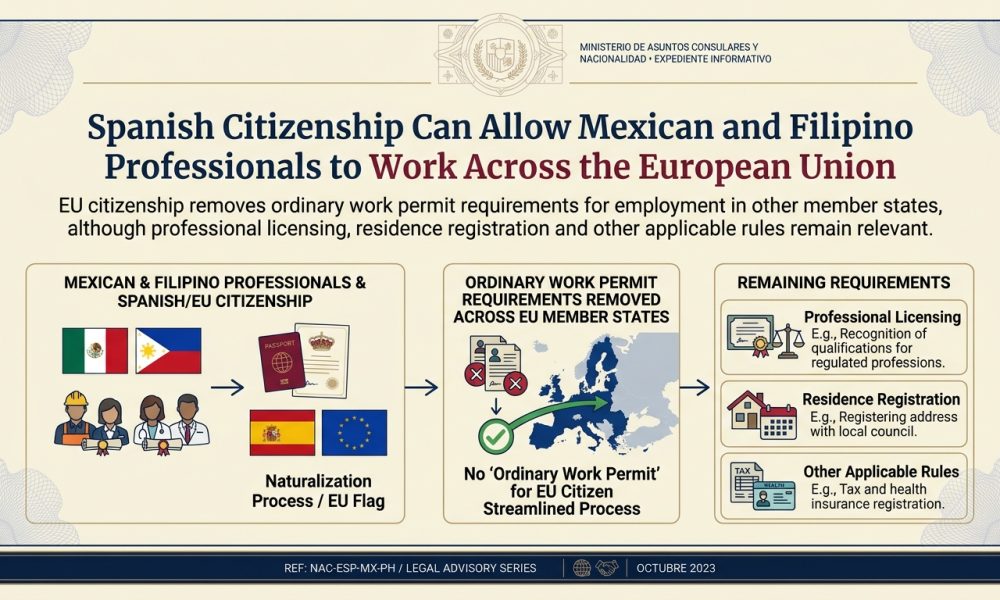
Naturalized Spanish citizens gain European Union employment rights. However, professionals trained in Mexico or the Philippines must still navigate qualification recognition, local registration, language standards, and employment rules before practicing in another member state.
WASHINGTON, D.C., November 24, 2026
Mexican and Filipino professionals who lawfully acquire Spanish nationality can enter European labor markets under rules designed for European Union citizens, removing ordinary work permit barriers while leaving professional qualifications, employment contracts and local regulations subject to independent assessment.
The change may matter for engineers, nurses, technology specialists, and entrepreneurs considering long-term relocation. Still, the right to work follows completed Spanish citizenship rather than simply holding a residence card, submitting a nationality application, or receiving preliminary approval.
Spanish Naturalization Changes Employment Status
Spanish nationality makes a person an EU citizen, giving a newly naturalized professional the same basic free movement rights as other Spanish nationals, regardless of whether the individual was originally Mexican, Filipino, or held another citizenship.
Article 45 of the Treaty on the Functioning of the European Union protects free movement of workers, meaning eligible citizens generally can seek employment in another member state without undergoing the conventional immigration sponsorship process imposed on third-country nationals.
That legal advantage should not be described as a universal employment guarantee, because employers remain entitled to assess relevant experience, require lawful professional qualifications, and apply ordinary recruitment standards consistent with European equal treatment rules.
The Two-Year Spanish Route Remains Conditional
Spain’s Civil Code provides a two-year qualifying residence threshold for certain nationals of Ibero-American countries and the Philippines. Still, legal and continuous residence, good civic conduct, and required naturalization formalities remain essential.
A Mexican or Filipino applicant who reaches the statutory threshold can request nationality. Yet, government processing, the required declarations, and civil registration may continue well beyond that period before the person can document citizenship for employment abroad.
Employers should not treat an application receipt, immigration residence card, or naturalization approval alone as conclusive evidence that a candidate already has the free movement rights of a registered Spanish citizen who has completed the required acquisition formalities.
A Work Permit Is Generally Unnecessary
Professionals can sometimes apply for vacancies before relocating and negotiate contracts while still in Spain. Still, they should verify the documentation the prospective employer needs to establish their effective citizenship and lawful ability to start work.
Once Spanish citizenship takes effect, an individual may ordinarily accept employment in France, Germany, Ireland, or another EU member state without applying for a separate work permit, even when the original qualifications were earned outside Europe.
This is an immigration distinction, not an automatic judgment about professional competency, and an employer may still require language proficiency, licensing, background checks and evidence that foreign academic credentials satisfy the demands of a particular position.
Public employment can also involve narrow nationality restrictions for posts involving the exercise of public authority or safeguarding state interests, so EU citizenship does not create unrestricted eligibility for every government role in every national administration.
Residence Registration Still Applies
Relocating professionals should keep records of arrival, rental agreements, and employment start dates, since local registration appointments, municipal records, and social insurance enrollment may be required even when no conventional residence permit is necessary.
During an initial stay of up to three months, EU citizens generally may reside in another member state with a valid passport or national identity card, subject to the limited exceptions recognized in European law.
For longer stays, workers and qualifying self-employed people generally have residence rights under Directive 2004/. However, the destination country may require registration and evidence supporting the individual’s lawful status and actual employment activity.
Jobseekers, students, and economically inactive newcomers may face different residence conditions, so it is important to distinguish an established employee from someone exploring possibilities without a contract, adequate resources, or qualifying insurance coverage appropriate to their circumstances.
Equal Treatment Protects Mobile Workers
An EU national working in another member state generally has the right to equal treatment with local nationals in employment conditions, remuneration and other covered social and tax advantages, subject to specific legal conditions.
Employers cannot ordinarily impose a foreign-worker permit requirement merely because a Spanish citizen was born in Manila or Mexico City. However,h legitimate language and professional competence requirements can still apply to particular roles.
Workers should also check collective agreements, occupational safety rules and local employment contracts, because free movement Protection operates alongside the host country’s substantive labor standards rather than replacing the framework governing wages and working conditions.
Professional Licensing Is a Separate Gatekeeper
A regulated profession is one whose legal practice requires specific qualifications, a professional title or authorization; common examples include doctors, nurses, pharmacists, architects, and other professions governed by national supervisory bodies in individual member states.
An applicant who trained in Mexico or the Philippines may need the relevant host authority to recognize that training, even after becoming Spanish, because the source of an academic qualification remains distinct from the holder’s nationality.
Professionals should examine the destination’s regulated-professions database, collect diplomas and transcripts, and identify the competent authority before accepting a start date that assumes immediate permission to practice or sign regulated professional work in that jurisdiction.
Foreign Diplomas Are Not Automatically European
Professional experience obtained in Mexico or the Philippines can still have substantial commercial value. Yet, regulators may distinguish work history from officially recognized training and require a detailed comparison of academic subjects, supervised practice, and professional competencies.
European rules provide recognition frameworks for qualifications obtained within member states. Still, diplomas originally awarded by a third-country institution can require national assessment before they receive equivalent professional standing in a destination country.
Where an EU country has already recognized a third-country qualification and the professional has acquired three years of relevant experience there, particular European recognition provisions may become available for subsequent movement to another member state.
The specific conditions are technical and profession-dependent, so a newly naturalized applicant should obtain written confirmation from the competent regulator rather than assume that holding a Spanish passport transforms every foreign diploma into an EU-issued qualification.
Healthcare Workers Face Important Safeguards
Medical regulators may also ask for criminal background disclosures, certificates of professional good standing, and evidence of continuing education, so acquiring Spanish nationality should be seen as one credential rather than the completion of clinical licensing.
Doctors and nurses may encounter licensing reviews, language assessments and evidence of clinical practice, because public health safeguards apply even where labor shortages encourage hospitals to recruit internationally trained professionals with increasingly diverse backgrounds.
The EU has automatic recognition mechanisms for certain professions based on harmonized European training standards. Still, a foreign medical degree does not necessarily qualify for that mechanism simply because the practitioner subsequently becomes an EU citizen.
A Filipino nurse planning to work in Germany or a Mexican doctor considering France should check the particular licensing body, supervised practice conditions, and accepted language certificates before treating an informal recruitment offer as permission to begin clinical duties.
Engineers and Architects Must Check Local Rules
Engineering and architecture illustrate the difference between open employment opportunities and protected professional activities, because some technical positions may be accessible through ordinary recruitment. At the same time,e specific signatures, design approvals, or titles require registration.
A Mexican engineer whose degree was earned outside Europe could qualify for a private technical role while still needing additional recognition for regulated responsibilities, making the job description and the host country’s legal classification decisive.
Architects may benefit from EU recognition systems when their training meets applicable requirements. Still, applicants should confirm whether they hold a qualifying credential and whether they need further documentation or adaptation measures for the intended work.
Technology Careers May Have Fewer Licensing Barriers
Candidates comparing opportunities across Germany, France and Ireland should investigate prevailing salary levels, employment protections and practical language expectations, because the strongest career choice depends on accessible roles and household costs rather than passport access alone.
Software development, digital marketing and many technology roles are not uniformly regulated professions, so newly naturalized Spanish citizens may face fewer formal qualification-recognition hurdles when applying for positions across European technology and business markets.
Employers can still ask for verified experience, security screening, or industry certifications. At the same time, workers must consider local contracts, data Protection obligations, and tax rules rather than assume free movement eliminates ordinary workplace responsibilities.
Professionals planning freelance services across several countries should establish where their business is registered and where work is performed, because cross-border activity can create complex obligations involving value-added tax, insurance and employment classification.
European Employers Still Face Skills Barriers
A Reuters report on barriers within the EU single market identified limited recognition of professional qualifications as an obstacle preventing labor from moving easily across borders, highlighting an enduring distinction between legal mobility and practical access to regulated jobs.
The February 2026 reporting focused on the broader European economic agenda rather than Mexican or Filipino applicants specifically. Still, it supports the conclusion that obtaining an EU passport cannot, by itself, resolve fragmented licensing requirements.
Language Requirements Can Influence Hiring
European employers may legitimately require language ability suited to a role’s responsibilities, especially where workers communicate with patients, give public safety instructions, or provide regulated services directly to vulnerable members of the public.
Spanish citizenship may open the right to seek employment in Poland or the Netherlands. Still, it does not automatically establish proficiency in Polish or Dutch, nor does previous DELE language testing satisfy every employer’s requirements.
Filipino professionals with strong English skills may find English-language vacancies attractive. In contrast, Mexican professionals may use Spanish and English experience strategically, though they must assess opportunities against the destination’s labor market and hiring conditions.
Family Residence Adds Another Layer
Before a move, the household should coordinate marriage and birth certificates, any required translations, and documents establishing dependency, ensuring a dependent family member does not mistakenly rely on a Spanish citizen’s rights without verifying applicable family procedures.
Qualifying spouses and dependent relatives of an EU citizen exercising free movement can benefit from derivative rights under Directive 2004/38. However, family relationships, supporting records and the precise circumstances of residence remain legally important.
A Filipino spouse who is not Spanish may be able to accompany a newly naturalized Spanish partner working in another member state. Still, the family should check the applicable visa and residence-card procedures before traveling.
Family rights do not make every relative an EU citizen or grant automatic naturalization, and a non-EU family member may still need documentation establishing the relationship and eligibility under the host country’s implementation of European rules.
Taxes and Social Insurance Follow Work Circumstances
Relocating to another EU country can change tax residence, payroll withholding and social security coverage, creating obligations separate from immigration permission that employees and entrepreneurs should review with appropriately qualified professionals before commencing work.
EU coordination rules can protect certain social security rights and clarify which system covers cross-border workers. Still, they do not create benefits without qualifying contributions or eliminate the responsible national authority’s requirements.
Remote employment for a company based in Spain while living elsewhere can raise additional employer-registration and permanent-establishment issues. Hence, a written agreement about the actual work location is important before moving across borders for professional reasons.
Dual Citizenship Does Not Erase Earlier Duties
Professionals who also hold American nationality remain subject to relevant United States passport and reporting rules. In contrast, Mexican and Philippine nationality retention questions must be assessed independently of Spain’s permission to naturalize qualifying applicants.
The U.S. State Department’s dual-nationality guidance explains that American citizens must use American passports to enter and depart the United States, demonstrating why several passports can create overlapping requirements rather than eliminating national responsibilities.
Identity Records Must Remain Consistent
A legitimate name change should be traceable through official civil records, especially when professional diplomas, employment references, and criminal-history certificates were issued under earlier names or different national surname conventions used by foreign institutions.
Readers considering Amicus International Consulting’s new identity services should recognize that genuine credentials and truthful disclosure remain necessary for Spanish naturalization, European professional licensing,g and employers performing lawful identity verification during recruitment and hiring.
Mobility Planning Should Follow the Correct Sequence
Professional planning also needs a realistic financial margin for qualification fees, temporary accommodation, and periods between job offers, since the right to enter a labor market does not guarantee a salary immediately after arrival or registration.
Families exploring Amicus International Consulting’s second passport services should distinguish legitimate planning assistance from government decisions, because neither citizenship recognition nor professional authorization can be guaranteed by a private intermediary promising immediate employment.
A practical sequence begins with eligible Spanish residence and nationality acquisition, continues through civil registration and authentic Identification, and then addresses specific employers, qualification authorities, relocation documentation, and family needs in the intended EU member state.
The result can be substantial professional mobility for Mexican and Filipino citizens who lawfully become Spanish. Still, success depends on distinguishing the right to work from the qualifications, language skills, and local obligations required to perform a particular job.




