
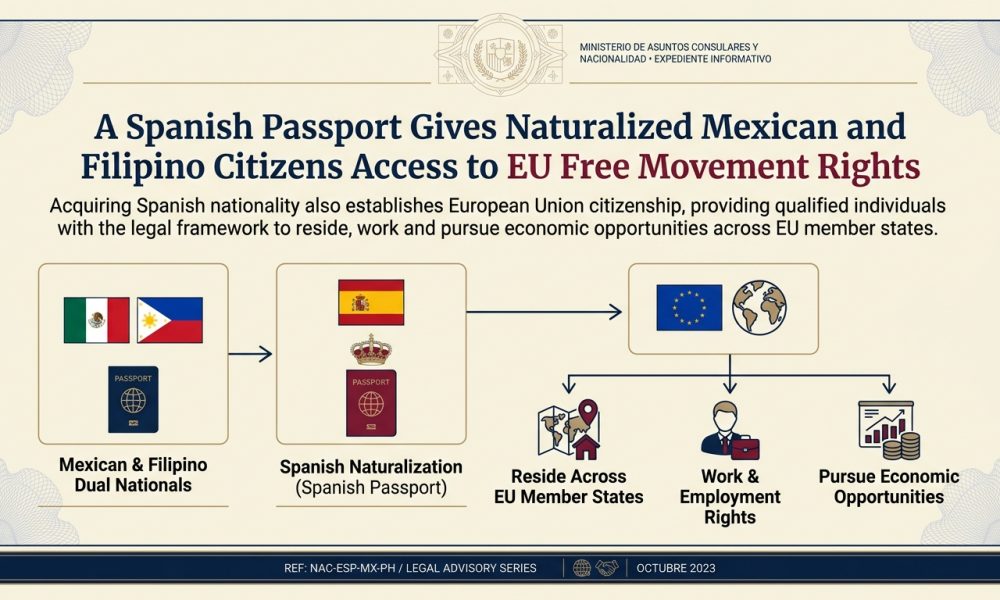
Spanish naturalization confers European Union citizenship, allowing qualifying former Mexican and Filipino residents to pursue work, residence and education across member states while remaining subject to registration, family, insurance and national legal requirements.
WASHINGTON, D.C., November 24, 2026
Mexican and Filipino nationals who complete Spanish naturalization gain more than an additional travel document, because recognized Spanish citizenship also establishes European Union citizenship and the associated framework for living and working across member countries.
That opportunity can transform long-term family and professional planning. However, the underlying rights arise from lawful nationality acquisition rather than passport possession alone, and extended residence in another member state remains subject to established conditions.
Spanish Nationality Is the Gateway to Union Citizenship
European Union treaties recognize every national of a member state as a Union citizen, meaning a person who validly acquires Spanish nationality receives that additional status without filing a separate application to become European.
The Spanish passport then provides widely recognized evidence of nationality for travel. Still, the legal basis is the citizenship granted through Spain’s official procedures, not a private arrangement or possession of an apparently valid booklet.
For migrants originally holding Mexican or Philippine nationality, the distinction matters because qualifying residence, documentary review, approval, the prescribed oath, and civil registration must be completed before ordinary Spanish identity and passport issuance can follow.
Two-Year Eligibility Does Not Mean a Two-Year Passport
Spain’s Civil Code provides a reduced application threshold after two years of legal, continuous residence for qualifying nationals by origin of Ibero-American countries and the Philippines, subject to good conduct and integration requirements.
That statutory threshold establishes eligibility to request naturalization, not a government commitment to conclude administrative review within two years or immediately produce a passport, because additional formalities follow even an approved nationality decision.
Applicants should also distinguish an authorization classified as residence from a temporary permission classified as a stay, since immigration records, renewals, and absences can affect whether the statutory period has been satisfied.
European Mobility Rights Begin With Recognized Citizenship
The resulting entitlement is especially important for people who previously needed employer sponsorship or a family-based visa in each destination, because Union citizenship changes the governing immigration framework while leaving ordinary national registration and professional regulations intact.
Once Spanish nationality takes effect, the holder becomes an EU citizen with rights under the treaties and Directive 2004/38, including the right to move to another member state without an ordinary third-country work visa.
Those rights do not eliminate every administrative obligation, because host countries can require residence registration and may assess whether people staying beyond the initial period meet worker, student, or financial-resource conditions.
A Mexican-born Spanish citizen considering Germany, or a Filipino-born Spanish citizen considering France, should therefore evaluate the destination’s registration rules while recognizing that nationality removes major immigration barriers encountered by ordinary non-EU applicants.
Short Visits Usually Require Only Valid Identification
For stays of up to three months in another EU member state, a Union citizen generally needs only a valid passport or national identity card, subject to narrowly defined public policy and security limitations.
The free-movement right can make exploratory visits and relocation research significantly easier, allowing newly naturalized Spaniards to assess neighborhoods, employers and schools without first obtaining the ordinary residence visa required of many foreign nationals.
A traveler should nevertheless distinguish access under EU law from airline document requirements and from the rules of countries outside the Union, since a Spanish passport does not erase every national border or customs procedure.
Longer Residence Depends on the Individual’s Circumstances
Beyond the initial three months, workers and genuinely self-employed people generally retain residence rights under the directive, while students and economically inactive residents face additional requirements concerning sufficient resources and comprehensive health insurance coverage.
Host authorities may request registration and supporting evidence. Still, they cannot ordinarily transform an eligible Union worker into a conventional foreign visa applicant merely because the person obtained Spanish nationality through naturalization rather than birth.
People relocating primarily for retirement should pay close attention to the insurance and resources rules, because a European passport alone does not automatically entitle them to every publicly financed benefit available in the destination country.
Employment Opportunities Reach Across Member States
Recruiters and businesses may view documented Spanish nationality as simplifying work authorization. However, candidates still need to assess language requirements, credential recognition, and local employment protections before deciding whether a particular opportunity meets their needs.
EU citizenship generally permits employment and self-employment in another member country without an ordinary work permit, expanding the labor markets available to naturalized Spaniards beyond the opportunities immediately surrounding their original Spanish residence.
Employers may still require professional qualifications, background checks or local registrations, especially in regulated sectors such as medicine, law and engineering, because free movement does not automatically recognize every diploma or license issued abroad.
An experienced Filipino healthcare professional or Mexican engineer should therefore examine recognition procedures before accepting an offer, distinguishing the right to enter the labor market from permission to practice a specifically regulated profession.
Entrepreneurs Gain Mobility but Not Regulatory Immunity
A newly naturalized Spanish citizen may generally establish a business or pursue self-employment in another EU country under applicable free-movement and internal-market protections, creating possibilities for consultancy, technology ventures and cross-border commercial activity.
Business registration, sector licensing, social insurance, and taxation still depend on the relevant jurisdiction, and operating from several member states may require professional advice on permanent establishments, employment status, and local reporting responsibilities.
Spanish citizenship can substantially reduce immigration obstacles, but it cannot replace commercial due diligence or authorize entrepreneurs to conceal beneficial ownership, ignore professional rules or transact without the permits required for their particular activities.
Students Can Pursue Education Across the Union
Spanish nationals can explore educational programs in other member states under the EU equal-treatment principle. However,h admission standards, language proficiency, enrollment documentation, and the calculation of available grants remain governed by specific institutional and national rules.
Students residing longer than three months may need to demonstrate enrollment, comprehensive health insurance, and sufficient resources, so families should budget for living expenses rather than assume EU citizenship guarantees unconditional financial support.
The meaningful opportunity nonetheless broadens choices for children whose parents completed Spanish naturalization, particularly when the family can plan schooling and residence together while meeting the documentation requirements of the chosen institution.
Families Can Often Accompany a Mobile EU Citizen
Where spouses or children remain outside Europe, entry visas and supporting documents may still be necessary under the applicable family rules, and authorities can examine whether the sponsoring citizen is genuinely exercising free-movement rights.
Directive 2004/38 provides important derivative rights for qualifying family members of an EU citizen moving to another member state, including certain spouses, registered partners, descendants and dependent relatives under specified legal conditions.
A Mexican or Filipino spouse who has not acquired Spanish nationality may therefore have a family residence route when accompanying a mobile Spanish citizen. However, marriage records, dependency evidence and residence-card procedures can still be required.
These rights should not be described as automatic citizenship for the spouse or children, since family residence and nationality acquisition remain separate legal processes, with additional complexities when the family returns to Spain itself.
Permanent Residence Normally Follows Five Qualifying Years
EU law generally grants permanent residence in a host member state after five years of continuous lawful residence there, subject to detailed rules governing continuity, qualifying status and certain permitted absences during that period.
This right concerns residence in the destination member state rather than a second naturalization grant, and an individual already Spanish does not need another country’s passport merely to obtain continuing lawful residence there.
Certain specialized cases may qualify for earlier permanent residence. Still, families should not assume that five years of intermittent tourism or residence that failed the directive’s conditions automatically fulfills the normal qualifying standard.
Social Benefits Depend on the Applicable Rules
Moving between member states can also affect where social security contributions are paid, which authority provides health coverage and how periods of employment are coordinated, so practical arrangements should precede a permanent household move.
EU citizenship includes equal-treatment protections under Union law. Yet, access to certain social assistance programs can depend on lawful residence status, economic activity, and permissible exceptions during the initial months.
New arrivals should check health coverage, employment contributions, and local benefit eligibility instead of relying on promotional claims that a Spanish passport automatically provides full public healthcare and cash assistance everywhere immediately.
The same caution applies to pension portability and recognition of contribution histories, because coordination rules can help workers but do not create employment credits or retirement contributions that an individual never actually earned.
Spain’s Naturalization Numbers Illustrate the Broader Context
A May 2026 report by The Local described nearly 300,000 residents acquiring Spanish nationality during 2025, highlighting the scale of an administrative system through which many previously non-EU residents obtain new citizenship rights.
Those figures encompass different national backgrounds and legal circumstances, so they should not be mistaken for a count of Mexican and Filipino applicants or proof that any particular household will receive an approval.
These EU rights nevertheless explain why obtaining Spanish nationality can be strategically different from renewing a Spanish residence card, even when the person has already lived and worked lawfully in Spain for years.
Citizenship Also Brings Political and Civic Rights
European Union citizenship can support participation in municipal and European Parliament elections in the member state of residence under applicable rules, alongside rights to petition European institutions and seek certain consular protections abroad.
These political and civic rights operate within specific registration and eligibility frameworks, and they should not be confused with unrestricted participation in national parliamentary elections throughout the Union or universal eligibility for government employment.
For naturalized Spaniards, this additional civic and political dimension reinforces that EU citizenship is a legal status with responsibilities and entitlements, not simply a travel advantage measured by destinations accessible without visas.
Passport Benefits Extend Beyond the European Union
Families should also distinguish the Schengen travel area from EU citizenship itself, since membership overlaps without being identical and border arrangements do not automatically confer a right to work or settle in nonmember countries.
A Spanish passport can also facilitate international travel under the entry policies of destinations outside the EU, although visa-free access, permitted lengths of stay, and employment rights vary by country and can change.
The United Kingdom is no longer an EU member state, and Spanish citizenship does not by itself confer the right to settle or work there without regard to British immigration law and applicable travel authorization requirements.
European Economic Area arrangements and Swiss agreements can provide related mobility opportunities beyond EU membership. Still, travelers should verify the legal basis rather than treating every European country as identical.
Existing American Obligations Can Continue
Some Mexican or Filipino applicants also possess American nationality, and the U.S. State Department’s dual-nationality guidance explains that U.S. citizens generally must use their American passports when entering or leaving the United States.
Acquiring Spanish nationality through naturalization does not automatically end American tax obligations or other citizenship duties, so families considering third citizenship should assess reporting requirements and the nationality-retention rules of every country involved.
For Mexican nationals, existing domestic constitutional nationality protections differ between birthright and naturalized citizenship. At the same time, Philippine rules require particular attention to citizenship reacquisition and subsequent foreign nationality choices, making individualized legal advice important.
Reliable Identity Records Remain Essential
Applicants considering Amicus International Consulting’s new identity services should distinguish lawful privacy planning from attempts to invent prior residence, alter birth records, or conceal legally relevant identities during nationality and passport procedures.
Civil registration, foreign police certificates and authenticated name-change documents should present a consistent history, because neither a Spanish passport nor EU free movement rights exempt holders from legitimate identity verification by public authorities.
Employers, regulated financial institutions and border officials can still request documents explaining historical names or citizenships, and a newly issued passport should not be represented as erasing earlier government records or legal obligations.
Planning Should Compare Rights With Practical Costs
A structured family timeline can begin with Spain’s nationality registration and proceed through passports, exploratory visits, employment recognition, and destination-country registration, so each decision rests on documented rights rather than estimates or promotional assurances.
Internationally mobile families reviewing Amicus International Consulting’s second passport services may evaluate European mobility alongside other lawful alternatives. Still, a consultancy cannot grant Union citizenship or guarantee the outcome of Spanish naturalization decisions.
A realistic strategy should compare professional licensing, schools, healthcare, taxation, and housing in the intended member state, while recognizing that naturalization in Spain is only the beginning of a distinct cross-border planning process.
When carefully documented and legally completed, Spanish nationality can provide Mexican and Filipino applicants with meaningful access to European opportunities. Still, lasting benefits depend on understanding the conditions attached to movement, employment, and family residence, with advance attention to changing domestic rules, realistic financial commitments, destination-specific documentation, and the different needs of spouses and children navigating unfamiliar public institutions and services.