
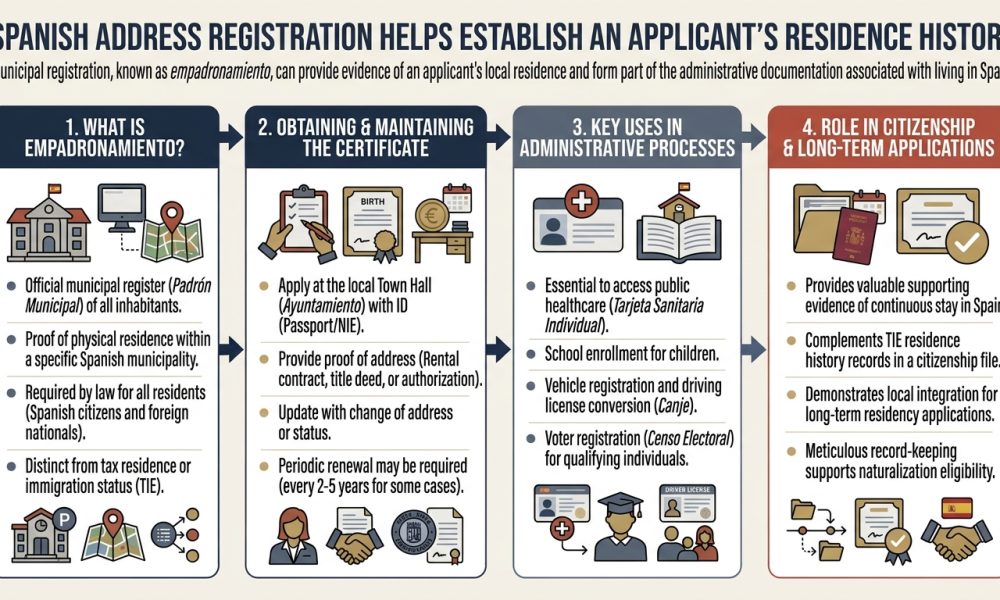
Municipal registration, known as empadronamiento, can provide official proof of an applicant’s local residence and support the administrative documentation required to live in Spain. However, registration alone does not establish lawful immigration status or eligibility for Spanish citizenship.
WASHINGTON, DC, November 21, 2026 — Mexican and Filipino nationals preparing for Spanish citizenship should understand the importance of municipal address registration, because Spain’s padrón municipal establishes an official record of where individuals habitually live and can help document their residential history.
Although the registration process is relatively straightforward, foreign residents often misunderstand its legal significance, assuming that obtaining a municipal registration certificate automatically establishes lawful immigration residence or starts the statutory period required for naturalization.
For qualifying Mexican and Filipino nationals by origin, who may apply for Spanish citizenship after two years of legal, continuous residence, maintaining accurate municipal records can support a broader application strategy without replacing the separate immigration authorization required by nationality law.
Spain Requires Residents to Register Their Habitual Address
Article 15 of Spain’s Local Government Framework Law, Law 7/1985, requires individuals who habitually live in Spain to register with the Municipality where they reside, regardless of whether they have Spanish nationality or foreign citizenship.
The municipal register identifies the population ordinarily living within a particular locality, allowing authorities to maintain administrative records relevant to public services, demographic planning, and the official relationship between residents and their local government.
Individuals living in several Spanish municipalities generally must register in the municipality where they spend most of the year, making the accuracy of the declared habitual address an important legal consideration.
Empadronamiento Establishes an Official Local Residence Record
Article 16 identifies the municipal register as the administrative record of a municipality’s inhabitants, with its information serving as evidence of residence within the municipality and the habitual address.
Certificates issued from the register have recognized evidentiary value for administrative purposes, making them useful when residents must demonstrate their address during immigration, education, family, or other official procedures requiring documented local residence.
However, the evidentiary value concerns registered residential facts rather than every aspect of immigration eligibility, so a certificate must be interpreted according to the specific legal question at issue.
Municipal Registration Does Not Grant Immigration Residence
Article 18(2) expressly states that registration of foreign nationals in the municipal register does not prove legal residence in Spain or confer immigration rights unavailable under applicable legislation.
This distinction is central to citizenship planning because an individual can be properly registered as a municipal inhabitant without possessing the type of legal residence authorization required to accumulate qualifying time for Spanish naturalization.
A Mexican citizen who registers an address while holding a tourist or student authorization should therefore not assume that the municipality has granted permanent residence or changed the municipality of an existing immigration permission.
BOE
The Difference Became Prominent During Spain’s Immigration Debate
In February 2026, RTVE’s verification report on municipal registration and electoral eligibility examined confusion surrounding the municipal register, population statistics and voting rights during discussions of immigration regularization.
The broadcaster explained that municipal registration records ordinary residence within a locality but does not independently establish immigration regularity or create the political rights associated with Spanish citizenship and other qualifying legal statuses.
For Mexican and Filipino residents, the reporting reinforces a practical distinction between establishing an address with a municipality and obtaining government authorization to reside, work, or eventually apply for nationality under Spanish law.
RTVE.es
Mexican and Filipino Nationals May Qualify for a Two-Year Citizenship Route
Article 22 of Spain’s Civil Code generally allows nationals of Ibero-American countries, including Mexicoand the Philippines,, to seek Spanish citizenship after two years of legal, continuous residence immediately preceding their applications.
This preferential period can create a significant advantage over the ordinary 10-year requirement that applies to many other foreign nationals. Still, the reduced duration does not eliminate requirements concerning immigration status, character, and integration.
Applicants who acquired Mexican or Philippine nationality later through naturalization should obtain individualized eligibility advice, because the provision’s reference to nationality by origin has consequences that cannot be resolved through passport possession alone.
The Municipality Cannot Start the Citizenship Clock on Its Own.
The relevant Municipality for nationality planning depends on qualifying legal residence under Spanish immigration and citizenship legislation, not simply the day an applicant first visits the municipal registration office.
A Filipino professional who obtained lawful residence several weeks before completing address registration may need to examine the official immigration authorization to determine the correct starting date for the citizenship calculation.
Conversely, a Mexican individual who registered locally during a period classified as a temporary stay cannot automatically convert that earlier period into qualifying nationality residence by later obtaining an employment permit.
A TIE Card and a Padrón Certificate Prove Different Facts
Spain’s foreigner identity card, commonly called the TIE, documents an individual’s recognized immigration status, while the municipal registration certificate confirms habitual residence in a particular municipality.
The two records can therefore complement each other during citizenship planning. Still, neither should substitute for the underlying legal authorization or the additional evidence needed to establish continuous residence.
A well-organized applicant should keep both documents alongside immigration approval decisions, especially when the physical residence card was issued after the legal authorization began or the individual later changed residential addresses.
Applicants Usually Register Through Their Local Town Hall
The relevant ayuntamiento, or town hall, administers municipal registration and sets appointment procedures and document requirements within the framework of Spain’s national legislation and technical registration instructions.
Mexican and Filipino residents should consult the municipality responsible for their actual home address before attending an appointment, because registration procedures can differ among Madrid, Barcelona, and other Spanish communities.
In many municipalities, registration can involve an appointment, identity documents, and proof of habitual accommodation. At the same time, some offices offer electronic procedures or require additional verification when residential circumstances are unusual.
Proof of Accommodation Is an Important Requirement
Municipal authorities commonly request evidence linking an applicant to the address being registered, such as a rental agreement, property ownership documentation, or a recognized record establishing residence.
A Mexican professional renting an apartment should generally keep the lease and supporting documents, while someone living with relatives or friends may need alternative evidence accepted by the municipality.
Property Ownership Is Not Always Necessary for Registration
Spanish municipal registration rules focus on an individual’s actual habitual residence rather than property ownership, so tenants and qualifying individuals living in accommodation provided by others can register.
Authorities may request authorization or supporting records when several residents share a home. Still, the objective remains verifying the individual’s genuine connection with the stated address rather than determining private property ownership rights.
A Filipino employee living with family members should therefore investigate the applicable shared-housing registration procedure rather than assuming that only the legal owner can establish municipal residence documentation.
Residents Without Conventional Housing May Still Have Registration Rights
Spain’s technical municipal registration instructions recognize circumstances involving individuals without conventional housing and provide procedures to record genuine habitual residence when ordinary rental or property documents are unavailable.
These situations require particular verification arrangements rather than fictitious addresses, because the municipality must maintain an accurate register reflecting where people actually reside within its territory.
Applicants should seek guidance from the responsible municipal office or authorized social services, particularly when temporary accommodation makes conventional municipality proof difficult despite genuine residence within the locality.
False Address Registrations Can Create Serious Problems
Using a fictitious address or registering at a property where an individual does not actually reside undermines the purpose of the municipal register and can expose the participants to administrative or criminal scrutiny.
A person seeking citizenship should never purchase a purported registration service that promises a Spanish address without genuine accommodation, particularly when the arrangement involves fabricated rental agreements or misleading declarations.
The resulting records may create inconsistencies during later immigration or nationality proceedings, making truthful municipal registration more valuable than an artificial address history designed to create an appearance of residence.
Local Authorities Can Verify Actual Residence
Spanish technical instructions allow municipalities to verify residence when documentary evidence is insufficient, including by examining records or using other lawful methods to establish whether someone genuinely lives at the declared address.
These checks reflect the register’s purpose: to record actual municipal inhabitants, not to substitute for immigration authorization or certify legal ownership of a property.
Mexican and Filipino applicants should cooperate truthfully with reasonable verification requests and preserve legitimate accommodation records, particularly where their residential arrangements involve shared premises or frequent changes in housing.
Municipal Registration Supports Access to Administrative Services
A current municipal registration certificate can be relevant when individuals enroll children in educational institutions, complete certain local administrative transactions, or demonstrate residential circumstances for services governed by regional and municipal rules.
However, eligibility for public healthcare, benefits,, or specific local prorams may depend on separate legal conditions, so registration does not automatically establish entitlement to every service associated with living in Spain.
Residents should therefore verify the specific rules governing the service they need, especially when immigration classification, household income or regional residence requirements create additional conditions beyond municipal registration.
A Historical Certificate Can Help Reconstruct Earlier Addresses
Municipalities may issue historical registration documentation reflecting a person’s recorded residence over an earlier period, creating useful evidence when an applicant has lived at several addresses before pursuing citizenship.
The distinction between a current certificate and a historical certificate matters when the nationality application requires evidence beyond the applicant’s current home or the date of the latest municipal registration.
Mexican and Filipino residents should request the document that matches the information needed, rather than assuming an ordinary current certificate provides a complete chronological history.
Registration Certificates and Informational Certificates Are Not Always Identical
Spanish municipalities may issue certificados de empadronamiento and volantes de empadronamiento, with their formal evidentiary character and accepted administrative uses potentially differing by municipality and requesting authority.
Applicants should confirm which document a particular immigration or citizenship procedure requires, especially when a formal certificate must show past registration dates or household composition.
Providing the correct document at the outset can reduce administrative delays, although even a formally certified municipal record remains separate from proof of lawful immigration.
Changes of Address Should Be Reported Accurately
Foreign residents moving between Spanish municipalities should update their registration to reflect their new habitual home, preserving a consistent chronology that corresponds with actual relocation dates and immigration records.
A Mexican professional moving from Barcelona to Valencia should not continue using an earlier address merely because the former municipality’s records are more convenient for a future citizenship application.
Properly maintained address histories can support the factual explanation of a resident’s movements within Spain, while a genuine domestic relocation does not automatically interrupt qualifying legal residence for nationality purposes.
Registration in Several Municipalities Can Create Inconsistencies
Spain’s municipal registration system is based on a pMunicipality’sal municipality rather than simultaneous ordinary registration in several localities, so accurate address selection matters for residents maintaining multiple homes.
A founder working in Madrid but spending most of the year at a family residence elsewhere should assess where habitual municipal registration properly belongs under the applicable legal standard.
The objective is not to create several overlapping residence histories, but to maintain a municipal administrative record reflecting the municipality where the individual actually resides.
Certain Foreign Registrations Require Periodic Renewal
Article 16 establishes a periodic renewal requirement that generally applies every two years to specified non-European Union foreign nationals without long-term residence authorization, subject to the categories and exceptions established by the legislation.
Mexican and Filipino residents should verify whether this obligation applies to their municipality. Failure to complete a required renewal can result in the administrative expiry of the municipal record. An expiring registration does not necessarily mean the underlying immigration authorization has ended. Still, it can create gaps or complications in documents intended to show a continuous local address history.
A Current Padrón Does Not Prove Continuous Presence Abroad Was Avoided
A person may remain recorded at a Spanish address while spending considerable time outside the country, making municipal registration alone insufficient to establish actual physical presence throughout a proposed nationality residence period.
For Mexican executives managing overseas companies, consistent registration may support the existence of a Spanish home but cannot, on its own, answer questions about lengthy business trips or sustained residence elsewhere.
Applicants should keep authentic travel records and supporting information about their actual circumstances, especially when the government’s nationality analysis requires evidence of legal, continuous residence immediately before the application.
Student Registration Does Not Convert Study Authorization Into Residence
Mexican and Filipino students commonly register with municipalities while attending Spanish universities, but the usual estancia por estudios classification remains different from qualifying legal residence for ordinary nationality purposes.
A student with a valid TIE and municipal registration certificate may therefore be lawfully present for education without accumulating the two-year residence period required for qualifying nationality-by-origin applicants.
Once the graduate obtains an appropriate residence authorization, the new legal status may support naturalization planning, but municipal registration alone cannot retroactively change the classification of earlier educational stays.
Employment Residence and Municipal Registration Work Together
A Mexican engineer with an approved employment residence authorization can use accurately maintained municipal registration records to show where the individual lived while working and complying with Spanish immigration requirements.
Employment contracts, Social Security records, residence decisions, and municipal certificates can collectively provide a more coherent chronology than any single document, especially when the applicant changed employers or addresses during the qualifying period.
These records support different parts of the applicant’s history, so it’s important to distinguish actual employment, immigration authorization, and habitual residence rather than treating one administrative document as proof of everything.
Spain’s Digital Nomad Residents Also Need Accurate Addresses
Qualifying international teleworkers who receive Spanish residence authorization may need to establish and update their municipal registration while living in the country, even when their employers and customers remain located abroad.
A Mexican digital nomad should therefore document their actual Spanish residence location rather than using the address of an accountant, immigration adviser, or coworking facility where they do not habitually live.
Accurate registration can support long-term residence documentation, but the applicant must separately maintain compliance with the conditions governing international teleworking and any later Spanish citizenship application.
Non-Lucrative Residents Should Document Genuine Settlement
Mexican retirees or financially independent residents with non-lucrative authorization may use municipal registration records to show their residential arrangements while meeting separate requirements for financial means, insurance, and immigration renewal.
The certificate can support a documented relocation. Still, it does not establish that the applicant complied with restrictions prohibiting employment or profesactivity for individualsuralnaturalizeturaliz,e residence and the correct immigration classifimatters matter more than maintaining registration at a Spanish address while spending most of their time overseas.
Family Registration Requires Consistent Household Information
Spouses and children living together in Spain may need documentation establishing their common residence when completing family immigration applications or other administrative procedures involving household relationships and dependent family members.
Mexican and Filipino families should ensure that the appropriate residents are recorded accurately, especially when relatives arrive at different times, move between homes, or change their immigration classifications after employment or graduation.
However, appearing together on a municipal household record does not automatically establish every legal relationship or nationality entitlement, so marriage certificates, birth records, and immigration authorizations remain independently important.
Spanish Citizenship Still Requires Good Civic Conduct
Applicants seeking nationality through residence must meet the good civic conduct requirements under Spain’s Civil Code, so a complete municipal address history cannot establish eligibility on its own when other statutory conditions remain unmet.
The government may review criminal background documentation, immigration records, nd additioal personalinformationy when discrepancies or unresolved circumstances require clarification before it can make a final decision
Mexican and Filipino applicants should therefore view municipal registration as one element within a broader lawful residence history, not an administrative shortcut that eliminates the government’s nationality screening obligations.
Language and Civic Knowledge Requirements Remain Separate
Qualifying Mexican nationals ordinarily benefit from the relevant Spanish-language examination exemption. At the same time, Filipino applicants may need accepted DELE language certification because Philippine nationality does not automatically establish the same exemption.
Applicants from both countries may also need to complete the CCSE examination concerning Spanish constitutional and sociocultural knowledge, unless an applicable exemption or recognized accommodation applies to their circumstances.
Neither the duration of municipal registration nor a historical address certificate replaces these examinations, making civic preparation an independent part of responsible naturalization planning.
U.S. Government Records Illustrate the Importance of Local Registration
The U.S. Department of State’s guide to Spanish civil documents identifies municipal registration as relevant to obtaining certain Spanish civil-status records, illustrating how documented local residence can affect administrative transactions beyond immigration.
The guidance provides useful context for Mexican-American and Filipino-American families who may need Spanish civil records during international legal procedures. However, Spanish authorities retain responsibility for defining the legal consequences of municipal registration.
Applicants should distinguish these administrative uses from naturalization eligibility, because the evidentiary importance of an address record in one procedure does not establish that it satisfies the requirements of another.
Privacy and Accuracy Matter When Maintaining Address Records
Municipal registration involves personal information concerning names, Identification,, nationality and habitual residence, making accurate disclosure and appropriate handling of official records important considerations for foreign residents.
Applicants should use authorized municipal procedures and protect the documents containing household details, particularly when third-party intermediaries offer to obtain certificates or handle sensitive Identification information.
An immigration adviser may assist with legitimate paperwork, but the applicant remains responsible for providing truthful details and ensuring that the recorded address reflects genuine residential circumstances.
Amicus International Consulting and Spanish Residence Planning
Amicus International Consulting addresses international relocation and nationality considerations through its residence and citizenship advisory services, providing broader context for individuals coordinating immigration authorization, family arrangements and long-term residence objectives across national borders.
The company’s second-citizenship and international mobility analysis also explains how additional nationality can support a broader international strategy. However, competent government institutions retain exclusive authority over official Spanish residence and naturalization decisions.
For Mexican and Filipino applicants, responsible preparation involves verifying the underlying immigration authorization, keeping municipal information accurate, and maintaining records that explain the actual residence history throughout the relevant period.
Conclusion: Address Registration Supports but Does Not Establish Citizenship Eligibility
Spain’s empadronamiento system provides an important administrative record of habitual municipal residence, helping Mexican and Filipino applicants document where they live while completing separate immigration and naturalization procedures.
However, the law expressly distinguishes municipal registration from lawful immigration residence, meaning a padrón certificate cannot independently establish eligibility for Spanish citizenship or convert a student stay into qualifying nationality residence.
Applicants seeking the preferential two-year naturalization provision should therefore coordinate accurate municipal registration with valid residence authorization, genuine continuous residence, reliable travel records, and the additional character and integration requirements under Spanish law.
Ultimately, well-maintained address records can strengthen a well-documented Spanish citizenship application. However, eligibility still rests on lawful, continuous residence and an independent nationality determination, not on registration at a Spanish address alone.




