
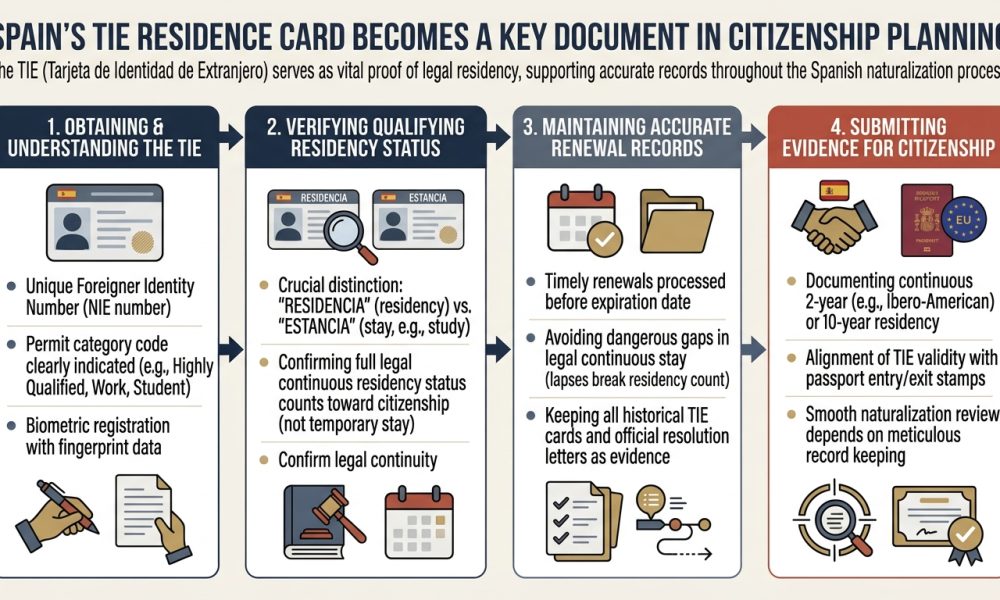
Spain’s foreigner identity card helps document an applicant’s authorized immigration status, making accurate residence records, timely renewals, and a clear understanding of the distinction between residence and temporary stays essential for Mexican and Filipino nationals pursuing Spanish citizenship.
WASHINGTON, DC, November 21, 2026 — Mexican and Filipino nationals planning to acquire Spanish citizenship must pay close attention to the country’s foreigner identity card, commonly known as the TIE, because this document provides important evidence of immigration status throughout the naturalization process.
Although the TIE is often described as a Spanish residence card, its legal significance depends on the underlying immigration authorization, so it’s essential to distinguish genuine residence from student stays and other permissions that do not ordinarily count toward citizenship.
For qualifying Mexican and Filipino nationals by origin, Spain’s preferential two-year naturalization provision can create an earlier path to apply. Still, eligibility ultimately depends on legal, continuous residence and meeting the government’s separate nationality requirements.
What Is Spain’s TIE Residence Card?
The Tarjeta de Identidad de Extranjero, or TIE, is an official Identification document issued to qualifying foreign nationals authorized to remain in Spain, recording key personal information and details related to the individual’s immigration status.
The card generally includes the holder’s photograph, identifying information, foreigner Identification number, and relevant validity details, allowing authorized institutions to verify the documented immigration classification during administrative and commercial transactions.
However, the TIE should not be treated as an independent grant of residence, because the legal rights it documents originate from the underlying visa, residence authorization, or other recognized immigration permission.
The TIE and NIE Serve Different Legal Purposes
Spain’s foreigner Identification number, known as the Número de Identidad de Extranjero or NIE, is an administrative identifier assigned to qualifying foreign nationals involved in Spanish immigration, financial, or other legally relevant procedures.
A person may have an NIE without a residence permit, meaning the number alone does not grant permission to live permanently in Spain or count toward qualifying residence for naturalization.
By contrast, a TIE documents a particular immigration situation, although the individual must still examine the underlying authorization before determining whether the period qualifies under Spanish citizenship legislation.
A Residence Card Does Not Automatically Establish Citizenship Eligibility
The Spanish Ministry of Justice explains that naturalization through residence requires a qualifying period of legal, continuous residence immediately preceding the application, together with satisfactory civic conduct and integration into Spanish society.
Physical possession of a TIE cannot, by itself, establish compliance with those requirements, particularly when the card documents a legal stay for educational activities rather than an immigration classification recognized as residence.
Applicants should therefore evaluate the authorization recorded in their immigration history instead of relying exclusively upon the appearance, issue date, or expiration date printed on a plastic Identification card.
Trámites y gestiones personales
Mexican and Filipino Nationals May Benefit From Two-Year Residence
Article 22 of Spain’s Civil Code generally provides a reduced two-year naturalization residence requirement for qualifying nationals by origin of Ibero-American countries, including Mexico, and for nationals by origin of the Philippines.
This preferential treatment differs from the ordinary 10-year requirement for many other foreign nationals, making the exact start of legally qualifying residence especially important for applicants pursuing Spanish nationality.
However, individuals who later acquired Mexican or Philippine citizenship through naturalization should not assume that those passports automatically establish the same nationality-by-origin eligibility under Spanish law.
The Immigration Authorization Determines the Legal Classification
A Mexican software engineer with an employment residence authorization and a Filipino university student with educational stay permission may both hold Spanish foreigner identity cards while occupying substantially different legal positions.
Employment authorization can establish residence relevant to naturalization, whereas ordinary student stay authorization generally does not count toward the qualifying residence required for citizenship.
These distinctions show why applicants should keep official immigration approval decisions alongside their TIE cards so that the government can review the actual legal classification throughout the relevant period.
Student TIE Cards Do Not Usually Start the Citizenship Clock
Spain’s immigration framework classifies ordinary authorization for studies as estancia por estudios, meaning a legal stay for educational purposes rather than the qualifying residence ordinarily required by nationality legislation.
A Mexican student who studies in Barcelona for three years may therefore hold valid immigration documentation throughout the academic program without accumulating three years of residence toward a citizenship application.
Government analysis and Spanish case law have distinguished these educational stays from qualifying nationality residence, making the student’s subsequent transition into an appropriate residence category particularly important.
Work Residence Can Establish a Qualifying Immigration History
Mexican and Filipino professionals who obtain approved employment residence may begin accumulating the legal residence required for naturalization, provided their authorizations remain valid, and they satisfy the applicable continuity conditions.
The relevant employment pathway may involve ordinary employer sponsorship, self-employment, highly qualified professional authorization, or another recognized category that permits the individual to reside and work in Spain.
Applicants should keep contracts, immigration approvals, and supporting records, especially when employment changes could require modifications or renewals that affect the continuity of their legal residence.
Spain’s Immigration System Continues Expanding
Spain’s foreign-resident population has grown substantially, making official immigration documentation increasingly important for workers, students and families establishing long-term connections with the country’s employment market and public institutions.
In a Reuters investigation published November 19, 2026, economists and financial analysts examined immigration’s contribution to Spain’s growth, employment and business activity while discussing competing political proposals concerning immigration policy.
The reporting found that foreign-born residents made up about 14% of Spain’s population, providing economic context for a residence system serving growing numbers of foreign workers and their families.
Reuters
A Favorable Residence Decision Can Precede the Physical Card
Spanish immigration authorities may grant a residence authorization before the applicant receives the corresponding TIE, creating an administrative interval during which the individual possesses a favorable decision but awaits Identification card issuance.
Spain’s Ministry of Inclusion has confirmed that a favorable immigration resolution can have legal effect independently of the later physical card, meaning the official decision should not be disregarded merely because fingerprinting or card collection remains pending.
For citizenship planning, establish the exact legal commencement date from the governing authorization and official records rather than automatically calculating it from the day the physical card was collected.
Inclusión y Migraciones
Fingerprint Appointments Form Part of Card Issuance
After receiving qualifying immigration authorization, foreign residents ordinarily must complete procedures for obtaining the TIE, which can include an appointment with the National Police for identity verification and fingerprint collection.
Applicants should preserve the favorable immigration decision, relevant appointment confirmation, and subsequent card documentation, particularly when administrative delays complicate the chronology of their residence.
The fingerprinting appointment is an administrative step toward card issuance rather than a separate naturalization milestone, so its date matters for documentation but does not automatically determine when qualifying residence legally began.
Applicants Should Review the Card’s Immigration Classification
The information on a TIE can indicate whether the holder has temporary residence, long-term residence, student stay authorization,, or anotherrecognized immigration status under Spanish law.
A foreign national should understand the legal conditions attached to that classification, including employment restrictions, renewal procedures, and any limitations concerning activities permitted during the authorization’s validity.
For Mexican and Filipino applicants, confirming the precise residence category can prevent errors when calculating eligibility under the preferential two-year naturalization provision.
The Card Expiration Date Requires Close Attention
Foreign residents should monitor the expiration dates of their TIE cards and immigration authorizations and initiate renewal or modification procedures according to the requirements for the relevant category.
An expired physical card does not necessarily mean that an individual’s underlying residence rights have ended, particularly when a timely renewal application preserves lawful status under applicable immigration regulations.
Nevertheless, applicants should not assume every expired card remains acceptable indefinitely, so official renewal records and confirmation of continued authorization are important when preparing future nationality documentation.
Renewal Applications Must Be Properly Documented
A Mexican professional renewing an employment residence authorization should keep the application acknowledgment, supporting employment information, and final government resolution. If the needed renewed physical card is issued later than expected, the applicant should preserve evidence explaining the administrative sequence rather than leaving an apparent documentary gap unresolved.
This approach matters when a citizenship application is approaching, because immigration officials and nationality authorities may review records covering the entire qualifying residence period.
Changing Immigration Categories Requires Accurate Records
Mexican and Filipino residents may transition between immigration classifications as their circumstances change, particularly when students graduate, professionals change employment, or families obtain different residence authorizations.
Such changes can be lawful and appropriate, but applicants must establish whether each earlier category counted toward nationality residence and whether the transition preserved the required legal continuity.
An official decision modifying immigration status can therefore matter more than the replacement TIE itself, especially when identifying the exact start of the qualifying citizenship residence period.
Municipal Registration Provides Supporting Residence Evidence
Spain’s padrón municipal records an individual’s registered address within a municipality and can provide supporting evidence concerning where a foreign resident has established ordinary accommodation during the relevant period.
However, municipal registration is not equivalent to immigration authorization, and a registration certificate does not, on its own, convert an unlawful stay or ordinary student authorization into qualifying residence.
Applicants should maintain accurate municipal records alongside immigration documents, ensuring that changes in residence are reflected consistently without treating address registration as a substitute for legal immigration status.
International Travel Records Help Establish Continuous Residence
Spain requires naturalization residence to be continuous and immediately preceding the application, making an applicant’s international travel history relevant even when immigration authorization remains valid throughout the period.
Mexican and Filipino professionals who travel frequently for business should preserve reliable records of departures and returns, particularly when substantial overseas assignments could raise questions about the continuity of their residence.
A valid TIE cannot, on its own, establish that every international absence complies with nationality requirements, so a realistic residence pattern matters more than the card’s printed validity dates.
There Is No Universal Travel Allowance Guarantee
Applicants frequently encounter informal guidance claiming that a particular number of months abroad is always permitted without affecting Spanish nationality eligibility, but such assurances oversimplify the legal continuity requirement.
The effect of an absence can depend on its duration, circumstances, and the overall evidence of residence, making an individualized assessment preferable to mechanically applying an unsupported travel allowance.
Foreign residents should therefore avoid arranging lengthy overseas assignments solely because their physical card remains valid, especially when their principal objective is a near-term citizenship application.
Illustrative Citizenship Timelines Require Careful Calculation
Consider a Mexican citizen by origin who receives qualifying employment residence beginning March 1, 2026, and maintains continuous legal residence without circumstances that undermine the relevant statutory requirements.
That individual may approach the ordinary two-year eligibility threshold in March 2028, but the date must be confirmed through the official immigration record and the applicable nationality requirements.
If the physical TIE was issued several weeks after the residence authorization became legally effective, the applicant should not automatically discard that earlier period without reviewing the government decision.
A Delayed TIE Appointment Does Not Necessarily Erase Residence
Spain has recognized that favorable immigration decisions retain legal effect while applicants await TIE issuance, making it inappropriate to assume that every delay in collecting a card interrupts lawful residence.
However, applicants must distinguish a granted residence authorization from a pending application that has not yet produced the relevant legal rights, because different immigration procedures can operate under different rules.
A complete timeline should identify each decision and its legal effect rather than assume that the physical presence or absence of a card resolves the entire citizenship calculation.
Long-Term Residence Cards Have Different Functions
Spain provides long-term immigration residence classifications under specified conditions, allowing qualifying foreign nationals to obtain a more durable residence status after meeting the relevant statutory requirements.
However, a Mexican national by origin may potentially become eligible to apply for citizenship before qualifying for ordinary long-term residence, because the preferential nationality threshold and long-term immigration requirements are separate legal frameworks.
Applicants should therefore avoid waiting for a particular long-term residence card solely because they believe it is an indispensable prerequisite for every Spanish citizenship application.
The TIE Does Not Replace a National Passport
A Spanish foreigner identity card generally documents immigration status within Spain, but it is not equivalent to a Spanish passport and does not establish that the holder possesses Spanish nationality.
Mexican and Filipino residents must maintain appropriate national travel documents and comply with international entry requirements, especially when returning to Spain after travel outside the Schengen area.
A residence card may help demonstrate a right to return under applicable conditions, but the necessary travel documentation must still be assessed based on nationality, destination, and carrier requirements.
Lost or Stolen Cards Require Official Replacement Procedures
Foreign residents whose TIE cards are lost, stolen, or damaged should follow the applicable police and administrative procedures to obtain replacement Identification, particularly when international travel or an immigration appointment is approaching.
Losing the physical card does not, by itself, mean you have lost your underlying residence authorization, but not being able to present current documentation can create practical difficulties during travel and routine administrative transactions.
Maintaining copies of immigration resolutions and Identification records can therefore help residents explain their status while completing the legitimate replacement process.
Spanish Citizenship Requires Evidence Beyond the TIE
A completed nationality application generally requires identity records, evidence of qualifying residence, criminal background information, and documentation concerning integration, and authorities may need information that cannot be established through the TIE alone.
The Ministry of Justice may obtain certain information electronically through authorized government systems, but applicants remain responsible for supplying required documents and ensuring that their declarations are complete and accurate.
A clear residence history can therefore support the application without replacing the government’s independent assessment of good civic conduct, integration and eligibility under Spain’s nationality legislation.
Mexican and Filipino Applicants Face Different Language Requirements
Qualifying Mexican nationals generally benefit from an exemption from the DELE Spanish-language examination because Mexico is recognized within the relevant Spanish-speaking nationality category, although other integration requirements remain applicable.
Filipino nationals generally do not receive the same automatic language-examination exemption solely because the Philippines qualifies for the two-year naturalization residence provision, so accepted Spanish-language certification may be required.
Both groups may also need to complete the CCSE examination covering Spanish constitutional and sociocultural knowledge, unless their circumstances qualify for a legally recognized exemption or accommodation.
United States Dual Nationals Need Separate Passport Planning
Some Mexican and Filipino residents of Spain also possess American citizenship, creating circumstances in which several countries’ passport requirements and immigration records must be coordinated accurately throughout the naturalization process.
The U.S. Department of State’s dual-nationality guidance explains that American citizens may hold additional nationalities while remaining subject to applicable U.S. passport and other legal obligations.
A Spanish TIE does not change an American citizen’s nationality, and obtaining Spanish citizenship later does not automatically terminate the existing American nationality relationship or its continuing responsibilities.
Family Members May Possess Different Residence Classifications
A Mexican employment resident may have a spouse or child with a separate family residence authorization, so it is important to examine whether each individual meets the relevant citizenship residence requirements independently.
Children may qualify through different nationality provisions depending on their age, birthplace, and parental citizenship, meaning the principal applicant’s TIE cannot establish identical naturalization eligibility for every household member.
Families should maintain separate immigration histories for each person and keep documents showing when individual authorizations began, especially when relatives arrived at different times or later changed legal status.
Spanish Citizenship Statistics Highlight the Scale of Naturalization
Spain’s National Statistics Institute reported that 299,732 foreign residents acquired Spanish nationality during 2025, an increase of 18.7% from the preceding year and the highest figure in the published statistical series.
The official figures included substantial numbers of residents acquiring nationality through residence, demonstrating the continuing importance of reliable immigration documentation and government records as foreign nationals pursue citizenship.
However, nationwide naturalization totals do not indicate an individual applicant’s likelihood of approval, because each case depends on the specific nationality classification, residence history, and other statutory requirements.
INE
Amicus International Consulting and Residence Documentation
Amicus International Consulting discusses cross-border residence and citizenship planning through its international relocation and citizenship advisory services, providing broader information about nationality strategies and the documentation required when individuals establish lawful residence abroad.
Its second-citizenship and international mobility analysis also examines the broader value of additional nationality. However, eligibility for Spanish citizenship remains subject exclusively to Spanish legislation and decisions by competent government authorities.
For Mexican and Filipino applicants, responsible planning begins with reviewing immigration approvals and the actual legal status those decisions confer, rather than relying upon the existence of a residence card alone.
A Complete Residence Timeline Can Prevent Avoidable Errors
Before applying for citizenship, foreign residents should assemble a chronological record containing immigration decisions, TIE issuance and renewal information, changes in residence classification and significant periods spent outside Spain.
The review should identify possible gaps, inconsistencies, and periods classified as student stays, especially when an applicant previously assumed that every year physically spent in Spain qualified toward naturalization.
Where the chronology raises uncertainty, qualified immigration advice and official records are more reliable than informal calculations based upon the first Spanish address registration or identity card collection.
Conclusion: The TIE Is Essential Evidence, Not a Citizenship Guarantee
Spain’s TIE provides important evidence of an individual’s immigration situation, but the underlying authorization determines whether time spent in the country can contribute toward the legal residence required for naturalization.
For qualifying Mexican and Filipino nationals by origin, the two-year citizenship provision creates a significant opportunity, although student stays, interrupted residence, and incomplete immigration records can complicate the calculation.
Ultimately, accurate documentation of residence authorization, renewals, and international travel provides a stronger foundation for Spanish citizenship planning than relying solely on a physical Identification card or an anticipated passport approval date.




