
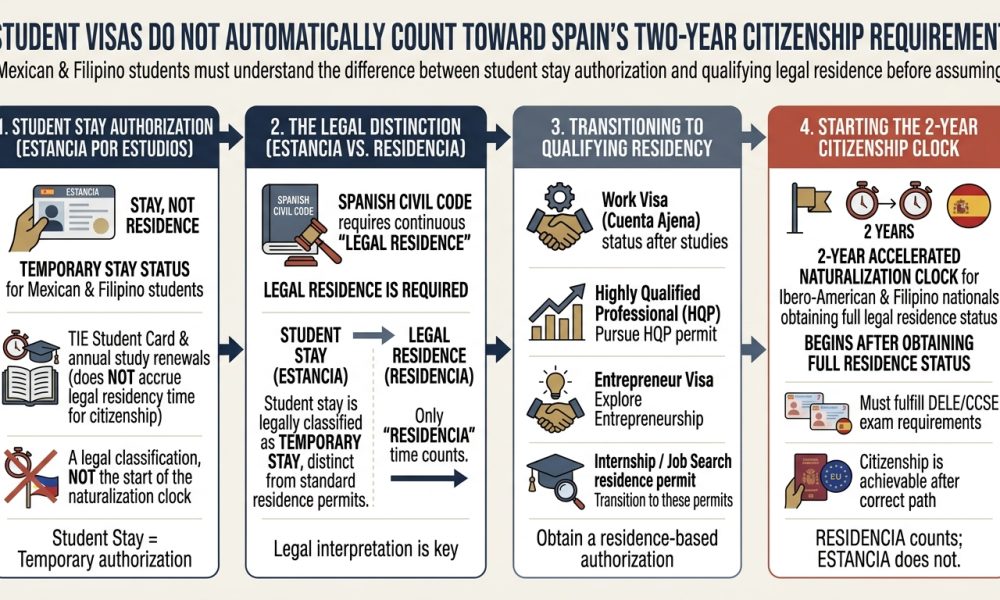
Mexican and Filipino students must understand the difference between student stay authorization and qualifying legal residence before assuming time spent studying counts toward naturalization eligibility, especially when planning to transition from university education into employment and eventual Spanish citizenship.
WASHINGTON, DC, November 21, 2026 — Mexican and Filipino students pursuing degrees in Spain may spend several years living legally in the country without accumulating the residence required for Spanish citizenship, because student immigration authorization is generally classified as a temporary stay rather than qualifying residence for naturalization.
This distinction matters especially for nationals of Mexico and the Philippines, who may benefit from Spain’s preferential two-year citizenship residence requirement but cannot automatically count years spent under ordinary student stay authorization.
For international graduates hoping to build professional careers and eventually obtain European Union citizenship, understanding when qualifying residence begins can prevent costly mistakes involving employment contracts, immigration renewals, and expectations about obtaining a Spanish passport.
Spanish Immigration Law Distinguishes Student Stay From Residence
Spain’s immigration system distinguishes between estancia por estudios, permission to remain for approved educational activities, and residencia, which establishes a legally recognized immigration residence status under applicable legislation.
Although both arrangements may permit an individual to remain legally in Spain for extended periods, they have different consequences when the government determines eligibility for nationality through the residence provisions of its Civil Code.
A Mexican student who completes an undergraduate degree and master’s program over several years may consequently have a substantial Spanish educational history without having accumulated qualifying nationality residence during those student-authorized periods.
Article 22 Requires Legal and Continuous Residence
Article 22 of Spain’s Civil Code establishes that naturalization through residence requires the relevant period to be legal, continuous, and immediately preceding the citizenship application, with different minimum durations determined by nationality or personal circumstances.
Qualifying nationals from Ibero-American countries, including Mexico and the Philippines, generally require two years rather than the ordinary 10-year period, provided they meet the remaining statutory requirements.
However, the reduced period does not change what constitutes qualifying residence, meaning the applicant must hold an appropriate immigration classification rather than relying solely on years of physical presence or university enrollment.
Student Authorization Generally Does Not Start the Citizenship Clock
Spanish government guidance distinguishes lawful educational stays from residence authorization for nationality purposes, explaining that the ordinary student classification does not count toward acquiring Spanish citizenship through residence.
An international student can hold a valid student identity card, maintain an apartment, register a local address,, and articipatein unparticipateife without necessanecessarinecessarilycificresidencspecific residence requirement for naturalizationistinction concerns the immigration authorization’s legal classification rather than the student’s commitment to living in Spain, making official permit records essential when calculating the earliest possible citizenship application date.
An Example Illustrates the Potential Timeline
Consider a Mexican citizen who enters Spain in September 2024, completes a two-year master’s program in June 2026, and subsequently obtains qualifying employment residence beginning in September 2026.
Assuming the applicant is Mexican by origin, maintains continuous lawful residence and satisfies every additional requirement, the earliest ordinary two-year nationality application date would generally fall in September 2028 rather than September 2026.
This example demonstrates why academic residence histories must be separated from immigration residence histories, especially when applicants begin long-term relocation planning several years before graduating from a Spanish institution.
Spain’s 2025 Immigration Reform Changed Student Procedures
Royal Decree 1155/2024 entered into force on May 20, 2025, introducing an updated immigration framework covering study authorization, employment rights, renewal conditions, and pathways from education into qualifying residence.
The revised regulations provide additional opportunities for some international students to move toward employment after completing their studies. Still, they do not automatically redefine every previous period of student stay as nationality residence.
A May 2025 report by The Local on Spain’s immigration reforms described changes affecting student employment opportunities and immigration transitions, illustrating the importance of distinguishing improved work rights from citizenship eligibility.
Spain’s International Student Population Continues Growing
Spanish government statistics released in September 2026 showed about 94,500 people holding student stay authorizations as of June 30, up more than 50,000 from the previous five years.
The government also reported a particularly substantial annual increase in international students from the United States, showing how Spain’s educational institutions continue to attract people with different nationalities and long-term immigration objectives.
These figures provide important context for Mexican and Filipino applicants because growing international enrollment does not change the nationality rules governing individual students, even when educational migration becomes increasingly economically significant.
Inclusión y Migraciones
Graduates Can Transition Into Employment Residence
Spain’s updated immigration rules allow qualifying graduates to seek a change from student stay authorization to residence and employment authorization, provided they meet the relevant educational, contractual, and immigration requirements.
Available procedures include employed work, qualifying self-employment, and certain activities exempt from ordinary work authorization, with each category requiring the documentation and eligibility conditions prescribed by the government.
For Mexican and Filipino graduates, this transition can become the decisive event in citizenship planning because obtaining genuine qualifying residence may establish the starting point for the subsequent naturalization period.
Article 190 Establishes Important Modification Procedures
Article 190 of Spain’s current immigration regulations addresses modifications from qualifying student and training authorizations into specified residence categories, providing a statutory framework for graduates who intend to remain after completing their education.
Applicants generally must prove completion of the relevant studies or training, meet applicable immigration conditions,, and subitappsubmit appropriatent or business documentadocumentation matching the requested authorizaauthorizationnish Ministry of Inclusion’s April 2026 guidance confirms that different modification pathways are available, making it important to determine which category applies before the student’s existing authorization expires.
Inclusión y Migraciones
University Graduation Does Not Automatically Grant Work Residence
A Mexican student receiving a Spanish master’s degree does not automatically obtain ordinary residence authorization merely by graduating, because employment or another qualifying immigration application must still satisfy the relevant statutory conditions.
The graduate may need an eligible employer, an appropriate employment contract, or qualifying independent business activity, along with the personal documentation immigration authorities need to approve the modification.
Students should therefore begin preparing their post-graduation immigration strategy before completing the academic program, particularly when they intend to remain in Spain without interrupting lawful status.
Students May Have Limited Employment Rights During Their Studies
Spain’s updated framework generally allows qualifying higher education students to undertake compatible employment or self-employment activities within applicable limits, including an ordinary maximum of 30 working hours each week.
However, permission to work while holding student stay authorization does not automatically convert the underlying immigration classification into residence, making authorized employment and nationality residence two separate legal questions.
A Filipino postgraduate student working part-time during university enrollment should therefore distinguish valid employment authorization from the date that qualifying residence begins after an approved immigration modification.
Employment After Graduation Requires the Correct Authorization
A university graduate with an offer from a Spanish company may pursue an appropriate residence and work authorization, allowing the individual to establish a professional immigration history under the applicable regulatory provisions.
The employer’s responsibilities and the graduate’s eligibility depend upon the selected category, including contractual requirements, social security arrangements, and any professional qualifications or licensing obligations affecting the proposed position.
For graduates pursuing Spanish citizenship, maintaining accurate employment and residence records can help demonstrate compliance during the subsequent naturalization period, although professional employment alone does not guarantee nationality approval.
Self-Employment Provides an Alternative for Some Graduates
Mexican and Filipino graduates planning to establish independent businesses may explore a shift to self-employment residency, subject to requirements on commercial viability, professional qualifications, licensing, and available financial resources.
A university graduate developing a consulting practice or technology business should confirm whether the proposed activity fits the appropriate immigration category, rather than assuming that standard student permission allows unrestricted business operations.
The correct authorization can potentially support qualifying residence for nationality purposes, provided the applicant actually maintains lawful residence and complies with the separate requirements governing citizenship.
Spain Also Offers a Postgraduate Job-Search Authorization
Certain graduates who have completed qualifying higher education can apply for residence authorization to seek employment or develop a business project, with the relevant procedure providing a maximum nonextendable period of 24 months.
Importantly, the government’s April 2026 guidance states that this particular job-search authorization does not itself permit employment, even though its legal classification differs from an ordinary student stay.
Graduates should therefore review both the residence implications and the work restrictions before choosing the arrangement, especially if they need immediate permission to begin paid professional activities.
A Job-Search Permit Is Not an Employment Permit
A postgraduate residence authorization should not be interpreted as permission to accept every available job, because the government distinguishes authorization to seek employment from authorization to perform it.
A Mexican graduate who identifies a suitable employer during the job-search period must follow the applicable procedure for obtaining the proper work authorization before undertaking employment that requires independent approval.
For nationality planning, verify the legal classification, validity, and continuity of the residence authorization separately from the graduate’s employment intentions and actual professional activities.
Highly Qualified Professionals May Have Another Immigration Route
Graduates recruited for eligible managerial, technical, or specialized positions may explore Spain’s highly qualified professional framework, including the national authorization and, where applicable, the European Union Blue Card procedures.
These arrangements establish independent qualification, employment and salary conditions, making them different from the ordinary student modification process even when the graduate previously completed academic studies at a Spanish university.
The potential benefit concerns establishing lawful professional residence under an appropriate category, not obtaining a special exemption from the citizenship requirements governing nationality by residence.
Student Time Can Matter Under Different Immigration Rules
Spain’s rules governing certain long-term European Union residence classifications may recognize part of qualifying student stay periods, creating confusion when applicants assume a comparable credit applies to nationality applications.
Those immigration residence calculations must be distinguished from Article 22 naturalization requirements because separate statutory provisions govern the recognition of educational stays for different legal purposes.
Applicants should therefore avoid transferring a percentage or residence credit from one immigration procedure into a citizenship calculation without confirming that the applicable nationality legislation expressly permits that treatment.
An Identity Card Does Not Establish the Correct Residence Category
International students whose authorized stays exceed six months generally receive a foreigner identity card, commonly called the TIE, documenting their immigration status during the approved educational period.
However, possession of a TIE does not automatically establish residence for nationality purposes, since the card can document different types of immigration authorization, including student stays that do not qualify.
The relevant evidence is the underlying authorization and its legal classification, notice, and the approval and subsequent modification documents, as matters more on the appearance of the identity card.
Municipal Registration Is Not a Substitute for Residence Authorization
International students may register their addresses with local municipal authorities through the padrón municipal, providing evidence of where they live during academic enrollment and ordinary daily activities.
Although this registration can support administrative transactions and document physical presence, it does not, on its own, convert student stay authorization into qualifying immigration residence for Spanish nationality purposes.
A graduate should therefore preserve municipal records alongside immigration approvals, recognizing that different documents establish different legal facts when nationality authorities review the application.
International Travel Can Affect Qualifying Residence
Once a former student obtains qualifying residence, extended overseas absences can affect the legal continuity requirement under Article 22, particularly where employment or family commitments involve frequent foreign travel.
Applicants should not assume that a residence card automatically protects their nationality timeline regardless of how much time they spend abroad, since continuity remains a separate statutory requirement.
Mexican and Filipino graduates should keep reliable departure and return records and seek qualified advice about unusually long absences, rather than relying on generalized travel allowances circulated through unofficial sources.
Mexican Nationals by Origin Must Establish Their Status
Spain’s preferential two-year nationality requirement applies to qualifying nationals by origin of Ibero-American countries, making the legal basis of Mexican citizenship important when determining eligibility for the shortened naturalization period.
A person who acquired Mexican citizenship through naturalization should not automatically assume that a Mexican passport alone provides the same Article 22 preference as nationality acquired by birth.
Applicants should establish their original nationality classification before calculating a citizenship timeline, particularly when their family backgrounds involve several nationalities acquired at different stages of life.
Filipino Nationals by Origin Receive the Same Residence Preference
Article 22 also identifies the Philippines among the countries whose qualifying nationals by origin can apply after two years of legal residence, reflecting a distinct statutory treatment within Spain’s nationality framework.
However, the provision does not mean that everyone who later acquired Philippine citizenship qualifies automatically, so the applicant’s original nationality and any previous naturalization history matter for the eligibility assessment.
A Filipino university graduate should therefore examine both the residence classification and nationality-by-origin requirement before relying upon a projected two-year application timetable.
Spanish Language Examination Exemptions Are Not Identical
Mexican applicants generally qualify for an exemption from the DELE Spanish-language examination if they hold nationality from a recognized Spanish-speaking country. However, other naturalization and integration conditions still apply.
Filipino citizens ordinarily do not receive the same automatic Spanish-language examination exemption solely because the Philippines is included in the preferential two-year nationality provision.
Consequently, Filipino graduates may need accepted Spanish-language certification in addition to the relevant civic knowledge examination, making language preparation an important element of their long-term citizenship planning.
Good Civic Conduct Remains Required
Successful graduates must demonstrate good civic conduct when applying for Spanish nationality, which may include criminal record certificates, immigration compliance information, and other documentation reviewed under the relevant nationality procedures.
Completion of a Spanish university degree does not automatically replace these character requirements, nor does employment with an established Spanish company establish unconditional eligibility for citizenship.
Applicants should preserve accurate records and provide truthful disclosures, particularly when earlier periods of residence in Mexico, the Philippines, or another country require additional supporting documentation.
Citizenship Approval Takes Longer Than the Residence Minimum
After completing two qualifying years, you can submit a nationality application. However, the Spanish government must still review the evidence and approve the request through its prescribed procedures.
Applicants generally must also complete the relevant oath or promise and civil registration formalities before obtaining the documentation needed for an ordinary Spanish passport application.
Students should therefore avoid planning international relocation or employment changes based on the assumption that a Spanish passport becomes available immediately after completing their second year of residence.
American-Mexican and American-Filipino Students Need Additional Planning
Students possessing American citizenship alongside Mexican or Philippine nationality may face additional obligations involving passport use, foreign financial accounts, and tax reporting while pursuing education or professional residence in Spain.
The U.S. Department of State’s Spain travel information provides official U.S. government guidance on overseas travel. However, Spanish immigration authorities determine whether a particular educational or residence authorization qualifies under domestic law.
Such applicants should independently review the legal consequences of obtaining another nationality, recognizing that Spanish residence status does not terminate existing American citizenship or other ongoing legal obligations.
Family Members May Have Different Immigration Classifications
A spouse or child accompanying an international student may obtain permission linked to the principal student’s educational stay. Still, that arrangement should not automatically qualify as independent residence for naturalization.
Examine the applicable classification and any later modifications separately for each family member, especially when one adult secures employment residence while another continues studying.
Families should therefore maintain individual immigration histories rather than assuming that the graduate’s eventual residence approval automatically changes the legal status or citizenship eligibility of the entire household.
Early Documentation Can Prevent Citizenship Timeline Errors
Mexican and Filipino students planning to settle permanently should keep visa approvals, student authorizations, academic completion certificates, employment contracts,, and subsequent residence decisions,sog adviserscanh accuratelydistinguish between different periods of legal status.
These records can also help identify administrative gaps or inconsistencies before filing a nationality application, particularly where the graduate changed institutions, completed several qualifications or held overlapping immigration authorizations.
The most important date for planning is the beginning of qualifying legal residence, not merely the original arrival date or the anniversary of enrollment at a Spanish university.
Amicus International Consulting and Graduate Mobility Planning
Amicus International Consulting discusses lawful international relocation and nationality strategies through its international mobility and citizenship services, providing broader context for graduates comparing educational opportunities with eventual residence and citizenship objectives.
Its second-citizenship planning analysis also examines the value of additional nationality within long-term mobility arrangements. However, Spanish government authorities remain exclusively responsible for determining qualifying residence and approving naturalization.
For Mexican and Filipino graduates, responsible planning begins with selecting an immigration authorization that fits their professional circumstances and documenting the transition from student status to genuine residence.
Conclusion: Student Years and Citizenship Years Are Not Interchangeable
Spanish student stay authorization allows qualifying Mexican and Filipino nationals to pursue education and, in appropriate circumstances, limited employment, but ordinary student periods generally do not satisfy the legal residence requirement for naturalization.
Spain’s 2025 immigration reforms provide clearer routes for certain graduates to transition into employment or other residence categories, creating opportunities to begin accumulating the qualifying residence necessary for future citizenship applications.
However, the two-year nationality preference remains limited to qualifying nationals by origin. It requires legal, continuous residence immediately before the application, along with good civic conduct, sufficient integration, and approval from the relevant government authority.
Ultimately, studying in Spain can become a valuable foundation for professional development and eventual European settlement, but obtaining Spanish citizenship requires a legally recognized residence history rather than simply counting the years spent attending university.




