
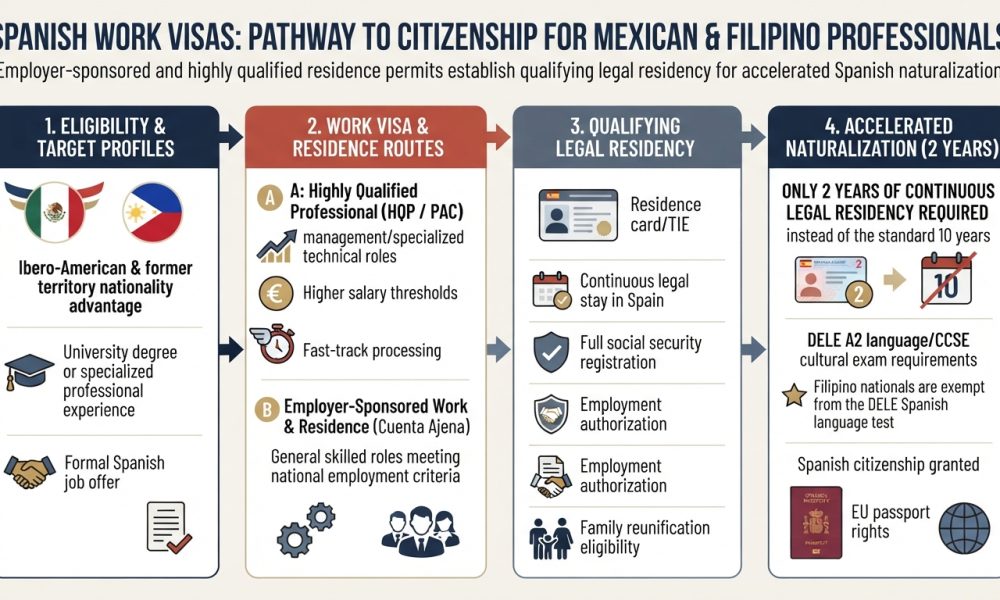
Employer-sponsored immigration and highly qualified professional permits can provide qualifying legal residence for Mexican and Filipino workers planning to establish long-term careers in Spain. At the same time, preferential nationality provisions may allow eligible applicants to pursue Spanish citizenship after two years.
WASHINGTON, DC, November 21, 2026 — Mexican and Filipino professionals seeking Spanish citizenship can pursue lawful employment-based residence through employer-sponsored work permits, highly qualified professional authorizations and other recognized immigration categories, potentially establishing the residence history necessary for naturalization under Spain’s preferential nationality legislation.
Spain’s Civil Code generally allows nationals of Mexico and the Philippines to apply for citizenship by origin after two years of legal, continuous residence, creating an alternative to the ordinary 10-year residence period applicable to many other foreign nationals.
However, receiving a Spanish employment contract or temporary work visa does not automatically establish citizenship eligibility, because immigration authorization, genuine residence, nationality by origin, civic integration, and government approval remain separate legal requirements.
Spain’s Two-Year Citizenship Provision Applies to Qualifying Nationals by Origin
Article 22 of Spain’s Civil Code provides a reduced two-year residence requirement for nationals by origin of Ibero-American countries, the Philippines, Portugal, Andorra and Equatorial Guinea, subject to the additional conditions governing naturalization.
Mexican nationals by birth and qualifying Filipino citizens from birth may benefit from this provision. At the same time, people who later acquired Mexican or Philippine nationality through naturalization should not assume that holding those passports provides the same preferential eligibility.
The legislation requires residence to be legal, continuous, and immediately preceding the nationality application, meaning employment authorization and a documented residence history can become important elements of a successful long-term citizenship strategy.
BOE+1
Employment Residence Can Establish a Citizenship Foundation
Spain’s ordinary employer-sponsored immigration pathwayallows qualifyingg foreign workers toobtain temporaryy residence and employment authorization when a Spanish employermeets applicablee hiring, contractual, and immigration requirements.
The authorization, commonly described as residencia temporal y trabajo por cuenta ajena, provides a legal basis to reside and work in Spain, potentially allowing qualifying Mexican and Filipino nationals to begin accumulating residence toward future naturalization.
However, eligibility depends on the employer’s authorization, the proposed employment conditions, and the applicant’s circumstances, so it is essential to distinguish a genuine work and residence permit from a short-stay visa or informal job offer.
Spain’s 2025 Immigration Regulations Govern Ordinary Work Permits
Royal Decree 1155/2024, which entered into force on May 20, 2025, introduced an updated immigration framework governing temporary residence, employment authorization, renewals, and several related immigration procedures for non-European Union nationals.
Under the regulations, ordinary initial employment residence authorizations generally apply to employment exceeding 90 days, with the initial authorization ordinarily corresponding to the permitted activity and lasting no more than one year.
Mexican and Filipino applicants considering employment in 2026 should therefore use current immigration guidance rather than relying upon earlier descriptions of Spanish work visa durations, renewal conditions or employer sponsorship procedures.
BOE
A Spanish Employer Normally Initiates the Ordinary Employment Application
Under the ordinary employment authorization procedure, the prospective Spanish employer generally submits the initial residence and work application to the appropriate immigration office, supported by a qualifying employment contract and required business documentation.
The employer must comply with applicable financial responsibilities nd employm,eand conditions. At the same time, the prospective foreign employee must satisfy the personal, immigration, and documentary requirements relevant to the proposed authorization.
This division of responsibility means a Mexican engineer or Filipino technician cannot simply transform an overseas employment offer into Spanish residence without completing the necessary government procedures and obtaining the appropriate authorization.
Labor Market Conditions Can Affect Employer Sponsorship
Certain ordinary work authorization applications require consideration of Spain’s national employment situation, including whether the position qualifies under a shortage occupation arrangement or an applicable statutory exception.
Employers may need to demonstrate difficulty filling a position through the available labor market, although the precise requirements depend upon the occupation, candidate, and applicable immigration provisions.
For Mexican and Filipino professionals, this makes preliminary employer eligibility particularly important, because a suitable salary and professional qualifications do not necessarily eliminate restrictions on recruiting workers from outside the European Union.
Employment Contracts Must Meet Spanish Legal Standards
Spanish immigration authorities assess whether proposed employment conditions comply with applicable labor legislation and collective bargaining requirements, including contractual terms on compensation, working hours, and the nature of the position.
Employers must also demonstrate the capacity to fulfill their obligations, meaning the sponsoring organization’s financial condition and legal standing can influence whether the employment authorization is approved.
Applicants should therefore review the actual contract and employer documentation before relocating, rather than assuming that a recruitment agency’s preliminary employment promise establishes a legally enforceable route to residence.
Social Security Registration Is an Important Immigration Step
Spain’s current ordinary work authorization regulations generally require employees to register in the relevant Social Security system within the prescribed period after lawful entry, making employment registration important.
For Mexican and Filipino workers, maintaining employment records and Social Security documentation can also help establish a consistent history of lawful residence and professional activity during subsequent immigration reviews.
Failing to complete required administrative steps can create problems despite an initially favorable immigration decision, illustrating why residence planning must continue after a visa or authorization is approved.
Highly Qualified Professional Permits Offer Another Pathway
Spain maintains a separate residence route for highly qualified professionals under Law 14/2013, administered through the Large Companies and Strategic Groups Unit, commonly identified by its Spanish abbreviation, UGE-CE.
This framework can support qualifying workers recruited for managerial positions or activities requiring recognized higher education qualifications or equivalent professional experience, making it relevant to certain Mexican and Filipino specialists pursuing established Spanish careers.
The government treats national highly qualified professional authorization and the European Union Blue Card as distinct categories, with different qualification and employment conditions that must be reviewed before submitting an application.
Plataforma One
The EU Blue Card Has Its Own Qualification Requirements
Spain’s European Union Blue Card pathway is intended for qualifying highly skilled employment and involves requirements concerning educational qualifications, employment arrangements, professional recognition and salary thresholds established under applicable legislation.
Certain applicants may rely upon qualifying professional experience where the law permits, although the precise experience standard and documentary requirements depend upon the relevant occupation and authorization category.
Mexican and Filipino professionals should verify current salary calculations before accepting employment, particularly because Spain introduced updated Blue Card reference salary guidance during 2026 that can affect eligibility for particular positions.
National Highly Qualified Authorization Can Differ From the Blue Card
Spain’s national highly qualified professional authorization is distinct from the EU Blue Card, allowing employers to seek authorization under a Spanish framework for eligible managerial or technically qualified activities.
Applicants may establish qualifications through recognized education or relevant experience under the conditions prescribed for the selected route, making the exact professional position more important than a general description such as executive or specialist.
For internationally recruited professionals, choosing the correct authorization can affect initial documentation, employment mobility and later immigration arrangements, even when both routes potentially support lawful residence relevant to citizenship.
Specialized Residence Procedures Can Offer Administrative Advantages
Spain’s official guidance describes highly qualified professional residence authorizations that may ordinarily be issued for three years, subject to employment conditions and the relevant statutory requirements governing the individual application.
The dedicated administrative framework also provides expedited processing arrangements, although the duration of an individual application can depend on documentary completeness and the circumstances requiring review.
An expedited immigration procedure should not be confused with expedited naturalization, because the Spanish nationality authority must still examine the applicant’s qualifying residence, personal history and integration after the statutory period.
Healthcare Professionals Must Consider Professional Recognition
Mexican physicians, nurses and other healthcare professionals evaluating employment in Spain must distinguish immigration eligibility from the recognition of foreign professional qualifications required to practice regulated medical activities.
A hospital’s willingness to recruit a candidate does not, by itself, establish that a foreign degree or specialist qualification permits professional practice, so recognition and licensing requirements matter before employment begins.
Filipino healthcare professionals face the same general distinction, particularly where educational records, professional registrations, and workplace responsibilities must meet Spanish standards regardless of residence authorization.
Technology and Engineering Roles May Support Skilled Migration
Mexican and Filipino technology specialists, engineers, and information systems professionals may explore highly qualified immigration arrangements when an eligible employer offers a position that meets the applicable qualification and compensation standards.
However, professional titles alone do not establish eligibility, because the government must assess the proposed employment, the applicant’s credentials, and the statutory criteria governing the selected authorization.
Applicants should preserve academic qualifications, professional experience records, and employment contracts, ensuring the evidence reflects the actual role rather than relying on broad job titles used in international recruitment advertisements.
Spanish Labor Migration Remains a Significant Policy Issue
Spain’s immigration policy has attracted considerable attention as employers seek workers across sectors including hospitality, construction, agriculture, healthcare and technology. At the same time, the government has introduced reforms affecting residence and labor market participation.
In January 2026, the Associated Press reported on Spain’s plans to regularize the status of potentially hundreds of thousands of migrants, placing employment authorization within a wider debate concerning migration, workforce needs and social integration.
That extraordinary regularization process should not be confused with employer-sponsored immigration for new arrivals, because it concerned specific people already living in Spain and operated through separate eligibility conditions and application deadlines.
potentially 500,000 people+1
Temporary Work Authorization Must Remain Valid
A Mexican or Filipino professional seeking Spanish citizenship should maintain valid immigration authorization throughout the relevant period, completing renewals and reporting material employment changes under applicable requirements.
An interruption in lawful residence can complicate the nationality calculation, even if the applicant previously lived and worked in Spain for a substantial period before the interruption.
Workers should monitor permit expiration dates and keep official renewal acknowledgments, recognizing that an employer’s administrative oversight can affect the employee’s longer-term immigration plans.
Changing Employers Requires Careful Immigration Review
Employment authorization may initially be linked to particular activities, locations, or contractual arrangements, meaning a change of employer or position may require review of the applicable modification rules.
A Mexican software engineer moving between companies or a Filipino healthcare professional accepting a new position should confirm whether the existing authorization permits the change before starting employment.
These considerations can differ between ordinary work authorization and specialized highly qualified professional residence, making individualized review preferable to assuming every Spanish residence permit provides unrestricted employment flexibility.
Job Loss Does Not Automatically Determine Citizenship Eligibility
An involuntary job loss can raise questions about work authorization, renewal, and continued immigration status, but the consequences depend on the permit category and the procedures available to the individual.
Applicants should consider whether another employment arrangement or a qualifying immigration change can preserve lawful residence, especially when they are approaching the naturalization application threshold.
The objective should be to maintain genuine legal residence through authorized procedures, rather than relying upon an expired employment document or assuming that earlier work automatically preserves citizenship eligibility.
Work Visas and Tourist Entry Are Legally Different
Mexican and Filipino nationals should distinguish permission to enter Spain for a temporary visit from authorization to establish residence and work, since tourism ordinarily does not create the legal basis required for work.
Even when the destination permits short-stay entry without a conventional visa, the traveler must meet the conditions for that visit and obtain appropriate authorization before engaging in prohibited professional activities.
The citizenship residence calculation depends upon qualifying legal residence rather than the mere accumulation of time physically present, making the initial immigration classification an essential part of planning.
Student Status Must Not Be Automatically Counted as Residence
A Mexican or Filipino graduate who previously attended a Spanish university may have accumulated valuable professional and social experience. Still, student stay authorization is generally treated differently from residence authorization for nationality purposes.
Certain graduates may qualify to transition into employment or another residence category after completing their studies, providing a possible foundation for the subsequent naturalization residence period.
Applicants should identify the exact date qualifying residence began instead of treating every academic year in Spain as citizenship residence, because administrative terminology and the underlying immigration category can change the calculation.
Two Years Means Eligibility to Apply, Not Automatic Nationality
The two-year provision for qualifying Mexicans and Filipinos establishes a reduced minimum residence period before applying for Spanish citizenship. However, approval still requires an independent examination under the Civil Code.
Applicants must demonstrate legal, continuous residence immediately before the request, along with good civic conduct and sufficient integration into Spanish society, regardless of employment status or professional qualifications.
The government can request additional documentation or refuse an application when statutory requirements remain unmet, making predictions of passport issuance within two years legally unreliable.
International Travel Can Interrupt a Qualifying Residence History
Mexican and Filipino professionals who travel for work, for conferences, or for extended absences from Spain can raise questions about the continuity of residence required for citizenship.
A valid work permit does not, by itself, establish that every overseas absence is compatible with naturalization, particularly where the individual maintains a principal household or regularly works abroad.
Applicants should preserve travel histories and seek advice on unusual assignments, rather than relying on unsupported claims that a fixed number of months abroad is universally permissible for all nationality applications.
Spanish Citizenship Requires Good Civic Conduct
Naturalization applicants must demonstrate good civic conduct, typically through relevant criminal record documentation and information assessed by Spanish authorities, making truthful disclosure important throughout the citizenship application process.
A professional who satisfies the preferential residence period may still face additional scrutiny because of relevant legal proceedings, incomplete identity records, or discrepancies between immigration and nationality applications.
Mexican and Filipino candidates should review requirements for foreign police records and officially recognized translations before applying, especially if their previous residence history spans several countries.
Spanish Language and Civic Examination Rules Differ
Spanish nationality procedures generally exempt qualifying nationals of Spanish-speaking countries from the DELE Spanish-language examination, but applicants may still need to complete the CCSE constitutional and sociocultural knowledge examination.
Mexican nationals ordinarily fall within the recognized Spanish-speaking nationality exemption. At the same time, Filipino applicants should not automatically assume the same exemption merely because the Philippines qualifies for the reduced naturalization residence period.
A Filipino professional without another applicable exemption may therefore need to demonstrate Spanish-language proficiency through an accepted examination while also meeting the civic knowledge requirements associated with ordinary naturalization.
Filipino Citizens Need to Examine Nationality Retention Rules
Filipino citizens considering Spanish naturalization should distinguish Spain’s favorable Ibero-American and Philippine nationality provisions from separate Philippine legislation governing the loss, retention, and reacquisition of citizenship.
Spain generally exempts qualifying Philippine nationals from the ordinary declaration of renunciation required of some naturalization applicants. Still, Philippine nationality consequences must be examined under Philippine law, not inferred from Spanish procedures.
An applicant who previously acquired another citizenship or reacquired Philippine nationality should obtain individualized advice, particularly when the person’s nationality history includes legal classifications different from Philippine citizenship by origin.
Mexican Citizens by Birth Generally Retain Mexican Nationality
Mexico’s Constitution protects nationality acquired by birth against deprivation, generally allowing qualifying Mexicans who become Spanish citizens to maintain their original nationality relationship with Mexico.
However, Mexican citizens who acquired nationality through naturalization face different constitutional provisions, and their eligibility for Spain’s reduced residence period also requires independent assessment of whether they qualify as Mexican nationals by origin.
Workers should therefore establish their precise nationality histories before relying upon two-year naturalization eligibility or assuming that the subsequent acquisition of Spanish citizenship cannot affect existing rights.
American-Mexican and American-Filipino Workers Face Additional Obligations
Some prospective Spanish residents possess American citizenship alongside Mexican or Philippine nationality, creating additional legal considerations involving international travel documentation, tax reporting and possible recognition of multiple nationalities.
The U.S. Department of State’s guidance on dual nationality explains that American citizenship can coexist with foreign nationality while still requiring compliance with U.S. law, including passport requirements.
Obtaining Spanish residence or citizenship does not automatically terminate American nationality, so coordinated immigration and tax planning matters for professionals maintaining family or financial ties across jurisdictions.
Employment Residence Can Create Spanish Tax Responsibilities
Mexican and Filipino workers establishing genuine residence and employment in Spain should examine Spanish tax residency and social security obligations, which can arise independently of any later naturalization application.
Foreign investments, rental property, and business ownership may create additional reporting requirements, especially if the employee continues receiving income from Mexico, the Philippines, or another country after relocation.
Applicants should distinguish lawful tax planning from nationality eligibility, because paying Spanish income tax does not automatically establish citizenship and obtaining a Spanish passport does not eliminate every foreign financial responsibility.
Family Members Require Separate Immigration Planning
Qualifying spouses and children may be eligible for accompanying residence or family reunification arrangements depending upon the worker’s permit category, financial circumstances, and applicable Spanish immigration legislation.
However, an employee’s work authorization does not automatically grant the same citizenship rights to the entire household, so each family member’s nationality, residence history, and application eligibility matter.
Families should consider school enrollment, healthcare, accommodation and lawful employment for accompanying spouses before relocating, particularly when the principal applicant expects to satisfy the nationality residence threshold relatively quickly.
Children Can Have Different Citizenship Opportunities
A child born in Spain to Mexican or Filipino parents may face nationality provisions different from those that apply to an adult foreign-born worker, particularly where birthplace, parental nationality, and residence influence citizenship eligibility.
Spain provides particular nationality rules for children born within its territory. It recognizes separate reduced-residence arrangements, so an individualized legal assessment is necessary before assuming children must follow their parents’ exact naturalization timeline.
Parents should preserve birth certificates, immigration records, and civil registrations, ensuring that each child’s potential nationality claim is documented under the relevant legal basis rather than the family’s general relocation strategy.
Spanish Citizenship Provides European Union Rights After Approval
A Mexican or Filipino professional who successfully acquires Spanish nationality becomes a European Union citizen, potentially gaining residence, employment, and mobility rights across participating member states under applicable European legislation.
These benefits can be valuable for workers whose careers involve several European markets, although professional licensing, local registration and specific administrative obligations may continue to apply after naturalization.
The prospect of European Union citizenship can support long-term planning, but applicants should recognize that Spanish employment residence provides more limited rights until the separate nationality process is completed.
Amicus International Consulting and Employment-Based Citizenship Planning
Amicus International Consulting discusses long-term nationality and mobility considerations through its analysis of second citizenship and international opportunities, providing broader context for professionals comparing European residence with alternative citizenship strategies.
The company’s international relocation and citizenship advisory services also address cross-border planning. However, Spanish employers, immigration authorities, and nationality officials remain responsible for the approvals required under their respective legal procedures.
For Mexican and Filipino workers, the essential preliminary assessment involves verifying nationality by origin, selecting an appropriate employment authorization and determining whether the proposed career arrangements can support continuous lawful residence.
Applicants Should Build a Consistent Documentary History
Workers should keep employment contracts, residence authorizations, Social Security records, address registrations, tax documentation, and international travel histories, especially if these records may later be reviewed during a citizenship application.
A consistent documentary history helps establish when lawful residence began and whether the applicant maintained the required conditions, while also reducing administrative complications arising from changes in employment or personal circumstances.
Conclusion: Spanish Employment Can Support a Faster Citizenship Application
Spain’s employer-sponsored and highly qualified professional residence programs offer qualifying Mexican and Filipino workers legitimate opportunities to establish careers while developing the legal residence history relevant to eventual Spanish naturalization.
For nationals by origin who satisfy Article 22, the potential two-year citizenship application threshold creates a significant distinction from Spain’s ordinary 10-year requirement. Still, it does not eliminate requirements for continuous residence, good character, or integration.
The most effective planning approach starts with genuine employment, appropriate immigration authorization, and accurate records, rather than assuming a job offer, professional qualification, or Spanish residence card automatically guarantees nationality.
Ultimately, Spanish employment can provide a practical foundation for long-term European settlement and possible citizenship, provided applicants fulfill the relevant work authorization rules and obtain independent approval under Spain’s nationality legislation.




