
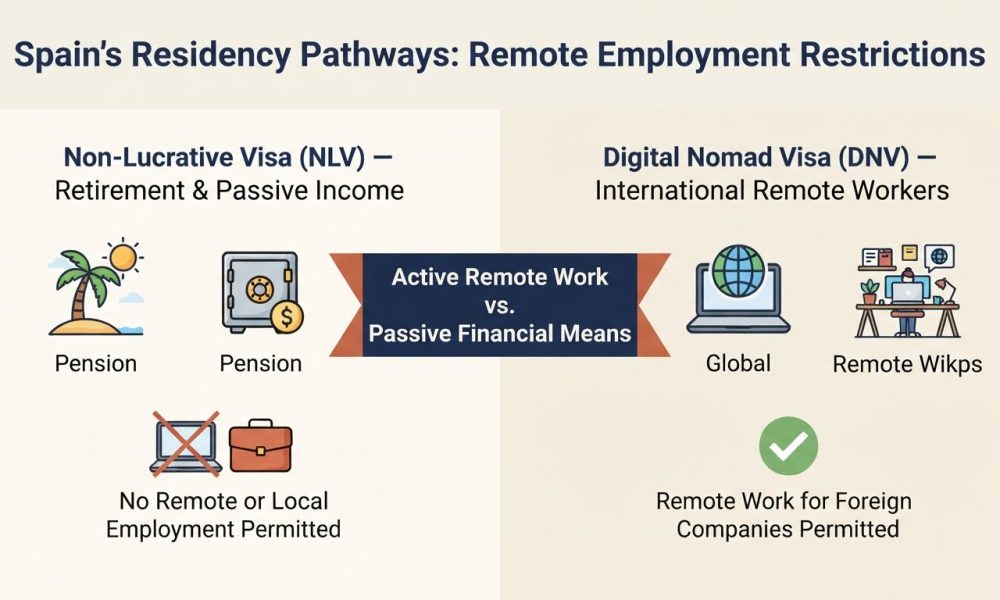
Spain’s non-lucrative residence authorization does not permit employment, including remote work for foreign employers, creating a significant distinction between retirement-oriented residency and immigration programs designed for international remote workers seeking lawful residence in Spain.
WASHINGTON, DC, November 21, 2026 — Mexican professionals, retirees and internationally mobile families considering relocation to Spain must distinguish passive-income residence from employment-based immigration, because Spain’s non-lucrative visa does not authorize remote work, even when the employer or clients are located outside Spanish territory.
This distinction matters for Mexican citizens pursuing Spanish citizenship through the preferential two-year naturalization residence provision, since an incorrect immigration classification can create compliance problems before the applicant becomes eligible to submit a nationality application.
Spain’s immigration regulations, updated by Royal Decree 1155/2024 and implemented in May 2025, expressly separate residence without professional activity from authorizations for employment, self-employment, and international teleworking, requiring applicants to select a category that matches their actual financial activities.
Spain’s Non-Lucrative Visa Does Not Permit Remote Employment
Article 61 of Royal Decree 1155/2024 defines non-lucrative residence as authorization for qualifying foreigners and their family members to reside in Spain without undertaking employment or professional activities, establishing a restriction that extends beyond conventional employment by Spanish companies.
The Spanish Embassy’s consular guidance expressly states that non-lucrative residence does not permit professional activities performed remotely, meaning applicants cannot rely on their employer’s foreign location to overcome the underlying prohibition.
A Mexican software developer working remotely for an American technology company, for example, should not assume that continuing to receive wages through an American bank account makes that employment permissible while residing in Spain under a non-lucrative authorization.
A Foreign Employer Does Not Create an Automatic Exception
One recurring misunderstanding is that Spain restricts only employment performed for Spanish companies, while allowing foreign residents to work freely online for employers established in Mexico, Canada, or the United States.
The relevant distinction is broader because non-lucrative authorization concerns whether the resident undertakes employment or professional activity, rather than where the customer, employer, company registration, or bank account is located.
A Mexican consultant who continues delivering paid services from an apartment in Valencia may therefore be undertaking unauthorized professional activity even when every client resides abroad, and every payment originates outside Spain.
The Location Where Work Is Performed Matters
Remote employment allows individuals to communicate with foreign businesses without physically attending an overseas workplace. Still, that flexibility does not eliminate the immigration rules governing professional activity performed from Spanish territory.
When a person lives in Madrid while preparing reports, managing clients, writing commercial software, or providing paid online services, the activity ordinarily occurs where that individual is physically working, regardless of the geographic location of the organization receiving the services.
Applicants should therefore evaluate their actual working arrangements before choosing a residence visa, rather than relying upon the convenient but legally unsupported assumption that online employment is invisible to immigration authorities.
Spain’s 2025 Regulations Reinforced the Distinction
Royal Decree 1155/2024 established the current regulatory framework for ordinary non-lucrative residence, specifying the financial, insurance and immigration requirements applicable to foreigners seeking to remain in Spain without working.
The provisions took effect on May 20, 2025, replacing earlier regulatory arrangements and establishing procedures applicants must review when preparing initial visa applications or subsequent residence renewals.
For Mexican nationals considering relocation during 2026, check materials describing the rules before this implementation date against current Spanish government guidance, particularly when older commentary suggests that foreign remote employment is compatible with non-lucrative residence.
Spain Provides a Separate Digital Nomad Immigration Route
Spain’s international teleworking framework was designed for qualifying foreign professionals who intend to live in Spain while performing eligible remote work for organizations located outside the country.
This arrangement, commonly called the digital nomad visa, operates under the legislation governing entrepreneurs and international mobility, making it a different immigration category from ordinary non-lucrative residence.
For Mexican employees whose earnings depend on continuing professional activity, the teleworking pathway may provide a more appropriate legal foundation, provided they meet its employment history, qualifications, financial means, and other eligibility requirements.
Digital Nomad Visas Reflect the Growth of International Remote Work
A January 2026 Euronews report on European digital nomad visas examined how countries, including Spain, have developed immigration arrangements that allow qualifying foreign professionals to work remotely while maintaining lawful residence.
The report illustrates why employment authorization must be examined separately from permission to reside, especially when applicants encounter several visas advertising similar lifestyle benefits but providing substantially different legal rights.
For Mexican applicants, the practical question is whether the proposed income will continue to come from active work after relocation, rather than whether the chosen visa offers an attractive location or a convenient residence timeline.
The Digital Nomad Route Has Its Own Employment Restrictions
Spain’s teleworking authorization generally permits qualifying employees to work remotely for companies outside Spain. At the same time, rules for self-employed professionals allow limited services for Spanish companies under specified conditions.
For qualifying independent professionals, Spanish clients may account for no more than 20% of the total professional activity. At the same time, salaried employees generally must perform their authorized teleworking activities for employers outside Spanish territory.
These provisions show that the digital nomad category is not an unrestricted general employment permit, so the applicant’s contracts, professional classification, and actual working arrangements matter during the eligibility assessment.
Qualifications and Employment History Must Be Documented
Spanish international teleworking requirements generally require recognized professional qualifications or at least three years of relevant professional experience, along with documentation establishing the applicant’s qualifying employment or business relationship.
Applicants ordinarily must demonstrate an existing professional relationship of at least three months and evidence that the work can continue remotely under the applicable statutory conditions.
A Mexican freelancer with irregular assignments should therefore examine whether current contracts and historical professional records meet the requirements, rather than assuming that occasional online income automatically establishes eligibility.
Retirement Income Is Different From Professional Income
Spain’s non-lucrative visa generally suits applicants who can support themselves through savings, retirement pensions, qualifying investment returns, or other financial resources that do not require ongoing employment or professional activity.
A retired Mexican executive receiving pension payments and investment distributions presents a different immigration profile from an executive continuing to supervise commercial operations, negotiate contracts, or provide compensated consulting services from Spain.
However, passive income alone does not automatically establish eligibility if the applicant also intends to maintain active professional responsibilities, so a full assessment of financial circumstances is necessary before applying.
Business Ownership Does Not Automatically Mean Active Employment
A Mexican entrepreneur may own shares in a foreign business and receive investment income without necessarily undertaking the daily professional activities normally associated with managing or operating the company.
The distinction depends on what the individual actually does while living in Spain, because receiving distributions as an investor differs from regularly directing employees, providing services, or completing compensated management assignments.
Applicants should document the nature of their income and responsibilities, recognizing that calling business earnings passive does not necessarily transform ongoing commercial activity into income compatible with non-lucrative residence.
Occasional Consulting Can Still Create Immigration Problems
Semi-retired professionals sometimes intend to maintain a small consulting practice while spending most of their time enjoying retirement, believing that limited hours or modest earnings do not constitute meaningful employment.
However, the non-lucrative residence rules do not provide a general allowance for a specified number of paid consulting hours. Hence, the nature of the work matters more than its frequency.
Mexican retirees considering occasional advisory assignments should therefore seek qualified immigration advice before accepting paid engagements, particularly when their residence authorization was approved based on financial independence from professional activity.
Financial Requirements Are Based on Spain’s IPREM
Spain’s non-lucrative residence regulations generally require applicants to demonstrate financial resources equivalent to at least 400% of the monthly Public Multiple Effects Income Indicator, commonly known by its Spanish abbreviation, IPREM.
For 2026, the monthly IPREM remains €600, producing a basic minimum financial requirement of €2,400 per month, or €28,800 over a 12-month initial residence period.
Each qualifying accompanying family member generally requires an additional 100% of IPREM, raising the financial threshold for married couples, parents, and households with several dependents.
Savings Can Support an Application Without Employment
Applicants may establish sufficient financial means through qualifying bank balances or recurring income sources that satisfy the applicable regulations, allowing individuals with accumulated assets to demonstrate financial independence.
A Mexican retiree possessing sufficient liquid savings may therefore have a viable residence application without receiving monthly pension payments, provided the resources are genuinely available and accepted under the governing evidentiary requirements.
Spanish authorities can examine account histories and supporting documents, making the accessibility, origin, and credibility of financial resources as important as the minimum amount required for the applicant’s household.
Financial Sufficiency Does Not Authorize Work
Meeting or exceeding the required financial threshold does not create permission to work remotely, because the financial test and the prohibition against employment operate as separate conditions within Spain’s non-lucrative residence framework.
A Mexican professional with €100,000 in savings would still need an appropriate work-authorizing immigration status before working or engaging in professional activity from Spain, despite the substantial financial reserve.
Applicants should therefore avoid treating non-lucrative residence as a flexible visa that permits employment whenever their accumulated savings exceed the required minimum, since that interpretation conflicts with the authorization’s underlying purpose.
Health Insurance Is Another Mandatory Consideration
Spain generally requires non-lucrative residence applicants to maintain qualifying health insurance covering their residence, establishing a separate eligibility condition that cannot ordinarily be replaced by proof of substantial personal wealth.
Applicants should confirm that the proposed coverage satisfies the applicable Spanish standards, especially when relying upon policies issued by foreign insurers or travel insurance products designed primarily for short international journeys.
Families must also consider coverage for accompanying dependents, existing medical needs, and the duration of insurance Protection, because residence approval and renewal require compliance with relevant health insurance conditions.
The Initial Non-Lucrative Authorization Generally Lasts One Year
Under the current regulatory framework, Spain’s initial non-lucrative temporary residence authorization typically lasts one year, during which the holder must remain compliant with the conditions supporting its approval.
Applicants who intend to stay beyond the initial period must follow renewal procedures and demonstrate continued financial means, qualifying health coverage, and other conditions under the applicable immigration provisions.
A one-year residence authorization does not create an entitlement to unrestricted future residence, so Mexican families planning for permanent settlement or Spanish citizenship must plan renewals.
Renewal Requires Genuine Residence in Spain
Spain’s current non-lucrative residence renewal rules expressly require applicants to have resided genuinely and effectively in Spain for more than 183 days during the relevant calendar year.
This requirement makes extended overseas travel particularly important for Mexican residents who maintain business responsibilities, family homes or substantial personal commitments outside Spain during the initial residence period.
A person who receives the permit but spends most of the year in Mexico should therefore not assume that an unexpired residence card guarantees approval of a future renewal.
International Travel Should Be Planned Against Several Rules
Travel planning involves more than preserving a non-lucrative residence permit, because individuals eventually seeking Spanish citizenship must also satisfy nationality legislation requiring legal, continuous residence immediately before the application.
These citizenship provisions are separate from immigration renewal conditions, so compliance with the more-than-183-day residence rule does not automatically mean every absence is acceptable for naturalization.
Mexican applicants pursuing a long-term nationality strategy should maintain complete travel records and seek individualized guidance on extended absences, rather than relying on informal claims about universally permitted travel periods.
Mexican Nationals by Origin May Benefit From Two-Year Naturalization
Article 22 of Spain’s Civil Code generally allows qualifying nationals by origin of Ibero-American countries, including Mexico, to seek Spanish citizenship after two years of legal, continuous residence immediately preceding the application.
However, this preferential provision does not automatically extend to every person holding Mexican nationality, because the legal distinction between Mexican citizens by origin and individuals who obtained Mexican citizenship through naturalization can be consequential.
The two-year requirement sets a potential application date rather than automatically approving citizenship, and applicants must also show good civic conduct, sufficient integration, and compliance with other applicable nationality conditions.
The Correct Residence Category Matters for Citizenship Planning
A Mexican citizen whose main goal is eventual Spanish nationality should consider whether the proposed residence category allows the person’s intended activities throughout the qualifying period.
An applicant choosing non-lucrative residence while secretly continuing paid remote employment may introduce immigration compliance concerns that undermine the stability of the residence history intended to support naturalization.
Choosing an appropriate work-authorizing route from the start can therefore matter more than obtaining an apparently convenient initial permit that doesn’t match the applicant’s actual economic circumstances.
Digital Nomad Residence Can Support a Different Long-Term Plan
Qualifying international teleworkers may obtain residence authorization through Spain’s specialized framework, potentially allowing them to establish lawful residence while continuing professionally authorized remote employment for foreign organizations.
The government offers an initial consular visa route and a separate residence authorization procedure for qualifying individuals already legally present in Spain, with different validity periods and requirements.
Applicants should confirm how their authorization interacts with potential nationality eligibility, recognizing that admission under a digital nomad program does not automatically guarantee citizenship approval.
Switching Immigration Categories Requires Legal Review
A Mexican resident who entered Spain under a non-lucrative authorization but later receives an overseas employment offer should review lawful modification or alternative authorization options before starting professional activity.
Spain’s government guidance warns that unauthorized remote work under a non-lucrative residence permit cannot be relied on as qualifying previous employment when applying for international teleworking authorization.
This makes planning particularly important because a later change in employment circumstances may require a different immigration procedure, rather than merely informing the authorities after the applicant has started working.
Unauthorized Work Can Affect Future Immigration Applications
Spain’s immigration legislation classifies work performed without the required authorization as a potential immigration infringement, meaning noncompliance can have consequences extending beyond the immediate employment arrangement.
The seriousness of any consequence depends upon the applicable legal provisions and individual circumstances. Still, applicants should not assume that remote employment is exempt from enforcement simply because compensation originates abroad.
Digital Nomad Income Requirements Follow a Different Benchmark
Spain’s international teleworking route generally measures financial sufficiency against the statutory minimum wage, rather than the IPREM calculation used for non-lucrative residence.
The Spanish consular guidance for 2026 identifies a principal applicant requirement equivalent to 200% of the relevant monthly minimum wage, with additional financial requirements for qualifying accompanying relatives.
Applicants should confirm the accepted calculation and current figures through the competent consulate, because outdated digital nomad articles sometimes reproduce earlier wage thresholds that no longer reflect the applicable requirements.
Social Security Compliance Can Affect Remote-Work Eligibility
International teleworking arrangements may require applicants and employers to address Spanish social security obligations or determine whether an applicable international agreement allows a different recognized coverage arrangement.
A Mexican employee working for an American corporation should therefore examine the employer’s willingness and ability to support lawful overseas employment, particularly when payroll and social insurance responsibilities require formal documentation.
A private employment contract alone cannot resolve those obligations, so coordinated immigration, employment, and social security advice is important before the applicant relocates.
Professional Licenses and Employment Contracts Require Review
Some professions carry licensing, confidentiality, or territorial restrictions that remain relevant when practitioners relocate internationally, even when the work can be conducted entirely through online communication.
Mexican lawyers, healthcare professionals and financial advisers should examine whether their professional responsibilities and client arrangements permit the intended services from Spain, alongside the immigration authorization governing remote employment.
A suitable residence permit does not independently replace the legal permissions required for regulated professional activity, making professional compliance another element of responsible international relocation planning.
Employers May Need to Approve International Remote Work
An employee’s ability to work from home in Mexico does not automatically create a contractual right to perform the same work from Spain, particularly when the employer maintains workplace location and information security policies.
Companies may also examine overseas payroll arrangements, confidentiality obligations, and potential business registration consequences before approving an extended international assignment involving an existing employee.
Applicants should obtain written employer authorization and confirm immigration eligibility before relocating, rather than assuming that an informal agreement with a supervisor provides sufficient legal Protection.
Tax Residence Is Separate From Immigration Permission
Mexican citizens establishing genuine residence in Spain may become Spanish tax residents under applicable domestic criteria, potentially triggering obligations for worldwide income and international financial reporting regardless of their visa category.
Tax consequences are based on residency history, income sources, and investment arrangements abroad.
An immigration authorization permitting remote work does not automatically guarantee access to preferential tax treatment, while a non-lucrative permit does not independently exempt a resident from Spanish tax obligations.
American-Mexican Applicants Have Additional Tax Responsibilities
Some Mexican nationals considering Spain also possess United States citizenship or American tax-resident status, creating a situation in which Spanish residence can coexist with continuing American financial reporting obligations.
The Internal Revenue Service’s guidance for U.S. citizens and resident aliens abroad explains that qualifying taxpayers generally remain subject to reporting on worldwide income while abroad, with exclusions or credits potentially available under the relevant provisions.
For these applicants, selecting a Spanish residence authorization should be coordinated with legitimate tax and employment planning rather than treated as a means of avoiding existing national reporting obligations.
Family Members Need Suitable Immigration Documentation
Spain’s non-lucrative residence framework allows qualifying family members to accompany a principal applicant under specified conditions. At the same time, the digital nomad regime also provides for eligible spouses, partners, and dependent relatives.
However, review the financial evidence, legal authorization, and permissible activities for each family member independently, especially when a spouse also intends to continue working after relocation.
A household with one retired partner and one actively employed professional may require a different immigration analysis from a household supported entirely by pensions or investment income.
Spain’s Residence Categories Must Match Household Economics
A Mexican family relying primarily upon wages from foreign employment should not describe those earnings as retirement income merely because the employer operates outside Spain or deposits funds into a foreign financial institution.
Similarly, a genuinely retired family living on qualifying savings and passive income should not assume that a digital nomad visa is required simply because they regularly use computers to manage personal affairs.
The appropriate residence category depends upon actual economic activity, making accurate financial classification more important than lifestyle labels such as expatriate, retiree, investor or digital nomad.
Civil Registration and Residence Records Support Long-Term Plans
Mexican citizens establishing long-term Spanish residence should maintain accurate Identification, address registration, immigration authorization, and financial documentation throughout the period preceding any eventual nationality application.
These records help authorities assess immigration compliance and continuous residence, especially when applicants have changed addresses, renewed residence permits, or undertaken substantial international travel.
Consistent information also reduces administrative complications when a person’s Mexican civil records, Spanish residence documentation, and foreign employment contracts list different names or residential histories.
Spanish Citizenship Is a Separate Government Decision
Even when a Mexican national completes two years of qualifying legal residence, the government must still examine the nationality application and determine whether all substantive statutory conditions have been satisfied.
Applicants may need to provide criminal background certificates, evidence of residence, and integration-related examination results, with procedures varying by nationality and any recognized exemptions.
The possibility of obtaining Spanish citizenship should therefore be evaluated as a long-term legal objective rather than an automatic consequence of receiving a non-lucrative or international teleworking visa.
Retirement-Oriented Applicants Should Avoid Unnecessary Employment Risk
For Mexican retirees with sufficient savings, pension benefits, or qualifying investment income, a non-lucrative residence visa may provide an appropriate framework for settling in Spain without seeking employment authorization.
However, applicants who plan to resume consulting, freelancing, or paid business management should evaluate those plans before applying, because a shift from retirement to active professional work can create immigration issues.
International Mobility Planning Begins With Income Classification
Amicus International Consulting examines the changing relationship between retirement and remote employment in its 2026 analysis of retired expatriates and digital nomad lifestyles, emphasizing the importance of separating passive financial support from compensated professional activity.
For Mexican applicants considering Spain, they should establish that distinction through contracts, pension documentation, investment records, and a realistic assessment of whether employment will continue after relocation.
Remote Workers Need an Authorization Designed for Their Activities
Amicus also discusses the practical requirements of international remote employment in its guide to digital nomads and lawful cross-border work, including the importance of income documentation, consistent employment records and an appropriate visa category.
Applicants should still verify applicable Spanish requirements directly with the competent authorities, because official residence approval, work authorization, and nationality decisions remain exclusively within the responsibilities of government institutions.
A Written Relocation Plan Can Prevent Avoidable Complications
Before moving to Spain, Mexican applicants should document their anticipated income sources, intended employment activities, family composition, insurance coverage, and travel commitments, and identify which requirements apply to their proposed immigration category.
This preparation can help distinguish a genuinely non-working retirement arrangement from a remote employment situation requiring separate authorization, reducing the likelihood of discovering a serious immigration mismatch after establishing residence abroad.
Conclusion: Remote Work Requires the Correct Spanish Immigration Authorization
Spain’s non-lucrative visa provides a lawful residence opportunity for financially independent Mexican applicants who do not intend to undertake employment or professional activities. Still, it does not authorize remote work simply because compensation originates outside Spain.
For active employees, consultants, and qualifying independent professionals, Spain’s international teleworking framework offers a distinct immigration pathway, although applicants must meet its financial, qualification, documentary, and social security requirements.
Mexican nationals pursuing eventual Spanish citizenship should also recognize that qualifying immigration residence and nationality eligibility are separate legal questions, making continued compliance, genuine residence and accurate documentation essential throughout the process.
Ultimately, the most reliable relocation strategy starts with choosing a Spanish residence authorization that matches the applicant’s actual financial and professional circumstances, rather than trying to fit ongoing employment into a visa designed for non-working residents.